

Markets love clean stories: software, platforms, AI. They’re less excited about specialist insurers buried in the “Financials” bucket – even when those insurers are growing faster, earning higher returns, and taking less risk than the AI darlings of the moment.
Kinsale is one of those businesses.
It doesn’t sell code or subscriptions. It underwrites weird, non-standard risks that other insurers don’t want on their books – and still manages to post underwriting margins most peers can only dream of. It’s founder-led, focused on a single niche, and has been executing the same playbook with discipline for more than a decade.
In our Quality Growth framework, Kinsale checks a lot of boxes:
🏗 A focused, specialist business in a deregulated niche (E&S) with real pricing power.
📈 A long runway for profitable growth, driven by market share gains and E&S migration.
💸 Strong, repeatable unit economics with sub-80% combined ratios and attractive float.
🧑💼 An owner-operator management team with skin in the game and a conservative culture.
🧱 A robust balance sheet and conservative reserving, built to survive bad years, not just good ones.
This Company Snapshot is your quick guided tour: what Kinsale actually does, why its economics are different from a typical insurer, and which risks you should care about before you size the position.
If that resonates, the upcoming five-part Deep Dive will take you from this overview into the details of regulation, reinsurance, reserves, and loss triangles—the parts most investors never read, but where the real edge lives.
👔 Company Name: Kinsale Capital Group (“Kinsale”)
🔎 ISIN: US49714P1084
🔧 Business model: Specialty insurer (Excess & Surplus lines)
🌍 Geographic exposure: United States
📈 Stock Price: $393
💰 Market Capitalization: $9.1 billion
👨💼 Number of CEOs since foundation: 1
👨👩👦 Founder-/Owner-operator: Yes
📅 CEO tenure: Since 2009
🥇 Insider ownership: 5.5% of shares
📊 10Y EPS CAGR: ~41%
🔁 Reinvestment profile: High (float-funded growth)
💸 Capital intensity: Capital-light
🏰 Moat: Specialization, Focus, Technology & Cost Advantage
🧨 Main risks: Cyclicality, Broker concentration, Investment risk, Reserve adequacy, Regulatory risk
🌳 Slow Compounding fit: Yes – high-quality underwriting, long growth runway
Business Model in a Nutshell: Kinsale is a U.S. specialty insurer focused 100% on commercial Excess & Surplus Lines, insuring hard-to-place risks that standard carriers decline. The company runs a high-volume, low-hit-rate underwriting model, supported by a proprietary tech platform that lets underwriters quote small and mid-sized accounts quickly and selectively. Economics are driven by disciplined underwriting (combined ratio mid-70s) and float-funded investment income.
Is Kinsale the best insurance business in the world?
An insurance company can be a wonderful business.
An insurance company sells a “Collect Now. Pay later” type of product. This generates the so-called “float”, which the insurance company can use to generate investment income.
An insurance company sells coverage for risks. Customers pay a premium today. The insurance company collects the premiums, while they don’t have to pay a claim right away. The time gap between collecting the policy premium and paying out claims can be significant, especially in certain types of insurances.
During this time gap, the insurance company has a large pool of money—the “float”—sitting in its bank account. The company doesn’t own this money (it’s a liability on their books because they might have to pay it back), but they get to invest it in stocks, bonds, and other assets.
That’s why an insurance company has a double-profit-engine.
Profit from underwriting: That’s the income from the underlying insurance business.
Profit from the Investments: The money earned from these investments is a major source of profit for the insurance company.
Think of “float” as an interest-free loan from policyholders that the insurer uses to make more money. As investor Warren Buffett famously explained, this allows an insurer to use “free money” for its own benefit.
Kinsale looks like the kind of stock most investors scroll past: a mid-size U.S. insurer, writing commercial policies in something called the “Excess & Surplus Lines” market. On the surface that sounds like the dusty back room of the insurance world. In reality, Kinsale sits in one of the most attractive corners of U.S. P&C – and has quietly turned it into a compounding machine. Since the IPO in 2016, the share price is up more than 20-fold, powered not by financial engineering but by old-fashioned underwriting profits and disciplined growth.
The niche Kinsale serves is simple to describe: it insures risks that the standard market does not want. Kinsale insures “hard-to-place”-risks, as these insurance coverages are anything but standardized products.
When a retail broker has tried the usual admitted carriers and gets only declines, the file often lands on the desk of an E&S wholesale broker – and from there on Kinsale’s screen. The company wants to see as many of these “hard-to-place” risks as possible, then cherry-pick the ones where the odds are clearly in its favour. It operates exclusively in U.S. commercial lines, with an average policy size of around $15,000, across a broad range of property and casualty classes – from construction liability and small business casualty to catastrophe-exposed property and various niche segments.
Economically, Kinsale’s engine is built on volume, selectivity and cost discipline. Each year the company receives close to 900,000 submissions but binds only a small single-digit percentage of them. That low hit rate is a feature, not a bug: it reflects a model where underwriters are encouraged to focus on the most attractive opportunities. At the same time, retention on existing policies is healthy and average premiums have been rising. The result has been a decade of 20–30%+ premium growth, far ahead of the broader industry.
What makes this more than “just” growth is the quality of the underwriting. In an industry that, on average, barely breaks even on underwriting over a cycle, Kinsale has consistently posted combined ratios in the mid-70s, with an expense ratio in the low 20s.
The combined ratio is a crucial metric in the insurance industry:
In simple terms, these ratios are just ways for an insurance company to measure if it’s making money or losing money on the policies it sells:
The loss ratio is the “claims” ratio. It answers the question: “For every dollar we collected in premiums, how much did we have to pay out in claims and the paperwork to handle those claims?”
The expense ratio is the “running the business” ratio. It answers the question: “For every dollar we collected in premiums, how much did we spend on salaries, marketing, office space, and other overhead costs?”
If the combined ratio is below 100 percent, the insurer is generating an underwriting profit from its core business. However, if the ratio exceeds the 100 percent mark, it signifies that the insurance operations are running at a loss, which must be offset by returns from investments.
This key figure thus provides a quick overview of the profitability and financial health of an insurance company.
And guess what:
Kinsale is the most profitable insurance company that I have ever seen in my investment career. Over the last 3 years, Kinsale posted an average combined ratio of ~77%, while the average for the E&S competitors is closer to ~92 %. That’s a huuuuuge difference. (It represents an EBIT-margin of ~23% for Kinsale vs. ~8 % for the competition. Kinsale makes a 3x higher EBIT contribution from every dollar earned in premiums.)
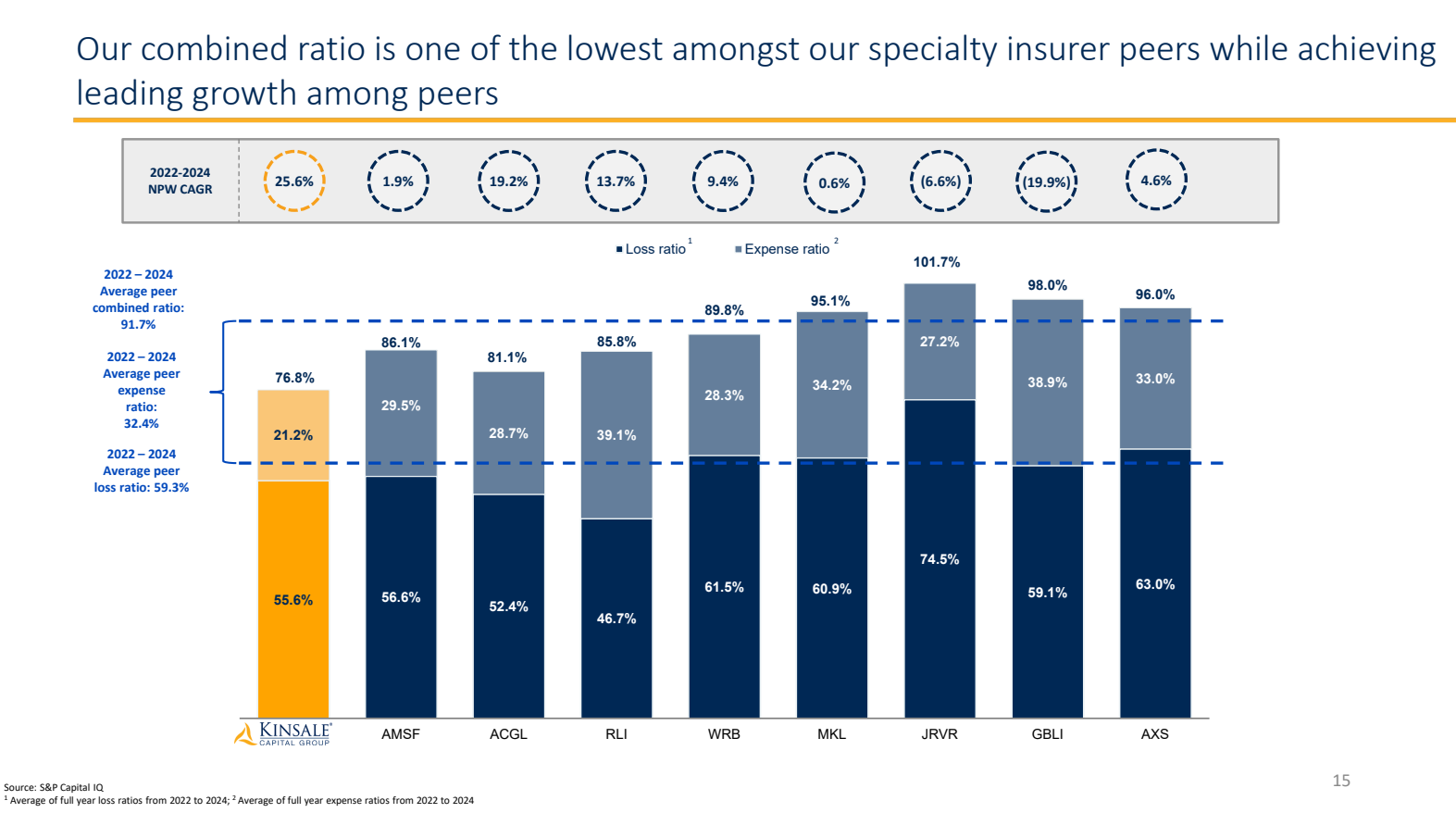
That isn’t a small efficiency tweak, it is a structural gap – driven by a focused portfolio, tight control of underwriting and claims, and a proprietary technology platform that automates the routine work and lets underwriters concentrate on risk selection. The company writes business across all 50 states, uses reinsurance intelligently to shape its risk profile, and converts a large portion of accounting earnings into cash.
Behind the machine is a founder-led management team with real skin in the game: Kinsale has had one CEO since 2009, insider ownership is meaningful, and capital allocation has been refreshingly straightforward – reinvest into the core underwriting engine as long as attractive opportunities are available, keep leverage conservative, and avoid empire building. The business is capital-light, benefits from float, and has grown EPS at ~40% per year over the last decade.
The best is yet to come: Despite its phenomenal success over the last one and a half decades, Kinsale today has a market share of ~1.6 %. The growth runway is huge.
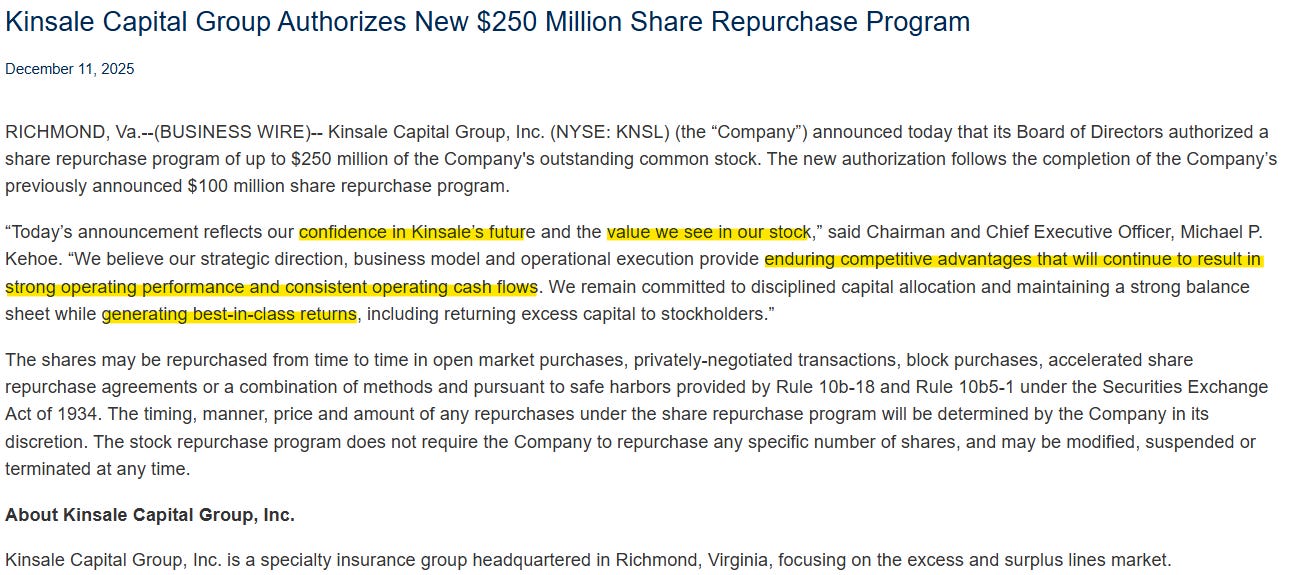
Currently, management views the stock as too cheap, as they announced a $250 million share-buyback program and reiterated the quality of the underlying business model.
This is not a risk-free story (no investment is risk-free): insurance is cyclical, Kinsale is exposed to catastrophe losses and to a concentrated broker base, and the regulatory framework for E&S and reinsurance matters a lot. Valuation also reflects much of the company’s success. But if Kinsale can preserve its underwriting edge and continue to take share in a still-fragmented E&S market, it has the ingredients of a long-term compounder: a focused niche, structural cost and speed advantages, a long runway for reinvestment and owner-operator governance.
The following Deep Dive will unpack each piece of that puzzle – from the plumbing of E&S and reinsurance to Kinsale’s loss triangles, technology stack and runway for growth.
It will be structured in five Parts plus one additional fundamental piece:
Part 1: Insurance 101 and E&S playground
Part 2: Regulation: Why E&S looks the way it does
Part 3: Kinsale’s Business Model
Part 4: The Kinsale machines: Understanding the Financials
Part 5: Compounder?
“The Fundamentals”: Reinsurance 101
This Company Snapshot is the 10,000-foot view. In the Deep Dives, we’ll zoom in on three layers:
The basics of the U.S. E&S market and surplus-lines regulation that makes Kinsale’s niche possible;
The inner workings of its underwriting machine – from submission funnel and pricing discipline to claims handling, technology stack and reinsurance program;
The hard numbers behind the story, including combined ratio drivers, reserve development, capital allocation and valuation.
Along the way we’ll dig into material you’ll rarely see discussed elsewhere: Kinsale’s statutory loss triangles and what they reveal about reserve quality, how reinsurance flows through the P&L and impacts the balance sheet, and much more.
Very good article. I have a position in Kinsale and I thought the same about the company when I bought into it.
Great snapshot. 👏