

In 5 articles, you’ll get a deep dive of Kinsale Capital Group (~100 pages).
It will be structured in five Parts plus one additional fundamental piece:
Part 1: Insurance 101 and E&S playground
Part 2 (today): Regulation: Why E&S looks the way it does
Part 3: Kinsale’s Business Model
Part 4: The Kinsale machines: Understanding the Financials
Part 5: Compounder?
“The Fundamentals”: Reinsurance 101
All parts are now available in one PDF. You can download it below.

👔 Company Name: Kinsale Capital Group (“Kinsale”)
🔎 ISIN: US49714P1084
🔧 Business model: Specialty insurer (Excess & Surplus lines)
🌍 Geographic exposure: United States
📈 Stock Price: $393
💰 Market Capitalization: $9.1 billion
👨💼 Number of CEOs since foundation: 1
👨👩👦 Founder-/Owner-operator: Yes
📅 CEO tenure: Since 2009
🥇 Insider ownership: 5.5% of shares
📊 10Y EPS CAGR: ~41%
🔁 Reinvestment profile: High (float-funded growth)
💸 Capital intensity: Capital-light
🏰 Moat: Specialization, Focus, Technology & Cost Advantage
🧨 Main risks: Cyclicality, Broker concentration, Investment risk, Reserve adequacy, Regulatory risk
🌳 Slow Compounding fit: Yes – high-quality underwriting, long growth runway
Business Model in a Nutshell: Kinsale is a U.S. specialty insurer focused 100% on commercial Excess & Surplus Lines, insuring hard-to-place risks that standard carriers decline. The company runs a high-volume, low-hit-rate underwriting model, supported by a proprietary tech platform that lets underwriters quote small and mid-sized accounts quickly and selectively. Economics are driven by disciplined underwriting (combined ratio mid-70s) and float-funded investment income.
1. Setting the stage: the rules behind Kinsale’s niche
Regulation is one of the least glamorous parts of any insurance discussion, but for Excess & Surplus Lines it is essential. The entire E&S value chain – from who is allowed to write business, to how brokers place risks, to where premium taxes are paid – is defined by a specific set of U.S. rules. These rules explain why the E&S market looks the way it does, why certain risks end up here rather than in the admitted market and how a company like Kinsale can write business across all 50 states while being domiciled in just one.
Compared with the standard P&C market, the E&S segment is smaller in absolute premium volume but plays a critical role in maintaining capacity for hard‑to‑insure risks. Regulators and lawmakers do not see E&S as a loophole or a lightly regulated side show. Instead, they treat it as a complementary channel that is deliberately given more flexibility on rates and policy forms, while still operating within a clearly defined legal framework.
This part walks through the key milestones and concepts: the state‑based nature of U.S. insurance regulation (McCarran–Ferguson), the NAIC’s Nonadmitted Insurance Model Act, the Terrorism Risk Insurance Act (TRIA) and, most importantly for E&S, the Nonadmitted and Reinsurance Reform Act (NRRA). We then look at eligibility standards, white- and blacklists, export lists and domestic surplus lines insurers before ending with what all of this means in practice for Kinsale.
When I started looking into Kinsale, I assumed I would find a clear explanation of the E&S regulatory framework in the company’s 10-K or in specialist articles online. I didn’t. Most descriptions were either too high level to be useful or so fragmented that it was hard to see how the pieces fit together. That is why I decided to go much deeper into this topic. The goal of this section is not just to list acronyms and laws, but to build an intuitive understanding of the rules that actually shape Kinsale’s playing field.
2. Why regulation matters in E&S
Compared with the standard P&C market, the E&S segment is regulated differently.
One of the key concepts about E&S regulation is that insurers are exempt from certain elements of insurance regulation that apply to admitted carriers, most notably with respect to freedom of rate and form. As described in Part 1 of this Deep dive series, this means that E&S carriers are not bound by prior approval of policy wordings and price structures in the same way admitted insurers are.
This flexibility is not an accident; it is a design feature. The surplus lines market functions as a valve for risks that cannot be written in the standard market on reasonable terms. To fulfil this role, E&S insurers must be able to structure contracts and price premiums in a way that fits the specific risk at hand. Without freedom of form and rate, they would not be able to offer coverage for high, unusual or emerging risks, and the system as a whole would struggle to provide capacity for these exposures.
The U.S. E&S segment is therefore best seen as a specialized sub-market within P&C that focuses on risks that are too unusual or too difficult for standard carriers to handle. Its regulatory framework has evolved over time through a series of laws and major events. In the early decades, formal rules were limited, simply because the market was small and relatively insignificant. As demand for coverage of hard-to-insure risks increased over the twentieth century, legislators and regulators gradually formalized the role of surplus lines and codified the boundaries within which this more flexible market can operate.
3. From state-based regulation to modern surplus lines rules
3.1. McCarran–Ferguson: states in charge
Modern U.S. insurance regulation starts with the McCarran–Ferguson Act of 1945. In simple terms, the Act states that the business of insurance is to be regulated by the individual states and that federal law shall not pre‑empt state insurance regulation as long as the states actively regulate the sector. It also grants insurers a limited exemption from federal antitrust law for activities that are part of the business of insurance and are regulated at the state level.
For the E&S market, McCarran–Ferguson confirmed that oversight of nonadmitted insurers and surplus lines brokers would remain primarily in the hands of state regulators. Even if an insurer is not admitted in a particular state where it writes surplus lines business, it is still subject to the solvency and market‑conduct rules of its state of domicile. The result is a system in which nonadmitted does not mean “unregulated”; it simply means regulated somewhere else.
The McCarran-Ferguson Act significantly shaped the insurance industry in the U.S., as most insurance companies are still primarily regulated at the state level today.
3.2. The NAIC and the Nonadmitted Insurance Model Act
Because each state has its own insurance department and legal framework, coordination is required to avoid unnecessary friction. This is where the National Association of Insurance Commissioners (NAIC) comes in. The NAIC is a forum in which state insurance regulators develop model laws and standards that states can choose to adopt. One of these model laws is particularly important for the E&S market: the Nonadmitted Insurance Model Act.
The Nonadmitted Insurance Model Act is not a federal statute. It is a template developed by the NAIC that individual states can incorporate into their own law. As such, the Nonadmitted Insurance Model Act is not automatically binding. The goal is to create a more consistent framework for nonadmitted insurance and surplus lines placements across the country. Key elements of the Model Act include:
Broker licensing: requirements for licensing surplus lines brokers who place nonadmitted business.
Disclosure: rules to ensure that policyholders understand they are buying nonadmitted coverage and what that implies.
Reporting: standards for reporting nonadmitted premiums and placements to regulators.
Tax collection and distribution: guidance on the collection and allocation of premium taxes, especially for multi‑state risks.
Taken together, these elements define who may place surplus lines business, what must be disclosed to buyers, how regulators receive information about the market and how states share in the resulting tax base.
The Nonadmitted Insurance Model Act was originally developed by the NAIC in the early 1990s as part of its efforts to regulate the Surplus Lines market
3.3. TRIA: terrorism as a systemic risk
A second important federal statute is the Terrorism Risk Insurance Act (TRIA) of 2002, which was introduced in the aftermath of the 9/11 attacks. TRIA established a federal backstop for insured losses from large, certified acts of terrorism. Under TRIA, participating insurers must offer terrorism coverage on certain commercial property and casualty policies, and the federal government agrees to share in losses above specified thresholds.
TRIA also matters for the E&S market. Many complex or high‑limit commercial risks – such as large industrial facilities or high‑profile real estate – are placed through surplus lines insurers. TRIA helps ensure that terrorism coverage remains available and affordable for these risks by providing a clear framework for sharing extreme losses between private insurers and the federal government.
4. The NRRA – the pivotal reform for nonadmitted insurance
4.1. What the NRRA set out to fix
Before the Nonadmitted and Reinsurance Reform Act (NRRA) came into force in 2011, surplus lines placements were often messy. Multi‑state risks triggered conflicting tax rules, states disagreed on who had the right to tax which portion of a premium and brokers faced overlapping licensing and reporting requirements. In practice, this created administrative burden, regulatory uncertainty and the risk of double taxation or, conversely, untaxed premium.
The NRRA, enacted in 2010 as part of the Dodd‑Frank Act, was designed to simplify and harmonize this landscape, as it simplified the regulation of E&S at the federal level.
The NRRA significantly simplified the oversight of E&S business at the federal (!) level.
Its most important provision is that only the policyholder’s home state is responsible for regulating and taxing non-admitted insurance. This home-state principle removed many of the conflicts and inefficiencies created by differing rules and tax structures across states. As a result, it became easier for surplus lines brokers to operate across states.
The key points of the NRRA can be summarized as follows:
Primary tax jurisdiction: Only the policyholder’s home state has the authority to levy premium tax on non-admitted insurance.
Regulatory authority: Responsibility for regulating the placement of non-admitted insurance lies solely with the policyholder’s home state. Insurers and brokers therefore need to comply with one set of placement rules rather than with separate regimes in every state where parts of the risk are located.
Simplified multi-state operations: By concentrating regulatory and tax authority in a single jurisdiction, the NRRA makes it easier for insurers and brokers to handle multi-state risks within a unified framework.
In the U.S., insurers are supervised by the insurance department of their state of domicile and must meet uniform eligibility requirements there. If an insurer wishes to write business in other states, it must also satisfy the eligibility criteria those states set for non-admitted carriers. This reflects the fact that insurance regulation in the U.S. is primarily a state responsibility; each jurisdiction defines its own standards, often centered on minimum capital and surplus levels. Federal law and NAIC model acts specify which types of criteria states may impose and where the limits lie.
As an additional control mechanism, surplus lines brokers themselves are subject to licensing and regulatory requirements. By law, risks may not simply be placed directly with any non-admitted insurer. Brokers must ensure that the carriers they use meet the relevant eligibility standards. Many states support this process by publishing lists of eligible surplus lines insurers. These lists are not always mandatory, but they provide a practical tool to help brokers place risks with previously vetted insurers. More about this in chapter 5.
Before a risk can be placed with an E&S carrier, the diligent effort requirement often has to be met. In practice, this means that the broker must first test whether the risk can be placed with admitted insurers. A common standard is that at least three admitted carriers must decline the risk before it may be “exported” to the surplus lines market. Some states go further and publish export lists that identify classes of business which are generally not written by standard insurers. For risks on these lists, the diligent-effort requirement can be waived, allowing the broker to place the business directly with an E&S insurer.
To summarize, for non-admitted insurance, the NRRA clarifies which state is in charge of regulation and taxation and sets guardrails around eligibility standards for surplus lines insurers. There are a few key concepts to understand:
Insurers – including E&S carriers – are regulated by the insurance department of their state of domicile.
If an insurer wishes to write business outside its state of domicile, it must meet the “eligibility criteria” that those other states set for non-admitted insurers.
Regulation applies not only to insurers, but also to brokers.
Surplus lines brokers must ensure that any non-admitted insurer they use satisfies the relevant eligibility criteria in the particular state. In many jurisdictions they can refer to so-called “white lists” of eligible surplus lines insurers.
Brokers cannot simply place any risk with an E&S carrier. They must satisfy the diligent-effort requirement, i.e. first attempt to obtain coverage in the standard admitted market before exporting the risk to the surplus lines market. In some states this process is replaced or simplified by “export lists”, which identify classes of business that may be placed directly with E&S insurers.
It all boils down to two key questions:
Is an insurer eligible to write non-admitted policies?
Which risks may be placed with a non-admitted insurer?
We’ll have a look at these principles now in more detail.
4.2. Key definitions and the “home state” concept
The NRRA introduces several definitions that are central to understanding the E&S framework. The most important are shown below:
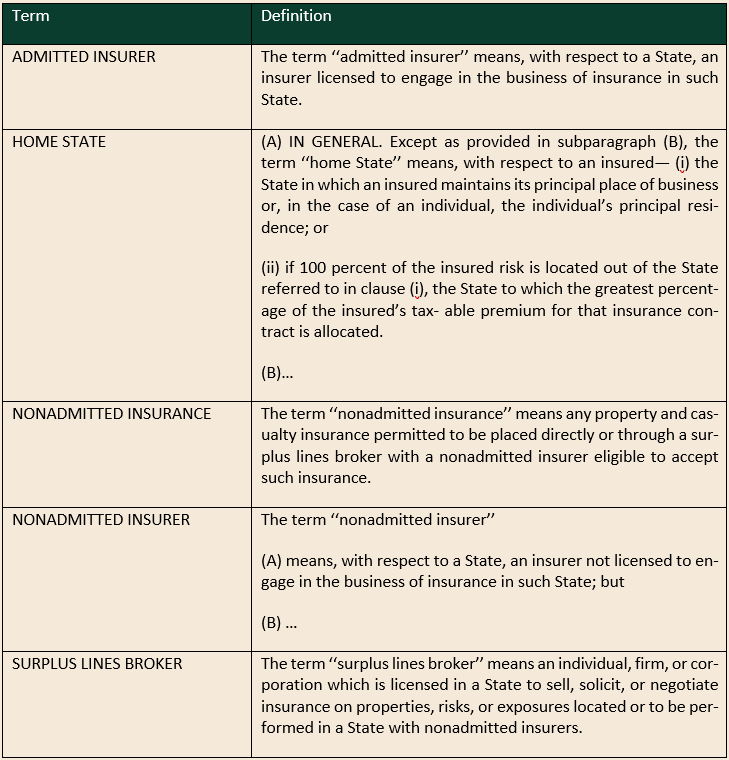
It is important to emphasize that “nonadmitted” does not equate to “unregulated”. Nonadmitted insurers are supervised by the insurance department in their state of domicile and must meet capital, solvency and reporting standards there. What changes under the NRRA is which state has the right to regulate the placement of a surplus lines policy and to collect the corresponding premium tax.
4.3. One‑state compliance and regulatory authority
The core principle of the NRRA for surplus lines business is one‑state compliance. The policyholder’s home state has exclusive authority to regulate the placement of nonadmitted insurance for that policyholder. Section 522 of the NRRA makes clear that only the home state may require a surplus lines broker to be licensed, collect reports or impose other procedural requirements in connection with a non-admitted placement.
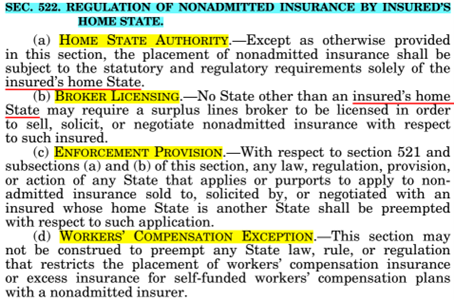
Section 522 is designed to cover regulatory areas other than insurer eligibility (which will be discussed in a minute) like broker licensing and all the requirements placed on the broker, such as a mandatory search of, and declinations from, licensed insurers prior to placement, and then recordkeeping, reporting, tax returns, tax payments, etc.
In practice, this means that both the insurer and the surplus lines broker look first to the law of the policyholder’s home state. They no longer need to satisfy a patchwork of rules in every state where parts of the risk are located. This significantly reduces complexity for multi‑state accounts and provides a clearer basis for compliance.
It is important to understand that regulation applies not only to insurers but also to brokers, because they are the ones who decide which risks are placed in the surplus lines market.
5. Gateways into the E&S market
5.1. Uniform eligibility standards for surplus lines insurers
Even though nonadmitted insurers are regulated in their state of domicile, states where policies are sold still have an interest in the financial soundness of carriers used by their brokers. Section 524 of the NRRA therefore sets boundaries on how states may regulate the eligibility of surplus lines insurers. The goal is to create uniform minimum standards for the approval of non-admitted insurers in order to avoid arbitrary or overly restrictive local rules. Section 524 distinguishes between:
Domestic insurers (Subsection 1).
Foreign insurers (Subsection 2). We’ll cover this in chapter 6.
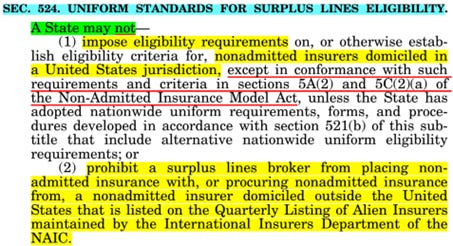
To be honest, Subsection 1 is confusing at first sight. The core of Subsection 1 is that a state is prohibited from establishing its own eligibility criteria for non-admitted insurers domiciled in another U.S. jurisdiction, unless those criteria comply with the requirements outlined in Sections 5A(2) and 5C(2)(a) of the Nonadmitted Insurance Model Act.
So, we need to look at the Nonadmitted Insurance Model Act as well.
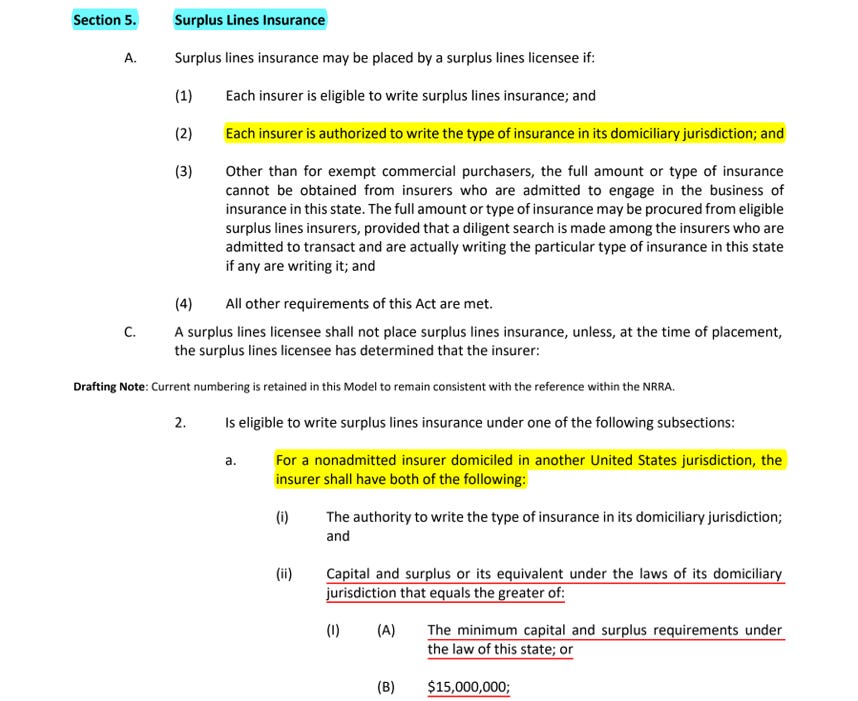
This means:
A non-admitted insurer must be authorized in its state of domicile for the specific line of insurance it intends to write.
A non-admitted carrier that whishes to place business in another U.S. jurisdiction must have a minimum of $15 million capital and surplus or the minimum required under state law, whichever is greater.
States are prohibited from setting independent eligibility requirements other than the two requirements just described.
Many states today require at least $15 million of capital and surplus. Some states set higher thresholds – for example, Massachusetts, California and New York – and a number of states reserve the right to accept insurers with somewhat lower capital on a case‑by‑case basis if other criteria, such as financial strength ratings, are strong.
Because nonadmitted insurers by definition are not licensed in the state where the risk is located, the burden of complying with these eligibility requirements falls largely on the surplus lines broker. Brokers must ensure that the insurers they use meet the applicable standards in the insured’s home state and, where relevant, appear on that state’s list of eligible surplus lines insurers.
If these criteria are fulfilled, an insurer is considered as “eligible”.
5.2. White lists, black lists and eligible surplus lines insurers
To make eligibility transparent, many states publish a list of approved surplus lines insurers – often referred to as a white list. An insurer that satisfies the applicable solvency, capital and other standards is added to this list, and surplus lines brokers may then place business with it subject to the usual rules. Being on the list is optional but comes with some advantages since the state has “approved” the insurer and certified that it meets the eligibility requirements. However, other states may require insurers to be on the list.
According to my research, roughly 40 U.S. jurisdictions publish such white lists.
A single state, Alabama, instead maintains a black list of insurers that may not be used for surplus lines placements.
States can maintain separate eligibility lists for domestic and foreign surplus lines insurers and can require brokers to verify that any insurer they place business with appears on the relevant list. The existence of these lists does not change the NRRA’s one‑state principle, but it makes it easier for brokers and policyholders to see which carriers have been approved by a given jurisdiction.
5.3. Diligent search and when it is waived
A central safeguard in surplus lines regulation is the requirement that E&S should be a market of last resort, not the first stop. The Nonadmitted Insurance Model Act therefore requires a surplus lines broker to conduct a diligent search of the admitted market before placing a risk in the E&S channel, unless an exemption applies.
In practice, this means that the broker must approach a specified number of admitted insurers that are licensed to write the risk in question and document their declinations. In many states the number used in practice is three, but the exact standard can vary. The underlying principle is clear: it must be demonstrated that coverage was not available on reasonable terms in the admitted market before the risk is exported to the surplus lines market.
5.4. Export lists and exempt commercial purchasers
Some risks are so clearly outside the appetite or capabilities of the admitted market that regulators recognize it makes little sense to require a full diligent search each time. For these cases, certain states maintain export lists – catalogues of classes of business that may be placed directly in the surplus lines market without first seeking quotes from admitted insurers. Regulators accept that the admitted market does not offer coverage for these risks.
Typical entries include high‑hazard or highly specialized activities such as certain entertainment venues, demolition contractors or emerging industries.
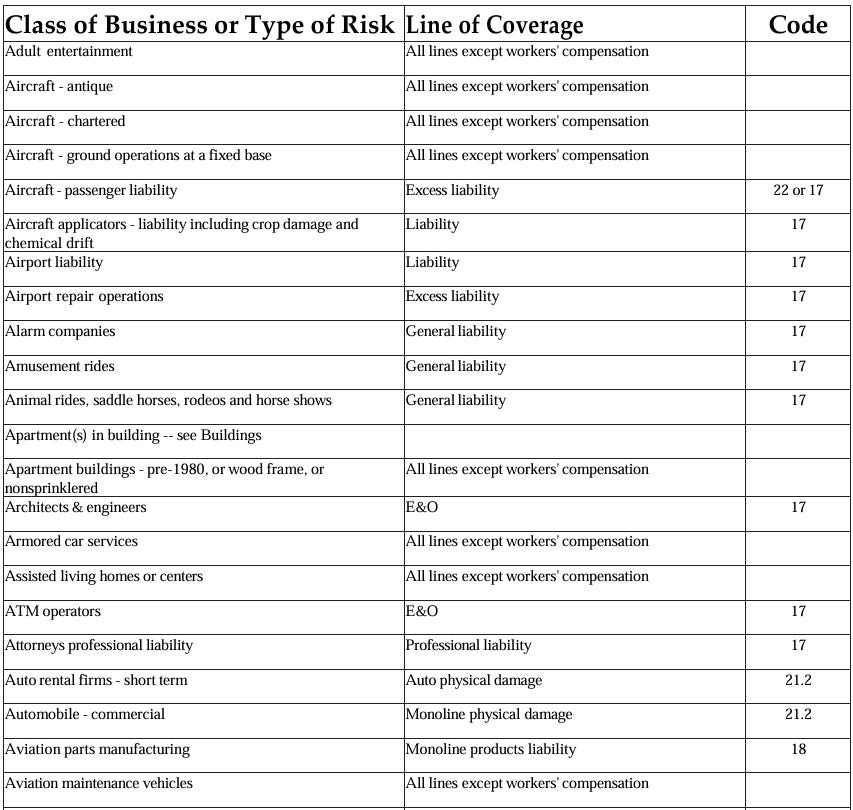
According to my research, only a 16 states currently maintain formal export lists. Where they exist, these lists can significantly speed up placements, because brokers no longer have to generate ritual declinations from admitted carriers for risks that are clearly not a good fit for the standard market.
The below screenshot is an excerpt from Alaska’s Export List as an example:
The NRRA also introduces the concept of the exempt commercial purchaser. Large, sophisticated commercial policyholders that meet certain size and expertise criteria can be treated differently from small retail clients. If specific conditions are met – for example, that the purchaser is advised by a qualified risk manager and acknowledges the use of nonadmitted insurers – the surplus lines broker may be allowed to forgo a full diligent search of the admitted market. This recognises that such buyers are capable of making informed decisions about the trade‑offs involved in using surplus lines carriers.
5.5. DSLI: What about E&S insurance in the state of domicile?
While a surplus lines insurer is generally not allowed to write surplus lines business in its own state of domicile – because there it is treated and regulated like a standard admitted insurer – many states have amended their laws to create the status of a Domestic Surplus Lines Insurer (DSLI). In those states, an insurer that is specifically approved or licensed as a DSLI may issue surplus lines policies in its home state. By contrast, an insurer domiciled in a state that does not permit DSLI status is effectively unable to write E&S policies in its own state.
Ironically, in states that do not recognize the status of a DSLI, a carrier domiciled there generally cannot write surplus lines business in its home state. The only practical ways around this are structural: either re-domiciling to a state that permits DSLI status or establishing a separate insurance subsidiary in such a state. What is not possible is simply treating a domestically licensed carrier as “non-admitted” in its own state without an explicit legal basis.
5.6. Summary by U.S. state
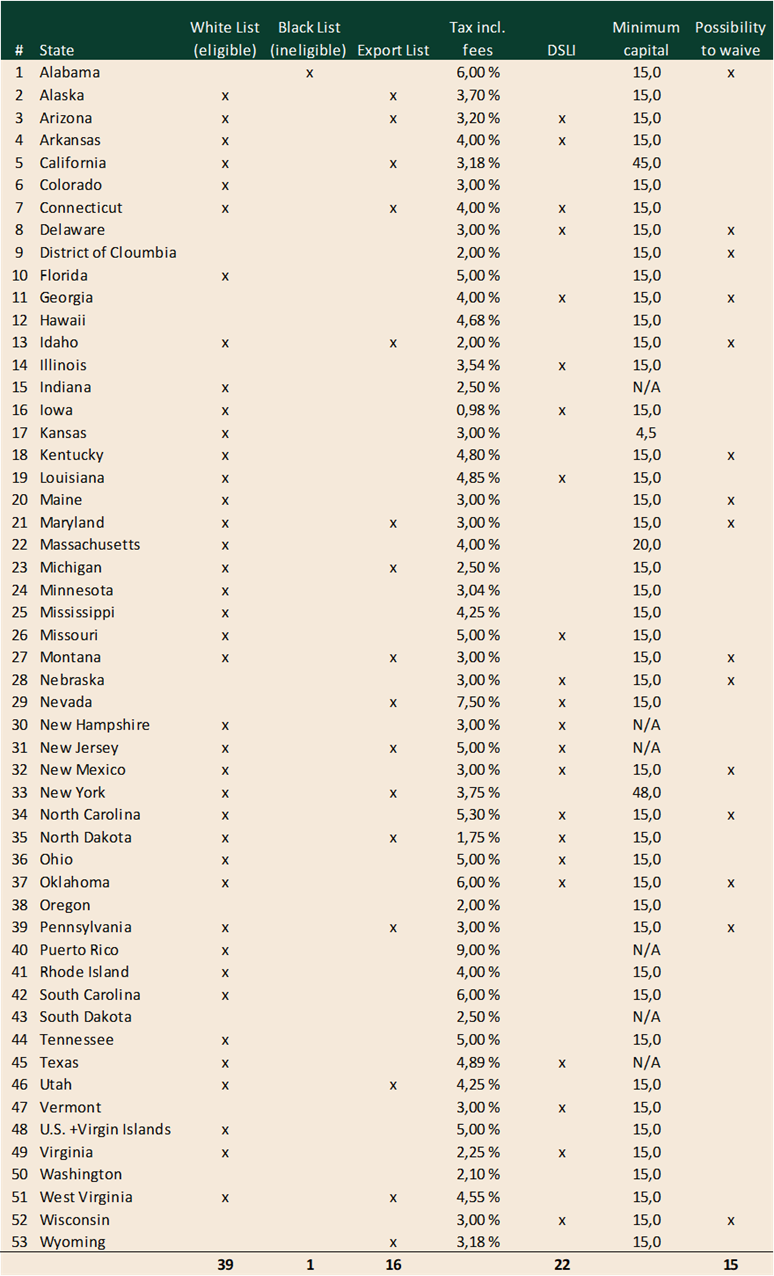
5.7. Example: one insurer, four states
A simplified example helps to make these rules more tangible.
Consider a surplus lines insurer domiciled in Delaware with 20 million dollars of capital and surplus. The insurer is licensed and in good standing in Delaware for the relevant lines of business and now wants to write surplus lines policies for risks located in Arizona, Illinois and California.
In its home state of Delaware, the insurer is fully licensed and subject to the standard solvency and market‑conduct rules. Whether it may also write surplus lines business there depends on whether Delaware has created the status of a DSLI, which allows certain domestically licensed insurers to write surplus lines business in their own state. Since that’s the case, the insurer is allowed to write E&S coverage in Delaware.
Arizona maintains a white list of eligible surplus lines insurers and sets a minimum capital requirement of 15 million dollars. Our Delaware insurer, with 20 million dollars of capital and surplus, could apply to be included on this list and, once approved, would be eligible for surplus lines placements in Arizona.
Illinois does not maintain a formal white list. For placements in Illinois, the surplus lines broker must therefore check whether the insurer can be considered as “eligible”. Since Illinois does not have any criteria differing from the uniform standards (i.e. regulation in the domiciliary jurisdiction and at least $15 million in capital). Since these requirements are met, the broker can treat the insurer as eligible for Illinois.
California, by contrast, has set a higher minimum capital requirement of $45 million for surplus lines insurers. The Delaware insurer with $20 million of capital falls short of this threshold and would therefore not be eligible to write surplus lines business in California.
The example illustrates how capital requirements and eligibility standards, even within the NRRA framework, can still differ materially between states.
After confirming the insurer’s eligibility in each of the four states, the broker must then assess whether the specific risk can be placed with an admitted carrier. Since neither of these states maintains an export list, the broker is required to conduct a diligent search of the admitted market. Only if this search fails and no admitted insurer is willing to write the risk may the broker place the business with a surplus lines insurer in those states.
6. Foreign insurers and the IID list
6.1. How alien insurers access the U.S. surplus lines market
In addition to domestic insurers, non‑U.S. (alien) insurers also participate in the U.S. surplus lines market. The NAIC maintains the International Insurers Department (IID). The IID reviews foreign insurers that wish to write nonadmitted business in the United States and publishes a list of approved alien insurers that meet specified financial and regulatory criteria.
Before the NRRA, the IID list was effectively a recommendation. Individual states could decide whether to recognise it or to impose their own additional requirements on foreign surplus lines insurers. This created uncertainty and the potential for duplicative or inconsistent vetting of the same carrier across different jurisdictions.
6.2. What Section 524(2) changed
Section 524(2) of the NRRA strengthened the position of the IID list. It provides that a state may not prohibit a surplus lines broker from placing nonadmitted insurance with a foreign insurer that appears on the NAIC’s quarterly list of approved alien insurers. Once the IID has vetted and listed an alien insurer, states may not add their own arbitrary eligibility barriers on top.
In other words, alien insurers listed in the IID list are now automatically approved in all U.S. jurisdictions, without the need for approval from individual states.
In practice, many U.S. jurisdictions now treat the NAIC’s IID list as the definitive list of eligible foreign surplus lines insurers. This simplifies compliance for brokers and policyholders and ensures that foreign carriers are held to a consistent set of standards when writing U.S. surplus lines business.
7. What this framework means for Kinsale
7.1. Corporate set-up and domicile
Kinsale Capital Group, Inc., the publicly traded holding company, is incorporated in Delaware. Its main operating insurance subsidiary, Kinsale Insurance Company, is domiciled in Arkansas. Kinsale Insurance holds a certificate of authority as a regulated insurer in Arkansas and is subject to the state’s full set of solvency, reporting and market‑conduct rules.
The Arkansas licence remains effective as long as Kinsale Insurance complies with the applicable laws and regulations, including capital and surplus requirements and periodic filing obligations with the Arkansas Insurance Department. From a regulatory perspective, Arkansas is therefore the company’s home base for supervision as an insurer.
Kinsale Insurance is designed as a DSLI in Arkansas. This status allows Kinsale to write surplus lines business in Arkansas as well.
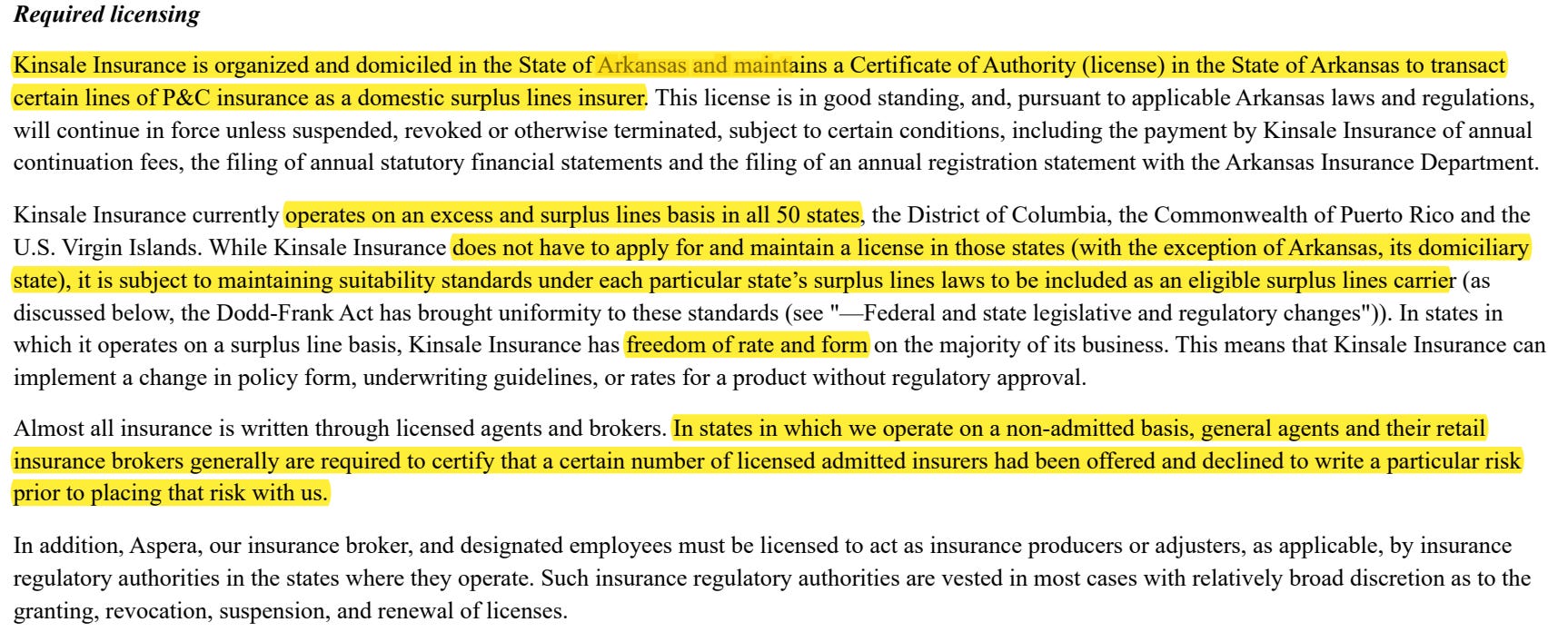
7.2. Practical implications for Kinsale’s growth
This regulatory set‑up has several practical advantages. First, supervision is concentrated in Arkansas, which simplifies the relationship with regulators. Second, NRRA’s one‑state compliance and tax rules mean that surplus lines brokers placing Kinsale policies primarily look to the regulations of the policyholder’s home state rather than to each individual risk location. Third, by meeting uniform eligibility standards and appearing on state white lists, Kinsale can access a broad national E&S market without having to build a large network of separately licensed admitted entities.
Taken together, McCarran–Ferguson, the NAIC model laws and the NRRA define the playing field in which Kinsale operates. They explain why E&S is both flexible and tightly framed and why a focused specialist like Kinsale can deploy capital into niche risks across the United States without becoming entangled in fifty different regulatory regimes. In the next part, we will turn to reinsurance – how Kinsale shares and shapes its risk exposure within this regulatory environment.
In Part 3, we’ll cover Kinsale’s business model in great detail.
Wow, I am impressed! Kudos for digging into such an out-of-the-way corner of insurance regulations!
Fantastic write-up. Never seen anyone go so deep in the regulatory weeds before! Will be reading all parts of this series