
HEICO Deep Dive (Part 3): Inside HEICO’s Crown Jewel
How the Flight Support Group turns customer savings, new product development, and accumulated trust into a self-reinforcing growth engine.

In 5 articles, you’ll get a deep dive of HEICO Corp. (186 pages).
It will be structured in five Parts:
Part 2: Why the Aircraft Aftermarket Creates a Structural Opportunity
Part 3 (today): Inside HEICO’s Crown Jewel
Part 4: The Second Engine and the HEICO Operating System
Part 5: The Economics Behind the Compounding Machine
All parts are now available in one PDF. You can download it below.
👔 Company Name: HEICO Corporation (“HEICO”)
🔎 ISIN: US4228061093 (Common Stock) and US4228062083 (Class A)
🔧 Business model: Aerospace and electronics serial acquirer
🌍 Geographic exposure: global (~62% U.S. and ~38% international sales across approximately 130 countries)
📈 Stock Price: HEI Common Stock: $339 | HEI.A Class A Common Stock: $253
💰 Market Capitalization: ~$40 billion
👨💼 Number of CEOs since foundation: 2 (one transition — Laurans Mendelson to Eric and Victor Mendelson)
since 1990
👨👩👦 Founder-/Owner-operator: Yes — owner-operated by the Mendelson family
📅 CEO tenure: Since 1990
🥇 Insider ownership: ~21.0% of shares
📊 10Y EPS CAGR: ~16%
🔁 Reinvestment profile: High
💸 Capital intensity: Low — capex-light, but inventory-intensive
🏰 Moat: Regulatory approvals, customer trust, installed-base scale, price and availability, culture
🧨 Main risks: Valuation, acquisition execution, aviation cyclicality, OEM countermeasures
🌳 Slow Compounding fit: Yes – high-quality (niche) serial acquirer
Business Model in a Nutshell: HEICO is a decentralized aerospace and electronics serial acquirer. Its Flight Support Group provides lower-cost aircraft parts, repairs, and distribution services, while its Electronic Technologies Group supplies highly engineered components for aerospace, defense, space, medical, and other demanding markets. Growth comes from new product development, market-share gains, and disciplined acquisitions of niche businesses that retain significant operational autonomy.
7. HEICO Today: One Company, Two Segments, Dozens of Niche Businesses
Describing HEICO simply as a PMA manufacturer captures its origins but only part of the company it has become. HEICO now designs, manufactures, repairs, and distributes a broad range of aerospace, defense, and electronic products through dozens of specialized operations worldwide.
Its products range from FAA-approved replacement parts and component repairs to microwave equipment, power supplies, antennas, cockpit displays, parachute systems, and components used in satellites and missile-defense systems. HEICO generally targets small but important products in technically demanding markets where quality, reliability, certification, specialized knowledge, or established customer relationships make competition difficult.
Management has repeatedly said that it does not view HEICO primarily as an aerospace or electronics company. Laurans Mendelson instead described it as a cash-generating vehicle:
“Basically, our strategy has always been, I’ve said HEICO, I’ve said this many times at presentations, I perceive HEICO not as an aerospace or electronic technologies company. HEICO is a very strong, well managed vehicle for generating cash flow. And as I look at HEICO, I see a snowball of cash. That’s why we are in business.” — Laurans Mendelson, Q4 2017 earnings call
Eric Mendelson returned to the same idea during the COVID-19 crisis in 2020. The disruption placed unusual pressure on commercial aviation but did not change the criteria by which the family evaluated HEICO or allocated capital:
“I have said for many years that HEICO is not an aerospace or electronics company. It is a vehicle that generates strong cash flow and that’s what we do. And we will make decisions based upon our cash flow profitability. […] We are looking for constant cash flow and growth. That’s what HEICO is all about. Forget aerospace, electronic technology, whatever. HEICO is a vehicle to generate cash flow and we do it through those 2 divisions which normally has high margins. And I think if you understand that you’ll understand HEICO better.” — Eric Mendelson, Q2 2020 earnings call
7.1. One company, two operating groups
HEICO reports through two operating segments: Flight Support Group (FSG) and Electronic Technologies Group (ETG). In fiscal 2025, the company generated $4.49 billion of consolidated revenue and slightly more than $1.0 billion of operating income. FSG contributed approximately 70% of both sales and segment operating income, with ETG providing the remaining 30%.
The Flight Support Group is the larger and older platform. It consists principally of HEICO Aerospace Holdings and HEICO Flight Support Corporation and their subsidiaries. FSG generated $3.12 billion of fiscal 2025 revenue and $750 million of operating income, for a 24.1% margin.
Its activities extend far beyond the PMA products most closely associated with HEICO. FSG reports three broad product lines. Aftermarket replacement parts generated approximately $1.92 billion in fiscal 2025, making them the company’s largest individual category. The line includes HEICO’s FAA-approved jet-engine and aircraft-component alternatives as well as replacement parts distributed by the group.
Repair and overhaul parts and services contributed another $749 million, including selected engine and aircraft-component repairs and overhauls, avionics, instruments, composites, and flight surfaces.
Specialty products generated $446 million and include thermal-insulation systems, complex composite assemblies, lightning-strike protection materials, precision-manufactured aerospace components, parachute systems, emergency-descent devices, and missile hardware.
FSG therefore serves several roles in the aviation aftermarket. It develops alternatives to OEM replacement parts, repairs components that might otherwise be replaced, distributes HEICO and third-party products, and manufactures specialized components for commercial aviation, defense, and space. Customers include airlines, cargo carriers, MRO providers, OEMs, business-aviation operators, the U.S. government, and allied foreign militaries.
The Electronic Technologies Group is smaller by revenue but similarly profitable. ETG generated $1.41 billion of fiscal 2025 revenue and $325 million of operating income, for a 23.0% margin. Approximately $1.14 billion came from electronic components used primarily in defense, space, and aerospace equipment, while roughly $271 million came from medical, telecommunications, industrial, and other electronics markets.
ETG’s portfolio includes microwave and radio-frequency products, power-conversion and distribution equipment, high-voltage interconnects, antennas, cockpit displays, memory products, infrared simulation and test equipment, locator beacons, fuel systems, surveillance equipment, and many other specialized components. Chapter 9.1 discusses these products in greater detail. For now, the important point is that ETG follows a different commercial model from PMA while preserving many of the same economics: its products are often technically complex, highly reliable, qualified for specific platforms, and inexpensive relative to the larger systems in which they operate.
The two groups also diversify HEICO’s end markets. Commercial aviation represented approximately 58% of fiscal 2025 consolidated revenue, defense and space another 31%, and medical, telecommunications, electronics, and other industrial markets the remaining 11%.
HEICO remains meaningfully exposed to commercial aviation but is no longer dependent on airline activity alone. Defense and space follow different cycles, while medical and industrial electronics provide smaller sources of diversification. This proved especially valuable during COVID-19, when the collapse in commercial flying sharply affected FSG while much of ETG continued operating close to normal levels.
The customer base is similarly broad. HEICO markets products and services in approximately 130 countries. In fiscal 2025, around 62% of revenue came from U.S. customers and 38% from elsewhere. No individual customer represented 10% of consolidated sales, while the five largest together accounted for approximately 20%.
This diversification matters because many subsidiaries operate in narrow niches. An individual business may depend heavily on one platform, program, or customer, but the consolidated group spreads that exposure across thousands of products, numerous aircraft and defense systems, and a broad range of customers and geographies.
FSG and ETG are distinct operating platforms but not isolated from each other. ETG companies may manufacture electronic or specialty products for Flight Support customers, while FSG’s airline, MRO, and distribution relationships can provide routes to market for ETG products. The Wencor integration has created additional opportunities for HEICO subsidiaries to quote products previously sourced outside the group. HEICO does not, however, force every operation into a centralized cross-selling system; cooperation is pursued where it creates practical value.
7.2. A collection of entrepreneurial businesses
The two-segment reporting structure can suggest two large, centrally managed divisions. Operationally, HEICO looks very different.
Since the Mendelson family took control in 1990, HEICO has completed approximately 112 acquisitions. These transactions added engineering capabilities, product portfolios, manufacturing facilities, repair stations, distribution operations, and customer relationships across aerospace, defense, space, and electronics. Most acquired companies retain their identity, management team, and operating responsibility. They join FSG or ETG for reporting and capital allocation but generally continue operating as decentralized businesses.
The subsidiary, rather than the consolidated group, is therefore the most useful unit for understanding HEICO. A typical company focuses on a narrow set of products and customers. Its president and local team remain close to engineering, manufacturing, inventory, employees, and demand, allowing decisions to be made by people who understand the product rather than by several layers of corporate management.
Victor Mendelson described the structure in 2024:
“We don’t believe in a structure where there are vice presidents and group vice presidents and assistant vice presidents. We don’t want anybody too far from the customer or from the engineering. And, you know, that’s panned out well. We’ve noticed that in a small business, if you look at HEICO, we’ve got about 10,000 people, but it’s not 10,000 people in some one location. You know, it’s about 100, 100-person operations, that kind of thing. And if you’ve got 75 or 100 people in a business, there’s nowhere to hide. If somebody doesn’t show up today, the boss knows.” — Victor Mendelson, Gabelli Funds 30th Annual Aerospace & Defense Symposium, September 2024
By the end of fiscal 2025, HEICO employed approximately 11,100 people, including around 5,300 in FSG and 5,800 in ETG.
The structure has several consequences. Local management remains directly accountable for customer service, quality, delivery, inventory, hiring, costs, and working capital. Managers can respond to market changes without waiting for headquarters, while their results remain highly visible. In a small operation, weak performance cannot easily disappear inside a large corporate organization.
Corporate management focuses on a narrower set of responsibilities: allocating capital, financing acquisitions, managing the balance sheet, establishing incentives, monitoring financial performance, and providing group-level governance. Capabilities, suppliers, and customers are shared where useful, but HEICO generally avoids centralization for its own sake.
The listed parent does not own 100% of every operation. Lufthansa Technik retains a 20% interest in HEICO Aerospace Holdings, preserving the ownership relationship established in 1997. Founders and other partners also retain minority stakes in several FSG and ETG subsidiaries.
These arrangements allow sellers to participate in the future growth of businesses they continue to manage, strengthen alignment, and make HEICO more attractive to entrepreneurs not ready to leave entirely. The accounting consequence is that part of the earnings of consolidated subsidiaries belongs to minority shareholders. In fiscal 2025, $55 million of net income was attributable to noncontrolling interests rather than HEICO’s listed shareholders (further explained in chapter 12.4).
Chapter 10.1 examines the decentralized model in greater depth. The central point here is that the HEICO name sits above a network of entrepreneurial operations. The parent provides capital, discipline, and a permanent home; subsidiaries provide products, technical knowledge, and customer relationships.
7.3. The Mendelson family
The Mendelson family links the HEICO that emerged from the 1990 takeover with the company today. This continuity is unusual because Eric and Victor Mendelson were involved from the beginning rather than joining decades later as second-generation successors. They helped identify the investment, fought for control, and built the two operating groups.
HEICO’s formal leadership structure changed twice in 2025. Laurans Mendelson, Chairman and CEO for more than three decades, became Executive Chairman, while Eric and Victor Mendelson became Co-CEOs and Co-Vice Chairmen. Laurans Mendelson died on September 27, 2025, at age 87. Under HEICO’s long-standing succession plan, Eric and Victor Mendelson immediately became Co-Chairmen while continuing to serve as Co-CEOs.
Eric Mendelson has led FSG since its formal creation in 1993 and was the principal architect of HEICO’s PMA development program. Victor Mendelson has led ETG since its formation in 1996. Both had served as Co-Presidents of HEICO since 2009.
Their responsibilities mirror HEICO’s structure. Eric Mendelson remains President and CEO of FSG, focusing on the aviation aftermarket, product development, customer relationships, and Flight Support acquisitions. Victor Mendelson remains President and CEO of ETG, bringing experience across electronics, defense, space, legal matters, and acquisitions.
Family influence is reinforced by continuing share ownership. HEICO has two publicly traded classes with virtually identical economic rights but different voting power. Each Common share, traded as HEI, carries one vote; each Class A share, traded as HEI.A, carries one-tenth of a vote.
As of January 2026, approximately 55.1 million Common shares and 84.3 million Class A shares were outstanding. The Mendelson Reporting Group beneficially owned approximately 9.23 million Common shares, equal to 16.47% of that higher-voting class, and approximately 974,000 Class A shares. Because the holdings are concentrated in Common shares, the family’s voting influence considerably exceeds its percentage of the combined economic share count.
The structure gives the family substantial influence without an outright majority of the economic interest. It also aligns a meaningful share of the family’s wealth with HEICO’s long-term value. The company’s performance affects the Mendelsons primarily through the same share prices and distributions that affect outside shareholders.
HEICO extends ownership beyond the family. Its U.S. savings and investment plan makes contributions in HEICO shares, giving many employees a direct economic interest. Chapter 10 discusses this broader ownership culture, an important part of HEICO’s effort to reproduce the mentality of a family-controlled small business across a much larger organization.
The current leadership arrangement combines continuity with a completed generational transition. Eric and Victor Mendelson jointly lead the listed company while continuing to oversee the two operating groups they spent decades building.
8. Flight Support Group (FSG): The Crown Jewel
FSG is the business on which modern HEICO was built. It began with one combustion chamber for a Pratt & Whitney engine and has grown into the world’s largest independent provider of FAA-approved aircraft and engine replacement parts, supported by component repair, overhaul, distribution, and specialty manufacturing.
8.1. The structure of the Flight Support Group
Every maintenance event begins with the same problem: an aircraft or component must return to service quickly, safely, and at a reasonable cost. HEICO built FSG to solve that problem in several ways—supplying approved replacement parts, repairing existing components, distributing urgently needed products, and manufacturing specialized aerospace equipment. Together, these capabilities address the customer’s underlying maintenance need rather than a single product or service.
Calling FSG a pure PMA business would therefore be misleading. PMA remains the foundation of its competitive position and its most distinctive capability, but the group increasingly presents itself as a provider of cost-saving aftermarket solutions. Depending on the component and customer situation, HEICO may offer a factory-new PMA part, an approved repair, an OEM product sourced through its distribution network, or a combination of these options.
Operationally, FSG comprises four principal groups:
the HEICO Parts Group (HPG),
the HEICO Repair Group (HRG),
the HEICO Distribution Group (HDG), and
the Specialty Products Group (SPG).
The groups are closely connected, but each addresses a different part of the aerospace value chain.
8.1.1. HEICO Parts Group (HPG)
HPG is the historical core of Flight Support. It designs and manufactures FAA-approved replacement parts for aircraft and engines and contains the engineering, regulatory, and manufacturing capabilities behind HEICO’s PMA portfolio. Several operating units focus on different aircraft systems, engine platforms, and product categories. The portfolio now spans virtually every ATA chapter—the standardized system used to classify aircraft equipment and functions—and includes engines, components, airframe structures, interiors, and avionics.
This part of FSG most closely resembles the HEICO described in Chapter 6. Customers identify expensive, poorly available, or otherwise unattractive OEM parts; HEICO evaluates the opportunity, develops an alternative, and seeks FAA approval to manufacture and sell it. The resulting product is sold directly to airlines and MRO providers or supplied through HEICO’s repair and distribution operations.
HPG’s reach bears little resemblance to the single combustion chamber with which the Mendelson era began. The group describes itself as the world’s largest independent provider of FAA-PMA-approved engine and aircraft-component parts, with approximately 20,000 approved products and roughly 400–550 new PMAs added each year.
Airlines incur technical and administrative costs when qualifying an alternative supplier. A small PMA company with only a few products may therefore struggle to justify the effort. HPG can offer an airline thousands of potential savings opportunities across engines, airframes, components, structures, interiors, and other systems. Once the customer has qualified HEICO and gained confidence in its quality systems, the same relationship can support many additional parts.
The products are sold factory-new. They are not used or refurbished substitutes but newly manufactured components produced under an FAA-approved quality and production system.
HPG’s role begins well before manufacturing. HEICO screens potential products using industry and customer information, analyzing demand, OEM pricing, availability, technical complexity, the expected life of the underlying platform, and the investment required to develop and stock the part. Only candidates combining technical feasibility with an attractive expected return enter development.
The operating units then perform the engineering needed to establish the replacement design. Depending on the product, this may include dimensional analysis, material characterization, coating development, manufacturing-process design, stress or performance testing, and preparation of the technical data required by the FAA. HEICO’s long approval history, engineering capabilities, and regulatory credibility allow it to process a large number of PMA applications more efficiently than a new entrant.
Manufacturing is another core capability. Design approval is insufficient if the company cannot repeatedly produce the component within approved specifications. HEICO has accumulated specialized knowledge in precision machining, forming, coatings, brazing, and other processes. It relies primarily on trade secrets, proprietary processes, software, and practical manufacturing expertise rather than a large patent portfolio.
Quality control connects design and production. Every batch must conform to the approved design and quality system. In aerospace, a defect can damage far more than one product’s economics; it can weaken confidence in the wider PMA portfolio. HPG’s technical record and consistent quality are therefore central to the group’s commercial value.
Once approved and manufactured, products are sold directly to airlines, cargo carriers, and repair and overhaul companies. They may also reach customers through other Flight Support businesses. HEICO repair stations can use HPG products when returning components to service, while distribution operations stock and deliver them alongside third-party products. HPG creates proprietary products; the wider FSG provides additional channels to the installed fleet.
HPG’s operating record reinforces this credibility. According to HEICO, the group has delivered more than 90 million parts without a service bulletin, Airworthiness Directive, or in-flight shutdown associated with its products. As discussed in Chapter 5.5.4, this history provides an important counterweight to longstanding safety concerns about PMA.
8.1.2. HEICO Repair Group (HRG)
HRG is Flight Support’s component maintenance, repair, and overhaul platform. According to HEICO, it is one of the world’s largest independent providers of component MRO and asset-management services, specializing in flight-critical equipment.
An important part of its offering is proprietary DER-approved repairs. As Chapter 3.10 explained, a Designated Engineering Representative is an FAA-authorized engineer who can approve certain technical data or recommend its approval. DER-approved data allow HEICO to use proprietary repair processes rather than relying exclusively on OEM instructions. In many cases, an airline can repair an expensive component instead of buying a new OEM or PMA replacement.
HRG is a specialized component MRO provider rather than a full-service maintenance organization. It does not perform heavy maintenance on complete airframes, overhaul entire jet engines, or provide airport line and base maintenance. Airlines and MRO providers instead remove accessories, line-replaceable units, and structural components from aircraft or engines and send them to an HRG repair station, where they are inspected, tested, repaired or overhauled, and returned to an airworthy condition.
HRG’s capabilities span avionics, electronics, electromechanical equipment, electrical harnesses and rewinds, fuel systems, hydraulics, power generation, pneumatics, aerostructures, wheels, and brakes.
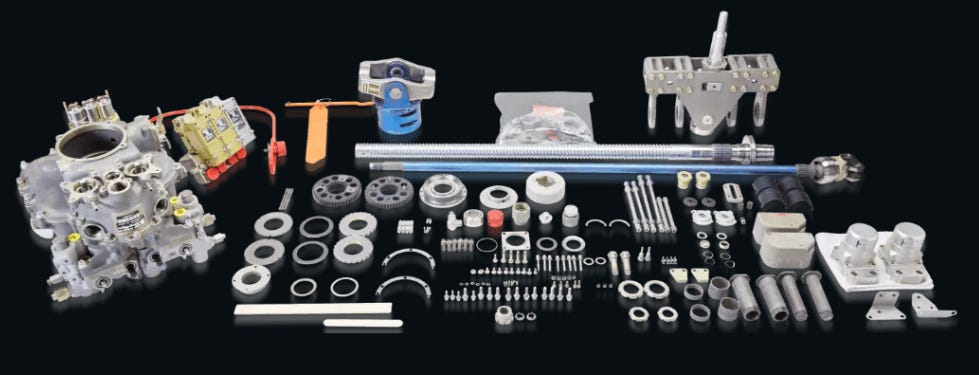
Products range from valves and actuators to complex avionics and structural assemblies, fuel pumps, generators, fuel controls, pneumatic valves, starters, turbo compressors, constant-speed drives, hydraulic pumps, wheels and brakes, composite flight controls, auxiliary-power-unit accessories, and thrust-reverser actuation systems.
The work involves more than replacing visibly damaged parts. A component entering the shop is inspected and tested to determine the cause and extent of failure. Depending on the unit, the process may include disassembly, cleaning, nondestructive testing, replacement or restoration of internal parts, reassembly, and functional testing before an authorized repair station releases it to service.
The difference between repair and overhaul is primarily one of scope. A repair addresses a defined defect or restores a failed function. An overhaul is more comprehensive: the unit is disassembled, inspected, and restored to an approved technical standard so that it can return to service in a specified condition. In both cases, appropriately certificated facilities and technicians must perform the work using approved data.
HRG may follow OEM maintenance instructions, but it also develops proprietary alternatives approved through DER data or directly by the owner or operator where permitted. Such repairs can provide greater engineering flexibility and restore a component instead of requiring an expensive assembly replacement or a more restrictive OEM procedure.
DER repair development is economically similar to PMA development. In both cases, HEICO invests in engineering and regulatory work to create a lower-cost alternative to the OEM solution. A PMA substitutes a factory-new HEICO part for an OEM part, while a DER-approved repair preserves and restores a component that might otherwise be discarded or replaced.
The repair and parts businesses reinforce each other. HRG repair stations consume replacement parts during overhaul and may use products from HPG and third-party suppliers. Conversely, the shops provide practical information about how components fail, which internal parts are replaced most often, and where OEM procedures create unusually high costs.
A recurring failure observed across many shop visits may reveal an opportunity for a new PMA part or proprietary repair. HRG is therefore not merely a channel for existing products but an important source of technical information and development ideas.
HRG also provides component-exchange and asset-management services. Under an exchange arrangement, an airline receives a serviceable unit immediately and returns its unserviceable component as the exchange core. HEICO repairs the returned unit and places it back into the available pool.
This can be more valuable than waiting for the airline’s own component to move through the shop. The aircraft returns to service sooner, while HEICO manages inventory, the repair cycle, and unit availability. Exchange services position HRG as an alternative to spare-component pools and OEM support programs.
The proposition therefore combines repair price, turnaround time, availability, and technical capability. A low quote offers little value if the component remains in the shop for months and the aircraft cannot fly. HRG’s inventory, exchange pools, and relationships with other Flight Support businesses allow it to address the total cost and operational impact of the event.
Customers include airlines, regional operators, cargo carriers, asset-management companies, independent MRO providers, military operators, and government agencies. HRG covers commercial and military aircraft, including avionics, navigation systems, and instruments used by the U.S. government and allied militaries.
HRG competes with three principal groups:
OEM-owned repair networks
Airlines operating their own maintenance shops
Other independent MRO providers.
Independence is part of HRG’s proposition. An OEM repair organization may be incentivized to maximize proprietary parts and procedures. HRG can compare repair, DER restoration, HEICO PMA, distributed OEM parts, and component exchange and select the most attractive approved outcome for the customer.
In sum, HRG broadens HEICO from a parts supplier into a maintenance partner. HPG creates proprietary factory-new alternatives, while HRG helps determine whether a unit should be repaired, overhauled, exchanged, or fitted with replacement parts. Together with distribution, these capabilities address a larger share of the customer’s maintenance problem rather than one component alone.
8.1.3. HEICO Distribution Group (HDG)
HDG is Flight Support’s global aircraft-parts distribution platform. HEICO entered the business through the 2005 acquisition of Seal Dynamics and expanded it through subsequent acquisitions. Today, HDG distributes FAA-approved components and OEM replacement parts for commercial and military applications through sales offices and stocking locations across the Americas, Europe, the Middle East, Asia, and Australia.
HDG differs fundamentally from HPG. It connects component manufacturers with airlines, MRO providers, aircraft manufacturers, and military organizations. HDG purchases or stocks parts, manages supplier relationships, handles documentation and logistics, and delivers the required component.
Products come from several sources. HDG distributes HEICO-manufactured PMA parts and replacement components supplied by unrelated third-party OEMs and specialist manufacturers. It remains useful even when HEICO offers no proprietary alternative—for example, when a part is too difficult or uneconomical to reverse-engineer, the platform is too new for meaningful PMA adoption, or the manufacturer prefers to reach a fragmented aftermarket through a specialist distributor.
The portfolio includes hydraulic, pneumatic, structural, interconnect, mechanical, and electromechanical components for commercial, regional, and general aviation. HDG also supplies military aircraft parts and support services to the U.S. Department of Defense, defense prime contractors, and allied foreign militaries.
HDG adds value because the aftermarket is highly fragmented. An airline or MRO may require thousands of part numbers from many manufacturers, often in small quantities and at unpredictable intervals. Buying each item directly would require numerous commercial relationships, purchase orders, quality checks, and logistics processes. HDG aggregates products from multiple manufacturers into a broader source of supply.
Inventory is central to the model. Maintenance demand does not follow a predictable production schedule: a component may fail unexpectedly, an aircraft may be grounded, or a shop may discover an additional need only after disassembly. Immediate availability then matters far more than a manufacturer’s theoretical ability to produce the part months later.
HDG holds inventory near major aerospace markets and provides urgent aircraft-on-ground (AOG) support. It also offers customized fulfillment programs, long-term supply agreements, and on-site customer support. Some businesses provide kitting, cable marking, technical assistance, and just-in-time delivery. These services reduce customer purchasing complexity and inventory requirements while preserving access to critical components.
Unlike an ordinary industrial distributor, an aerospace distributor must preserve each part’s documentation and traceability. Before installation, the customer needs evidence of source, condition, and regulatory status. HEICO supplies the relevant airworthiness and conformity documentation, combining physical availability with confidence in a controlled and traceable supply chain.
HDG includes several specialized businesses. Seal Dynamics, the original distribution platform, serves the commercial aerospace aftermarket and provides 24/7 AOG support. Air Cost Control specializes in electrical interconnect products, including connectors, cables, harness protection, electromechanical devices, and related accessories for aerospace, defense, and space.
Blue Aerospace serves the military aftermarket through parts distribution, supply-chain and program management, MRO support, and engineering services for platforms including the F-16, F-15, F/A-18, and C-130. Pioneer Industries represents manufacturers supplying the U.S. military and other government customers and manages procurement, inventory, military packaging, contract administration, and compliance requirements that many smaller manufacturers would struggle to handle independently.
The 2023 Wencor acquisition materially expanded distribution. Its activities cover high-use commercial and military aftermarket products including bearings, tooling, interiors, filters, hardware, lighting, electrical products, safety equipment, communications components, and seals. Wencor also brought a global logistics network, online ordering, and inventory-management programs.
Distribution is strategically important for three reasons:
First, it gives HEICO a commercial relationship with customers even where no HEICO PMA exists. An airline may initially buy an OEM component through HDG and later adopt a HEICO replacement or HRG repair. Distribution therefore increases customer touchpoints across the group.
Second, HDG provides information about actual aftermarket demand. Its businesses see which parts customers order repeatedly, where lead times are increasing, and which products are becoming difficult or expensive to source. That information can reveal opportunities for HPG to develop a PMA, HRG to create a proprietary repair, or HDG to secure another distribution agreement.
Third, distribution supports parts and repair operations. HRG repair stations need replacement components to complete overhauls, including HEICO PMAs, Wencor products, and OEM parts sourced through HDG. Access to several supply channels can reduce turnaround time and help HEICO select the most economical approved solution.
Distribution may also be preferable to PMA development. Attractive rights to an existing product can generate a return without a multi-year engineering and approval process. HEICO can support the customer immediately while avoiding the technical, commercial, and inventory risk of developing a competing product. Management can choose among manufacturing, repair, and distribution based on each opportunity’s economics rather than treating PMA as the only solution.
Distribution nevertheless has a different economic profile from proprietary parts. The distributor shares economics with the manufacturer and has less control over the product and pricing. It must also purchase and hold inventory before receiving customer orders. That inventory may lose value if the aircraft is retired, grounded for an extended period, or supported by a different component.
HDG broadens HEICO’s proposition from selected proprietary alternatives to a much wider share of customer aircraft-parts requirements. HPG develops the alternative, HRG restores the component, and HDG makes the required product—whether made by HEICO, Wencor, or an OEM—available when and where the customer needs it.
8.1.4. HEICO Specialty Products Group (SPG)
SPG is the least intuitive of Flight Support’s four groups and often receives the least investor attention. It brings together specialized manufacturers of highly engineered, mission-critical mechanical solutions, including structural, thermal, and composite products for commercial aviation, defense, space, and selected industrial applications. SPG houses businesses that do not fit neatly into parts development, component repair, or distribution. Compared with the other groups, these companies generally sit further upstream and more often supply OEMs, original equipment suppliers, defense primes, and government customers.
The range is diverse. SPG manufactures personnel and cargo parachutes, heavy-airdrop platforms, and emergency-descent devices for pilots and crews in elevated cockpits. It also produces removable thermal-insulation blankets for engines and other high-temperature applications, conductive foil mesh protecting composite structures from lightning strikes, and complex composite assemblies for aircraft, defense systems, and spacecraft. Other activities include precision machining and missile hardware.
The products may appear unrelated but share similar economics. They are highly engineered, produced in modest volumes, and represent only a small portion of the larger aircraft or defense system’s value. Reliability, qualification, and delivery performance are nevertheless critical, giving customers little reason to switch merely for a small component-cost saving.
SPG therefore differs from the traditional PMA model. HPG enters the aftermarket as a lower-cost approved alternative to an OEM part, while SPG is often the original qualified manufacturer or subcontractor. Its position may begin during the design and production phase of an aircraft, spacecraft, or defense program and continue as long as the platform remains active.
The revenue profile also differs. PMA demand is driven largely by aircraft utilization, maintenance events, and the installed fleet. SPG depends more on OEM production rates, customer programs, defense procurement, and contract timing. Some products later generate replacement demand, but the relationship often begins with an OEM, prime contractor, or government customer.
Despite these differences, SPG fits the broader HEICO model. Its products occupy narrow technical niches, account for a small share of total system cost, and require capabilities that cannot be replicated quickly. Many are manufactured in modest volumes but must meet demanding specifications, supporting attractive economics without mass-market production.
The position is durable but not risk-free. An SPG business may depend on a limited number of customers or programs. Production delays, program cancellations, defense-budget changes, or lower aircraft deliveries can affect demand, while poor quality or delivery performance can cost future work. Consolidation across numerous products, customers, and platforms reduces some of this concentration.
SPG also strengthens Flight Support’s manufacturing base. Its machining, composite, thermal, and fabrication capabilities can support products developed elsewhere in HEICO. After the Wencor acquisition, management specifically identified SPG as an internal resource that Wencor could approach for new product quotations.
The four-group structure differs from external reporting. FSG is one operating segment, and revenue is divided into only three product lines: aftermarket replacement parts; repair and overhaul parts and services; and specialty products. The organizational groups and reported categories overlap but do not correspond exactly. Distribution, for example, is not separately disclosed and is largely included in aftermarket replacement parts (further explained in Chapter 8.8).
The interaction among the groups matters more than the labels. HPG develops proprietary alternatives; HRG brings HEICO into the maintenance event and consumes PMA and distributed products; HDG provides inventory, customer access, and market intelligence; and SPG adds manufacturing capability and exposure to additional aerospace and defense applications. Wencor spans several activities and materially increases their scale.
“With regard to PMA versus repair or distribution, again, I think what the airlines are looking for is reducing their total cost of ownership, producing their total costs. And whether we sell a product as a direct PMA or we embody it in a repair or we are able to structure something with the distribution deal, I think that they’re all very complementary and things are getting very fuzzy between our PMA and our repair, because there are all sorts of products, which perhaps in the past we would have sold as PMA and now we’re selling as repairs, because sometimes you’re able to salvage part of a unit and have the cost of the repair be lower than the cost of making a brand new part.” — Eric A. Mendelson, Q4 2015 earnings call
Recurring aftermarket demand should not be confused with long-term order visibility. The installed fleet, recurring maintenance events, and growing number of approved parts provide a durable demand base, but customers place orders relatively close to delivery. Visibility also differs among FSG activities:
“In our parts business, both PMA and distribution, we receive most of the orders in the month of shipment. So the visibility there is probably 30 to 60 days out. Within repair, it’s probably another 30 days on top of that. And in specialty products, it’s probably, say, another 60 days on top of that.” — Eric A. Mendelson, Q1 2020 earnings call
This creates an important distinction between structural demand visibility and near-term revenue visibility. HEICO can assess long-term drivers through utilization, maintenance activity, fleet age, and customer adoption, but has less visibility into exact quarterly timing. PMA and distribution are particularly short-cycle, with most orders arriving near shipment. Repair adds approximately one month of visibility, while specialty products generally add another two. Changes in demand can therefore appear in HEICO’s results quickly, as COVID-19 demonstrated.
8.2. From customer problem to approved product
HEICO does not develop products by searching randomly through an aircraft for technically replicable parts. The process begins with customer demand and then passes through financial, technical, and regulatory filters.
Airlines, repair stations, and MRO providers already know where the pain lies. They see which OEM products are purchased frequently, which prices have risen most aggressively, which components suffer from poor availability, and where a credible alternative could create meaningful savings. HEICO’s long-standing customer relationships provide this information before engineering resources are committed.
The Lufthansa partnership established the original model: Lufthansa Technik identified high-volume, high-value products, supplied technical knowledge, and provided demand after approval. Today, the network is much broader. HEICO serves every major airline, operates repair and distribution businesses, and receives product requests from across the aftermarket.
The first question is whether customers genuinely want the product. A technically attractive part has little value if airlines resist approving it, the installed base is too small, or expected volume cannot justify the engineering and inventory investment. HEICO also considers similarity to products it has already developed, sourcing and manufacturing speed, and the capital required before meaningful revenue begins.
Eric Mendelson described the decision process in 2025:
“We look at how similar it is to something that we’ve done before, how much the customer wants it, what the payback looks like, what the investment is, how quickly we can get it from the vendor. I mean, all of that stuff is put together, and basically that goes into an IRR analysis.” — Eric Mendelson, Q3 2025 earnings call
This discipline matters because regulatory approval alone does not make a product economically successful. HEICO must pay engineers, acquire and analyze OEM samples, create drawings, select materials, qualify processes, perform tests, prepare the submission, and build inventory. The product must then pass each airline’s qualification process before meaningful purchasing volume develops.
HEICO has historically focused on parts offering meaningful cost or availability benefits without imposing disproportionate customer risk. Less safety-sensitive articles are generally easier for airlines to approve than the most critical engine components, although the portfolio has become more technically demanding over time. Management has repeatedly said that HEICO now develops products whose complexity and criticality it does not disclose for competitive reasons.
“We continue to develop 300 to 500 new PMAs per year, similar number of DER repairs. […]. In addition, we’ve got a number of, you know, I would say, extremely complex, critical products which we offer, which we don’t publicly speak about for competitive reasons. Sometimes our competitors know about them, other times they don’t.” — Eric A. Mendelson, Q3 2022 earnings call
Once selected, the product must reproduce the required performance on a design and manufacturing basis acceptable to the FAA. As discussed earlier, equivalency does not mean merely looking similar; the product must preserve airworthiness and function correctly within the broader system.
HEICO may also improve a product while preserving its required form, fit, and function. An OEM design may have entered service decades before newer materials, coatings, and manufacturing methods became available, while operating experience may reveal recurring weaknesses. HEICO can incorporate those lessons provided the result remains fully compatible and satisfies FAA requirements.
Approval is followed by another capital commitment: HEICO must manufacture and stock enough parts to support customers reliably. A lower price loses much of its value if the part is unavailable when needed, so the company builds inventory before the full demand curve is visible.
Management describes development and commercialization as gradual. Depending on complexity, a product may take roughly a year from identification until sufficient inventory is available. Customer acceptance then builds over time, with the product typically reaching full commercial potential after three to four years. Revenue therefore ramps rather than appearing immediately upon FAA approval.
This creates a portfolio effect. Each product may be small and ramp slowly, but HEICO introduces several hundred PMAs and a similar number of DER-approved repairs in a typical year. Annual cohorts overlap: new approvals enter airline qualification, earlier cohorts gain adoption, and mature products continue serving aircraft that may remain in operation for decades.
Catalog breadth has also changed the offer. A small supplier with one or two PMAs asks an airline to undertake qualification for limited savings. HEICO spreads that effort across a much broader portfolio. Once an airline trusts its engineering, quality, and support, it can evaluate additional products without treating HEICO as a new supplier each time.
Wencor materially increased that scale. Before the acquisition, HEICO offered roughly 12,000 PMAs and Wencor about 7,000, creating a combined portfolio approaching 20,000 approved replacement parts. By early 2025, management also referred to nearly 10,000 DER-approved repairs.
The portfolio now extends far beyond HEICO’s historical engine focus. It expanded from one JT8D combustion-chamber product into additional engine parts and then fuel, hydraulic, pneumatic, electromechanical, wheel and brake, airframe, interior, and avionics products.
“You know, HEICO started out life as a JT8D engine parts manufacturer, and then we got into other engines and components, and as time has gone on, into structures and avionics.” — Eric A. Mendelson, Q3 2025 earnings call
FSG remained entirely dependent on engine products until the early 2000s, when HEICO deliberately began diversifying. By early 2026, approximately three-quarters of PMA sales came from non-engine products:
“When you look at […] the products that we’re doing, our sales in the PMA business are roughly 3/4 non-engine, which would be components, airframe, interior, and about 25% engine.” — Eric A. Mendelson, Q1 2026 earnings call
This diversification matters. Engine products can offer attractive savings, but OEM control through service agreements, licensed repair networks, and warranty pressure is strongest in the engine aftermarket. Non-engine categories expose HEICO to more customer pain points and often face fewer contractual barriers, while reducing dependence on individual engine programs.
HEICO has built a repeatable process for identifying customer problems, screening the economics, completing engineering and regulatory work, establishing supply, carrying inventory, and driving adoption. The process that continually produces new PMA parts is the strategic asset.
8.3. The customer value proposition
HEICO’s value proposition rests on three elements: cost, availability, and credibility. Cost attracts attention, availability may create the immediate reason to switch, and confidence determines whether an airline is willing to install the product.
8.3.1. Price
Price is the first element. OEMs often control the aftermarket for products designed into an aircraft or engine. Once certified as part of the platform, the operator may have no alternative approved source and must continue buying from the same supplier. HEICO enters as an approved second source without bearing the cost of developing the entire aircraft, engine, or system, allowing it to offer a substantial discount while still earning attractive margins.
HEICO commonly introduces parts at approximately 30–40% below the corresponding OEM price. The initial discount often widens because OEMs have historically raised prices much faster than HEICO. Over time, the gap can exceed 50% and, for mature products, may reach 70–80%.
HEICO and the OEM frequently pursue very different pricing strategies after the alternative enters the market. OEMs tend to exploit sole-source positions through substantial increases, while HEICO has generally raised prices only modestly. The price advantage can therefore compound for many years.
HEICO’s descriptions of this behavior have remained remarkably consistent. In early 2012, Eric Mendelson said airlines expected OEM pricing on newer platforms to become even more aggressive:
“I was just over in Singapore last week, and many people were commenting that on the newer platforms, they sense that the OEM prices are going to be even more egregious than they’ve seen in the past.” — Eric A. Mendelson, Q1 2012 earnings call
Later that year, management described repeated increases as a fundamental feature of the OEM aftermarket model and a source of customer frustration:
“They [=> the OEMs] have a distressed relationship with their customers because of their ability to maximize profit through pricing. And that’s the way unfortunately they have to do it. We on the other hand build up a lot of customer goodwill and we view it as an investment by keeping our prices reasonable” — HEICO management, speaker unclear, Q2 2012 earnings call
In 2013, Eric Mendelson quantified typical annual increases at approximately 5–7%. He linked the behavior to what Laurans Mendelson called the “expanding universe”: even as PMA suppliers gain share, the OEM aftermarket continues growing through price alone.
“But the reason it’s sort of staying at that level is, of course, the OEM, my dad always has spoken about the theory in the expanding universe. The OEM prices continue to go up by just say 5%, 6%, 7% per year and that frankly dwarfs the PMA percentage of the total market.” — Eric A. Mendelson, Q4 2013 earnings call
By 2017, the pattern was unchanged. Eric Mendelson cited examples of OEMs raising prices by 10–11% annually for several consecutive years. HEICO could theoretically have followed but deliberately chose not to:
“I mean I’ve heard examples. There are some OEMs out there that have raised prices 10%, 11% per year for the last number of years. And we’ve been clearly, we could have done the same and we didn’t. […] And HEICO has developed this reputation of not taking advantage of the customers when we can take advantage of the customers.” — Eric A. Mendelson, Q2 2017 earnings call
Independent reports on two major engine families appeared to support the broader observation. According to Eric Mendelson, CFM56 and CF6 parts prices had increased by roughly 8% annually over ten years:
“There have been many newspaper or many media reports on the increases coming on particularly the cost of engine parts. There’s been articles and independent reports that have come out, particularly on the CFM56 and the CF6 showing price increases over a 10 year period, roughly in the 8% per year area. And airlines see that, they’re not happy about it. And I think that there’s continued opportunity throughout the industry.”— Eric A. Mendelson, Q2 2017 earnings call
The pandemic did not materially change the behavior. In early 2021, management observed that some OEMs had increased prices particularly sharply to recover margins lost during the collapse in aviation activity:
“The Pricing umbrella does widen over time, and we can get to a point where if somebody has been buying a part from us for 15 to 20 years, our price could end up being 70%, 80% below the OEM price. […] The OEMs, I would say, this year in general, their price increase, I mean, they’ve been across the board. Some have decided to raise price substantially in order to make up all of the lost margin that they’ve Surrender due to the pandemic.” — Eric A. Mendelson, Q1 2021 earnings call
HEICO continued to view its share gains within a much larger and increasingly valuable OEM aftermarket. Even when customers adopt HEICO products, the OEM generally retains most of the market and benefits from continued increases on the remaining volume:
“And also, I want to point out that even though we will take market share, in no means should this be interpreted that OEM businesses will not do well because we take a minority of the market share. We leave a majority for the OEM. The OEMs have been pretty aggressive with price increases, and we’re just trying to take our little piece.” — Eric A. Mendelson, Q1 2021 earnings call
Victor Mendelson summarized the economics even more directly in 2024. His 6–13% range should not be read as a measured annual average for every product, but it illustrates the pricing power available to a sole approved source:
“So what do you do if you’re the only approved source? Of course, rational people raise prices, and they raise prices 6%-13% a year, regardless of economic conditions” — Victor H. Mendelson, Gabelli Funds 30th Annual Aerospace & Defense Symposium, September 2024
Eric Mendelson cited one major OEM that raised prices twice in a year—first by 10% and then by another 18%—while HEICO remained far more conservative:
“So honestly, I think that our pricing has been a lot more conservative and gentle than it could be. Our competitors are substantially raising price. I just received an email last night from a I don’t want to call out the OEM, but it’s an OEM that everybody knows. And they increased price twice last year, once 10% and another time 18%.”— Eric A. Mendelson, Q1 2024 earnings call
These statements span more than a decade, several aviation cycles, and the industry’s largest disruption. Percentages differ by product, platform, OEM, and period, but management’s description has remained consistent: OEM replacement-part prices have generally risen much faster than HEICO’s.
How the price advantage compounds:
The following chart illustrates how a conventional initial PMA discount can widen into the 70% range. It starts with an OEM price index of 100 and a HEICO price of 70, a 30% discount. The OEM price then increases by 7% annually, while HEICO raises its price by 1%.
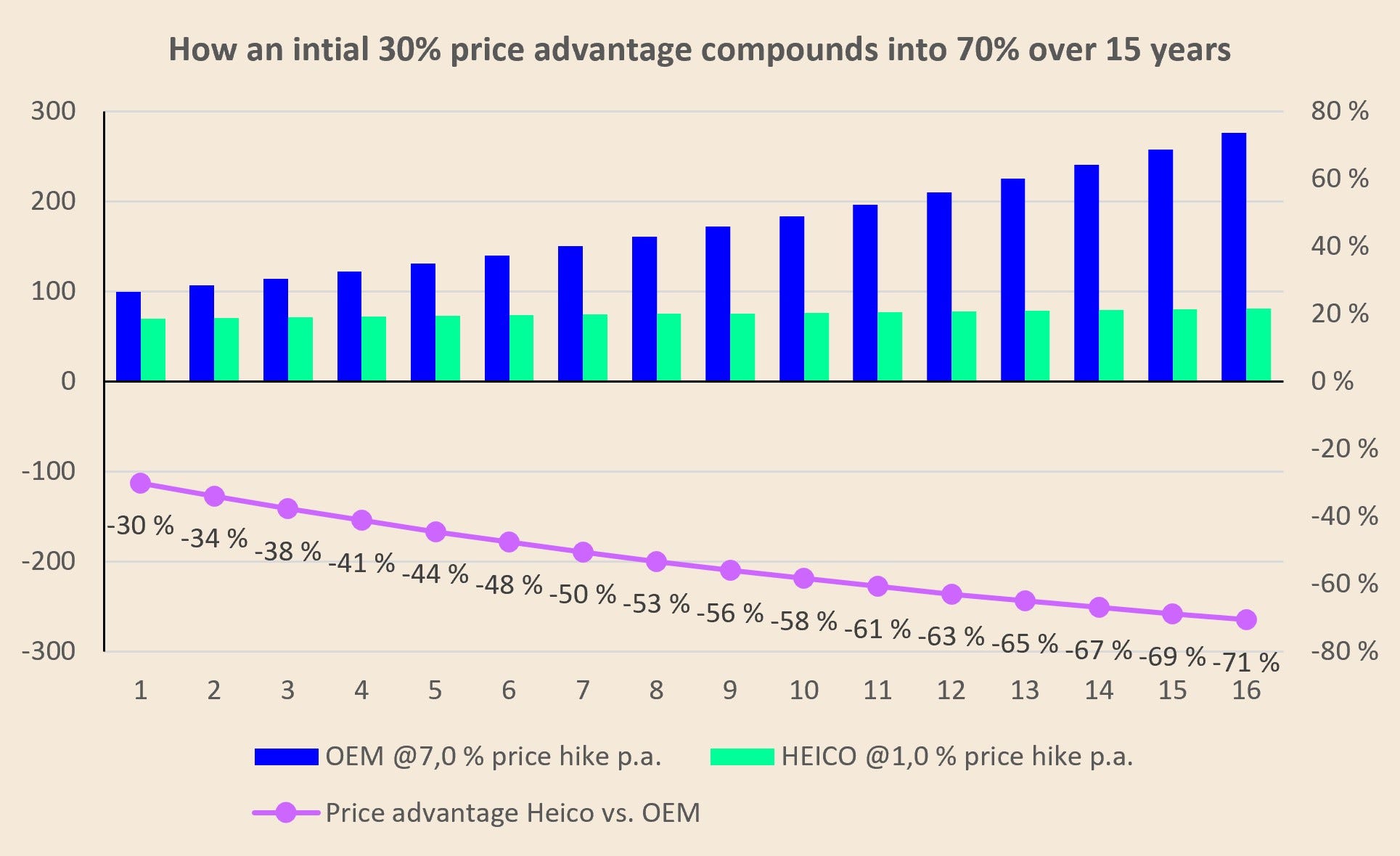
Under these illustrative assumptions, the OEM price rises from 100 to approximately 276 over 15 annual increases, while HEICO’s price reaches only about 81. The relative discount widens from 30% to roughly 71%. Even with 2% annual HEICO increases, it would reach approximately 66% after 15 years and more than 70% after 20 years.
The chart is illustrative rather than a reconstruction of one part’s history. It nevertheless shows why management’s claim that mature HEICO products may sell for 70–80% less than OEM equivalents is mathematically plausible. A modest annual pricing difference becomes enormous when compounded across a 15- to 20-year product life.
Eric Mendelson described this development in 2021:
“The Pricing umbrella does widen over time, and we can get to a point where if somebody has been buying a part from us for 15 to 20 years, our price could end up being 70%, 80% below the OEM price.” — Eric A. Mendelson, Q1 2021 earnings call
By 2024, HEICO’s prices as a percentage of the corresponding OEM price had reached their lowest level in company history:
“I can tell you that our prices that we sell as a percentage of OEM, I would say, are unfortunately at an all-time low. So, the OEMs have raised prices faster than we have raised prices.” — Eric A. Mendelson, Q2 2024 earnings call
The word “unfortunately” is revealing. A widening discount benefits customers and makes HEICO more attractive, but also shows how much pricing power the company chooses not to exercise. HEICO could retain more of the available savings while remaining far below the OEM price.
The restraint is deliberate. Management believes that maximizing every product’s price would weaken customer relationships, reduce incentives to approve additional HEICO parts, and potentially provoke a more aggressive OEM response. HEICO instead earns attractive margins while leaving a meaningful and visible share of the benefit with the airline.
Laurans Mendelson summarized the philosophy more directly:
“We don’t try to screw our customer.” — Laurans A. Mendelson, Forbes interview, 2020
The wording is blunt but captures HEICO’s long-term approach. Management could retain more savings through higher prices but believes fair treatment creates greater value through stronger relationships, higher volumes, and additional development opportunities.
HEICO was following the same approach in 2025. Eric Mendelson characterized increases as ranging from the low single digits to the upper end of that range and primarily intended to offset cost inflation:
“We could, frankly, I think our prices could be a lot higher, but we don’t do that. And our prices have been, as you know, sort of the increases have been sort of low single digits, maybe the high end of low single digits, but really sufficient in order to cover our cost increases.
We do have certain contracted customers where, as a result of fixed prices for a longer period of time, there could be more substantial price increases. But if you look at it on an annualized basis, it’s still that, I would say, low single digits up to the high end of the low single digits [=> of price increases]. So we have not, no, we’ve not pushed the pricing. We want to make sure that we’re very fair.” — Eric A. Mendelson, Q1 2025 earnings call
The commercial value extends beyond goodwill. Airlines can reward HEICO with more volume on existing products and ask it to develop further alternatives. Eric Mendelson described an unusually direct example after attending an MRO conference in Dallas:
“We believe that we’ve been able to successfully pass along our cost increases, along with maintaining our profit margin, while at the same time, keeping our customers happy. […] actually have to just add a little anecdote.
I was at the MRO conference in Dallas a couple of weeks ago, and actually we had a major airline that everybody would be very, very familiar with. I can’t mention the name. They brought all of their senior leadership to frankly thank HEICO. In all of my years, I’ve never had a meeting quite like this, where they brought their senior leadership to thank HEICO, one, for coming up with our new product solutions and helping them with all sorts of stuff that others wouldn’t. Number two, not taking advantage of them and not doing what other people are doing. They called out a number of other manufacturers, and they said that HEICO really differentiated itself and was going to be rewarded with not only increased business on products that we currently offer, but increased business on new stuff that they wanted us to develop for them. I think as a result of treating our customers right, this is gonna work.” — Eric A. Mendelson, Q2 2022 earnings call
The anecdote shows how pricing reinforces the development pipeline. Fair treatment strengthens relationships, increases volume from the existing catalog, and encourages customers to bring HEICO more parts to develop.
This supports a different growth model from that of many sole-source aerospace suppliers. By treating customers fairly, HEICO has historically been rewarded with unit growth. Much of FSG’s organic growth has therefore come from volume rather than price.
“Our organic growth comes primarily from volume, not from price. We tend to be very price friendly to our customers.” — Eric A. Mendelson, Q2 2016 earnings call
HEICO generally raises prices only to reflect underlying input-cost inflation.
HEICO benefits when an existing customer approves another product, installs it across more of its fleet, or adds product families to a long-term agreement. The company can outgrow the underlying aftermarket without relying on double-digit annual price increases.
Long-term agreements are an important part of the relationship. They give airlines price visibility and supply protection while providing HEICO the volume commitments needed to procure materials, build inventory, and organize production. In 2024, management estimated that well over half of the PMA business might be under contract:
“Our customers, with regard to PMA, they like the idea of having a long-term agreement, and we like that idea too, because we can go out and procure the product for them and protect them. You know, clearly, if they want to be protected on price, we’re happy to do that, but in turn, they’ve got to commit to us. So, you know, definitely on the PMA side, the percentage of contracts would be, you know, I’m guessing well over 50%.” — Eric A. Mendelson, Q2 2024 earnings call
These agreements commonly run for three to five years and may contain flat pricing or inflation-linked adjustments. They can temporarily limit HEICO’s ability to reprice during periods of rapidly rising costs, as in 2022 and 2023, but strengthen the relationship and shift value creation toward higher volumes and broader adoption.
Price protection generally applies only to products already covered. If the customer later adds another HEICO part, it is priced at the current level rather than the historical price granted to the existing portfolio. Airlines therefore have an incentive to qualify and contract products early:
“So if a customer is buying a product and it’s under contract, then obviously, they would have price protection for the terms of the contract, the duration of the contract, if that’s what it’s provided for. And of course, there are different things which matter to different customers, so we’re very accommodating there. However, if that customer wants to start buying a part that they haven’t purchased, then they would get a price based on the newest price as opposed to what the old price was. So there’s definitely a big incentive to get started and get locked in with us as early as possible.” — Eric A. Mendelson, Q1 2024 earnings call
Early commitment can lock in supply and a more favorable starting price, while HEICO gains longer-term volume and better procurement and inventory visibility.
The airline’s financial benefit becomes especially visible across several contracts and pricing cycles. HEICO may protect the customer through modest increases while the OEM raises list prices much faster, widening the gap even as HEICO continues earning attractive margins:
“When our customers commit to us long term, and we give them, you know, pricing protections, we can get into an area where our parts can be as much as 70% below the OEM after many years. We still drive a very nice margin, and the airlines save a lot of money.” — Eric A. Mendelson, Q1 2023 earnings call
The proposition is broader than a cheaper introductory price. HEICO offers an alternative pricing trajectory: the initial 30–40% discount creates immediate savings, while the difference in annual increases can multiply those savings over the remaining life of the aircraft or engine platform.
HEICO’s large advantage might suggest maximizing volume. Management has historically been more restrained, seeking an attractive minority share for each part while leaving the OEM most of the market.
HEICO described this approach in 2013:
“We only go for up to one third market share on each of the parts we provide. So we intentionally leave them [=> the OEMs] with two thirds. So, if you look at the economics of that, they can get two thirds at an aggressive price. And if they want to try to squeeze us on the one third that we’re going to take and compete on price, then we’re just going to have to go after some of the two thirds some of the other pieces that they’ve got in order to capture our target market share.” — Eric A. Mendelson, Q1 2013 earnings call
The logic is straightforward. If the OEM retains roughly two-thirds of volume, it can earn a high contribution on most of the market at its existing price. A reduction might recover share but would apply to every unit sold. The OEM must weigh contribution from recaptured volume against the margin sacrificed across its remaining installed base.
The following table illustrates the trade-off in a simplified 100-unit market. The OEM charges $100 per part with $50 of variable cost, earning $50 of contribution per unit. HEICO enters at $70, a 30% discount, and earns a 30% contribution margin. If the OEM responds, the model assumes a 15% reduction to $85 and recovery of the entire market.
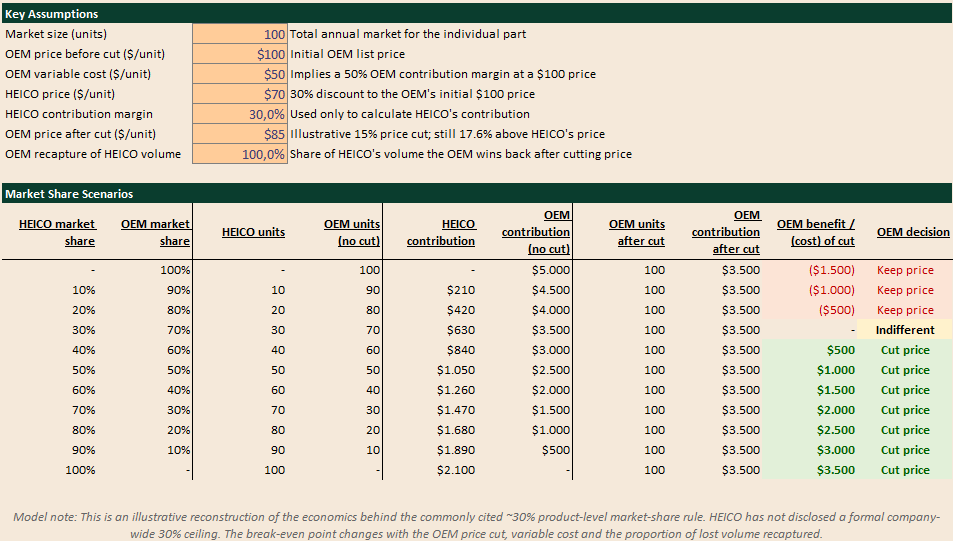
At a 20% HEICO share, the OEM sells 80 units at $50 of contribution, or $4,000. Reducing the price to $85 and regaining all 100 units generates only $3,500, so the OEM is better off accepting the lost volume and preserving price.
At a 30% HEICO share, the alternatives produce the same result and the OEM is indifferent. Above 30%, the balance changes. At a 40% share, the OEM earns $3,000 at the original price versus $3,500 if it lowers the price and recaptures the market. The incentive to respond increases with HEICO’s share.
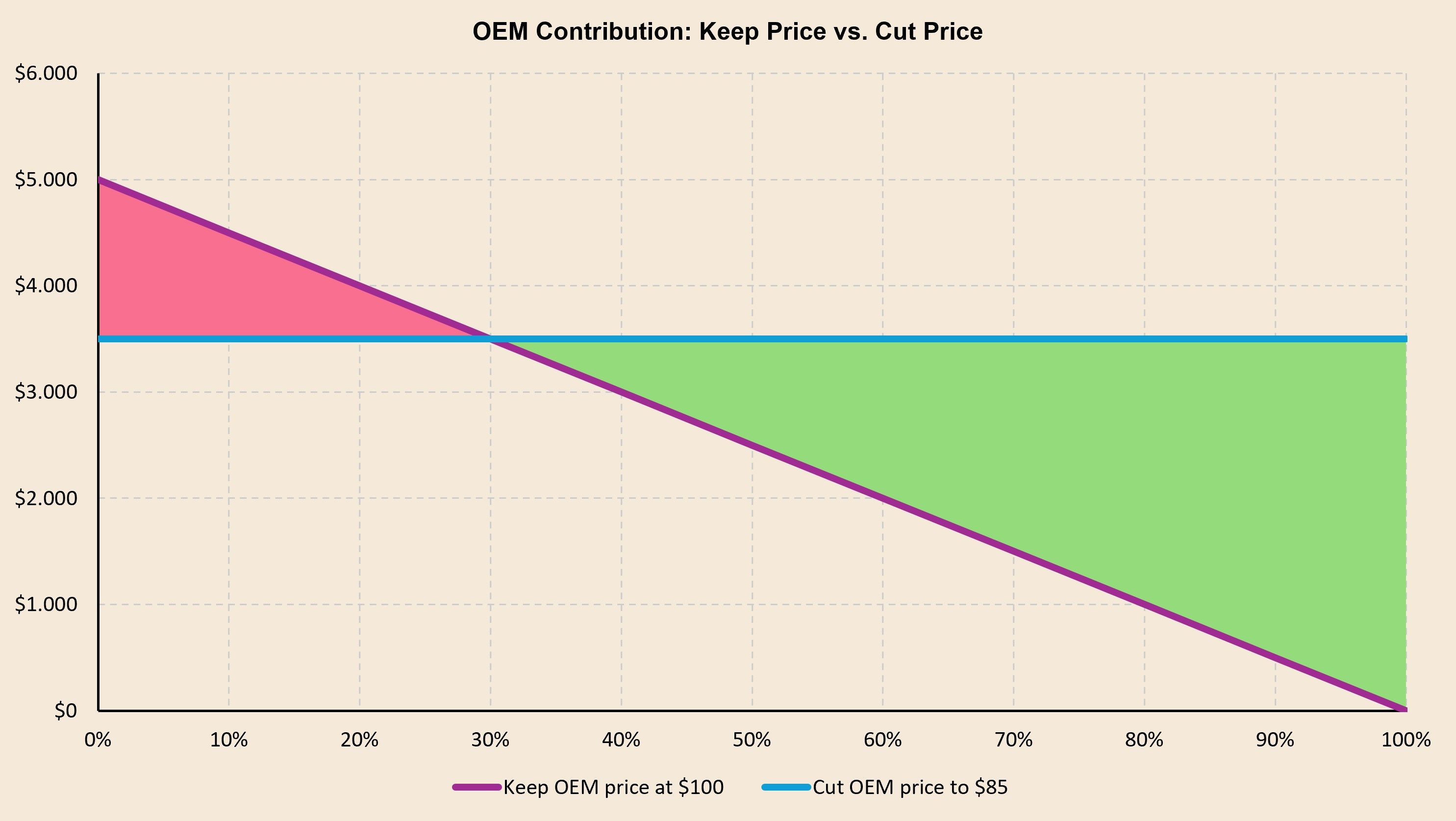
The intersection near 30% visualizes the strategic equilibrium. Below that level, maintaining the high price is more profitable; above it, a reduction becomes increasingly attractive under the model assumptions.
The threshold is not universal. It depends on variable cost, the required price reduction, and the volume recovered. If the OEM had to match HEICO’s $70 price fully, it would sacrifice far more contribution per unit and the break-even share would move to 60%, as the sensitivity analysis below shows.
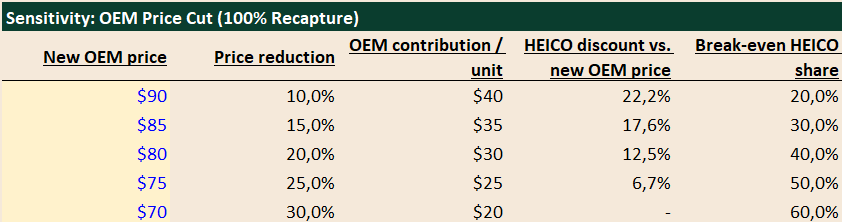
The model nevertheless captures the logic behind HEICO’s stated one-third target. The company seeks enough volume to earn attractive returns but generally stops before its presence becomes painful enough to make the OEM abandon its high-price strategy.
Management described the same balance eight years later:
“And also, I want to point out that even though we will take market share, in no means should this be interpreted that OEM businesses will not do well because we take a minority of the market share. We leave a majority for the OEM. The OEMs have been pretty aggressive with price increases, and we’re just trying to take our little piece.” — Eric A. Mendelson, Q1 2021 earnings call
HEICO’s restraint extends beyond market share. It also largely avoids the engine OEMs’ most valuable parts. Rather than targeting life-limited parts—highly engineered, safety-critical components replaced after prescribed cycles—HEICO focuses primarily on expendables and selected repairables:
“Our expertise is in a certain area, and I would anticipate we continue to focus in that area. In general, we do expendables, parts which are replaced typically at every shop visit or at most shop visits. And then we also do certain repairables as well. So I think we’re going to continue to focus in those areas. We don’t do [life-]limited parts. And that really is the bread and butter for the original equipment manufacturers.” — Eric A. Mendelson, Q1 2019 earnings call
Life-limited parts are crown jewels of the engine aftermarket: highly engineered, safety-critical, replaced at mandatory intervals, and typically carrying some of the OEM’s highest margins. Avoiding them reduces the threat HEICO poses to core OEM economics.
This creates rational coexistence. HEICO earns attractive margins and gives airlines substantial savings on the minority share it captures. The OEM retains most volume and continues charging high prices across that larger base. Both can therefore earn attractive economics in the same product market.
The strategy also creates an implicit deterrent. If the OEM aggressively defends HEICO’s targeted one-third share, HEICO can pursue more of the remaining two-thirds. Leaving most of the market untouched is cooperative only while the OEM accepts the arrangement.
HEICO’s restraint therefore operates in two directions: it leaves substantial savings with airlines and substantial market share with the OEM. This supports goodwill, reduces destructive price competition, and allows HEICO to repeat the model across thousands of parts rather than maximize one product’s share.
The approach resembles Nick Sleep’s concept of “scale economies shared”, best known through Costco. Costco passes a meaningful share of its purchasing power and operating scale to members through lower prices, strengthening loyalty and volume. HEICO follows a similar principle. As engineering expertise, catalog breadth, and customer relationships expand, it could raise prices more aggressively; instead, it preserves a large discount. Customers save, HEICO earns attractive margins and gains volume, and the resulting trust supports further approvals. Shared savings therefore reinforce the scale advantages that made them possible.
These dynamics benefit HEICO in several ways. The widening discount makes mature products more compelling, supports additional approvals, and strengthens the company’s reputation as a long-term cost-saving partner. HEICO preserves attractive margins because its manufacturing costs do not rise nearly as fast as OEM list prices. Customers save more, HEICO earns a strong return, and the OEM retains most of an aftermarket that continues expanding through price increases.
8.3.2. Availability
Availability is the second element. Aircraft-on-ground costs can quickly exceed the price difference between components. During supply-chain disruptions, a product available today may be worth more than a cheaper one arriving months later. By ensuring immediate part availability, they are actively de-risking their customers’ supply chains.
HEICO’s PMAs provide a second source, while its inventory and distribution infrastructure make that source usable. Recent shortages have strengthened this proposition. Airlines must keep older aircraft operating while facing long lead times for parts and maintenance capacity. Even OEMs (!) have occasionally purchased HEICO or Wencor products when their own parts were unavailable and repaired units could not otherwise be shipped.
“I have to say, I don’t wanna mention which ones, but even OEMs have now moved to buying both HEICO and Wencor PMA products because if they don’t have the parts on the shelf, and they’ve got to ship even their own repaired units.” — Eric A. Mendelson, Q2 2023 earnings call
Availability can begin a relationship that later becomes permanent. A customer may first approve a HEICO part because the OEM cannot deliver. Once the alternative performs successfully, the airline has less reason to return to the higher-priced source.
8.3.3. Credibility
“You know, we’re not the small PMA company that we used to be many, many years ago. I think that credibility is very important.” — Laurans A. Mendelson, Q3 2020 earnings call
Credibility is the third requirement. An employee approving an alternative has less personal downside from staying with the OEM, even when it charges more. The savings belong to the airline; the perceived career risk sits with the decision-maker.
“It’s very hard to convince people to buy an alternative on an airplane.” — Victor H. Mendelson, Gabelli Funds 30th Annual Aerospace & Defense Symposium, September 2024
HEICO has spent decades reducing that perceived risk. Its FAA approval record, technical capabilities, quality systems, Lufthansa relationship, and successful service history all contribute. Catalog breadth also matters: every successful product provides more evidence that HEICO can support the next.
This creates an asymmetric sales process. Winning the first product can be slow, but subsequent approvals become easier. HEICO already sells to virtually every major airline, so the main organic opportunity is no longer adding customer names but increasing the number of products each customer buys.
“So, it’s not so much getting new customers for us as it is selling customers more of our product line.” — Eric A. Mendelson, Q3 2020 earnings call
The relationship can deepen for years. An airline may begin with low-risk, non-engine products, gain confidence through operating experience, and then expand into additional systems, repairs, and distribution arrangements. Savings open the door; consistent quality and delivery determine how far it opens.
International adoption follows a similar path. Airlines receiving many new aircraft may receive more OEM attention and have less immediate need for alternatives. As fleets mature, maintenance costs rise, OEM support becomes less generous, and PMA’s financial value becomes clearer. HEICO has observed this pattern across North America, South America, Europe, and Asia.
External validation helped overcome early skepticism, but partnerships and regulatory approvals could only open the door. Lasting credibility had to be earned through product performance. In aerospace, reputation builds slowly over many years and can be damaged by one serious quality failure.
Victor Mendelson described quality as an existential requirement rather than another operating objective:
“Another is an absolute commitment to quality. And in our industry, by the way, you’re probably going to be out of business if you don’t have complete quality because this is either a high-reliability, harsh-environment business in everything that we make.” — Victor H. Mendelson, Fernway Insights interview, 2022
This principle has tangible economic consequences. Higher testing standards, additional inspections, stronger quality systems, and conservative manufacturing controls all cost money. HEICO accepts those costs because protecting its reputation is more valuable than maximizing the margin on one part.
“Quality is absolutely number one, and we will overspend to get that quality. That’s very, very important to us.” — Laurans A. Mendelson, Q2 2012 earnings call
Spending beyond the minimum standard is central to HEICO’s credibility with airlines, MRO providers, regulators, and other customers. A lower-priced alternative creates value only if customers trust its reliability. Quality is therefore more than a defensive requirement; it is the foundation for winning approvals, expanding into more complex products, and earning additional customer responsibility over time.
8.4. Cyclicality: short-term volume pressure, long-term share gains
HEICO is exposed to the commercial aviation cycle, but downturns affect it more subtly than through a simple demand decline. Lower flight activity initially reduces wear, parts consumption, and repair volume. In a severe disruption, as COVID-19 demonstrated, this near-term volume effect can outweigh the benefit of greater customer cost consciousness. HEICO is therefore neither recession-proof nor conventionally countercyclical.
Over time, however, financial pressure can strengthen its competitive position. When airline economics deteriorate, management teams scrutinize every source of savings. PMA parts, alternative repairs, and independent distribution solutions receive more attention than during periods of strong profitability, when qualifying a new supplier feels less urgent.
Management has consistently described this mechanism:
“Yes, what we say is that typically when the economy turns down, airlines get more focused on their cost savings, whether it’s parts, repair, distribution—basically all of our offerings—and we get, if you will, spec’d in on additional products as the economy is getting weaker. […] I think HEICO’s credibility at the airlines is at a level that we’ve never seen before. I mean, I’ve been with the company now almost 22 years, and I’ve never seen this level of acceptance at the airlines and desire to continue to develop more new parts. I think we’ll continue to see new parts to new customers and take market share that way.” — Eric A. Mendelson, Q2 2011 earnings call
The reference to being “spec’d in” is important. Before using a new PMA part or alternative repair, an airline generally completes its own technical, engineering, procurement, and quality approvals. That requires time and internal resources. During favorable periods, potential savings may not justify the effort; a downturn moves the same opportunity higher on the priority list.
The mechanism is not limited to demand-driven recessions. Rising fuel prices can create similar pressure by compressing airline profitability and increasing the need to reduce other costs:
“Yeah, there’s no question that whenever fuel prices go up, the airlines get more serious about cutting their costs, and they become much less complacent and much more aggressive. I think that is a good medium- and long-term driver for our business.” — Eric A. Mendelson, Q1 2012 earnings call
The immediate benefit may be modest because qualifying more products does not instantly offset lower industry volume. The more important effect is that each approval expands HEICO’s position within the customer’s maintenance system. Once the airline has completed the work, used the product successfully, and gained confidence in its performance, the approval does not ordinarily disappear when traffic and profitability recover.
After completing the approval process and gaining confidence in a PMA part, a customer has little reason to return to the more expensive OEM alternative. The relationship is highly sticky, helping HEICO emerge from downturns with deeper customer penetration and a stronger competitive position.
“I think normally we always say that we gain market share in financial downturns. That’s when airlines realize they’ve got to focus on cost.” — Eric A. Mendelson, Q3 2014 earnings call
The same dynamic applies when uncertainty rather than an outright recession prompts airlines to reassess costs. Concerns about passenger demand, fuel prices, financing costs, supply-chain reliability, or general industry conditions can all increase willingness to consider alternatives to established OEM solutions:
“I think one of the other things that’s important to note is that whenever there’s angst or concern, anxiety, whatever, with regard to commercial aviation, airlines realize that they’ve got to get more serious and cut costs. That always helps us in the long term. There ends up being more interest in our products. We get approved in more spaces, and that, in turn, leads to greater future revenue and earnings.” — Eric A. Mendelson, Q2 2026 earnings call
This creates an attractive through-cycle pattern. In the short term, HEICO remains exposed to flight activity and maintenance volume. Over the longer term, financial pressure can accelerate customer approvals, broaden the applications in which HEICO products are accepted, and increase its share of airline maintenance spending. When traffic recovers, HEICO participates in higher industry volume from a stronger commercial position.
2.5. Wencor
HEICO’s August 2023 acquisition of Wencor differed from its typical transaction. Most targets are small specialists adding a product line, manufacturing capability, or customer relationship. Wencor was already a substantial aftermarket platform and the second-largest independent PMA provider.
HEICO paid $1.9 billion in cash and $150 million in Class A shares, for total consideration of approximately $2.05 billion. It was the largest transaction in company history by purchase price, acquired revenue, and acquired income.
The strategic appeal lay in complementarity rather than simple share consolidation. HEICO began in engine products and later built a broad non-engine offering; Wencor was particularly strong in non-engine PMAs, value-added distribution, and component repair. The catalogs contained surprisingly little overlap.
“You know, HEICO started out over in the PMA area focused on engine parts. Wencor has focused on non-engine parts. HEICO also does non-engine parts, but there are actually very little similarity in the product that we do. As a matter of fact, the HEICO component repair stations purchase all of the Wencor PMAs because HEICO doesn’t offer those PMAs. We’re very excited about the complementary nature there. With regard to component repair, Wencor overhauls a lot of components and is in a lot of market niches where HEICO is not in. We think that that’s gonna broaden us. Likewise, in distribution, we focus in different areas. Wencor is, for example, has a very large position over in the bearings area, whereas HEICO basically isn’t involved in the bearings business” — Eric A. Mendelson, Q2 2023 earnings call
HEICO’s repair stations were already buying Wencor products, providing direct evidence that the portfolios were complementary.
Wencor also brought a developed e-commerce platform, distribution relationships, and customer positions that differed from HEICO’s. Each company could introduce products where the other had stronger relationships, while a combined catalog approaching 20,000 PMAs made HEICO relevant across more of an airline’s maintenance spending.
The acquisition expanded development capacity as well. HEICO and Wencor had experience with different product types, and engineering or regulatory knowledge from one category could shorten the path in another. HEICO manufacturers can quote work previously outsourced by Wencor, while Wencor’s distribution infrastructure can carry additional HEICO products.
Cultural fit was another part of the thesis. Although Wencor had been private-equity-owned, its organizational structure and customer focus resembled HEICO’s decentralized model.
“They’ve got a DNA so similar to HEICO. They’re very focused on the customer, very focused on efficiency, getting it done, jumping through hoops for the customers, so there couldn’t be a better marriage” — Eric A. Mendelson, Q3 2023 earnings call
HEICO did not respond to the transaction’s size by fully absorbing Wencor into a centralized organization. It preserved the business as an operationally separate unit with its existing management structure.
“Wencor continues as an individual autonomous business. No plan to change that.” — Eric A. Mendelson, Q1 2024 earnings call
Autonomy does not mean disconnection. The objective is cooperation without destroying local responsibility: Wencor remains autonomous in day-to-day operations while the businesses work together where the economics are clear.
By the third quarter of 2024, management provided a detailed list of collaborative initiatives:
“Some examples of how we’re now working together include: one, utilization of all HEICO and Wencor PMAs and DERs at all of our repair stations. Two, commercial and defense aftermarket sales cooperation. Three, Wencor e-commerce platform lists all HEICO non-competitive PMAs. Four, Wencor is utilizing HEICO’s manufacturing base, in particular, our Specialty Products and Electronic Technologies Group, to quote new products. Five, engineering and regulatory cooperation. Six, sharing best-in-class vendors. And seven, driving various back-office synergies, such as payroll and export compliance, that will help offset the cost of additional regulatory compliance, such as Sarbanes-Oxley and HEICO’s FAA ODA program.” — Eric A. Mendelson, Q3 2024 earnings call
The most important opportunities are likely on the revenue side. Cost savings can offset some expense of operating Wencor within a public company, but they were not the reason to pay more than $2 billion. The larger prize is selling more products through the combined customer, repair, and distribution network.
Each repair station can use the full range of HEICO and Wencor PMAs and DER-approved repairs. The e-commerce platform can expose customers to unfamiliar products, sales teams can introduce the combined catalog through their strongest relationships, and shared engineering can increase the number and speed of development opportunities.
HEICO’s balance sheet may also allow Wencor to pursue opportunities that were difficult under private-equity ownership. Management argued that lower leverage would provide more freedom to invest in sales, product development, and inventory—especially important in a constrained market where having the product on the shelf can determine who wins the order.
The initial customer response was strong:
“Yeah, we both HEICO and Wencor performed very well in terms of new PMA generation. We’re continuing to invest, continuing to find new opportunities. So I mean, without doubt, this is going to be a record year in terms of PMA generation and the number of parts that we can come out with. I can tell you that I’ve met with a number of customers since Wencor has closed, and they are really excited and enthusiastic, unlike I’ve ever seen, concerning our product, our product line. They want us to do more. You know, again, there’s going to be plenty of business for the OEMs.
You know, there’s more than enough business to go around, but they clearly have seen, after going through a supply chain constraint like we’ve seen over the last couple of years, not only does HEICO bring cost savings, but we also bring availability” — Eric A. Mendelson, Q4 2023 earnings call
Wencor has changed HEICO’s position with customers. The combined company is no longer merely a specialist offering selected alternatives; it can address a much larger share of parts, repair, and distribution requirements.
“I think in speaking with our customers, we are viewed as a much more complete supplier.” — Eric A. Mendelson, Q3 2024 earnings call
The transaction still carries risk. HEICO paid a price management described as high, and Wencor was far larger than any previous acquisition. Value creation depends on preserving its entrepreneurial culture while realizing cooperation across product development, repair, distribution, and customer relationships. Excessive centralization could weaken the model; insufficient cooperation could leave much of the strategic value unrealized.
Management’s comments so far indicate that integration has progressed well. The larger catalog, complementary capabilities, and customer demand were visible almost immediately, but the full effect should develop over years because product approvals, airline qualifications, and cross-selling require time.
8.6. Market size and HEICO’s position
Market-size estimates vary widely because sources often measure different parts of the aerospace value chain. The global MRO market, replacement-parts market, and PMA market are sometimes treated as interchangeable, although each is a narrower subset of the preceding one.
For context, Fortune Business Insights valued the global commercial-aircraft original-equipment market at approximately $118 billion in 2025 and projected roughly $240 billion by 2034, implying annual growth of about 8%.
A rough cross-check suggests that the estimate is plausible. Airbus generated about $60 billion of commercial-aircraft revenue in 2025, excluding Helicopters and Defence and Space, while Boeing reported approximately $41 billion from Commercial Airplanes. After adjusting for the undisclosed aftermarket portion of those revenues and adding smaller OEMs, the industry falls into a similar range. This is only a high-level check, not a precise market calculation.
Roughly 50–60% of this spending supports fleet growth, while the remaining 40–50% replaces retired aircraft.
Replacement deliveries have an obvious negative aftermarket effect. Once an old aircraft is permanently retired, it stops generating maintenance, repair, and replacement-parts demand. HEICO products tied exclusively to that platform will eventually decline as the fleet reaches the end of its life.
Retirements are only one side of the equation. Most of the installed fleet remains in service and ages by another year. As aircraft age, warranties expire, components accumulate flight hours and cycles, and inspections, repairs, and replacement needs generally increase. HEICO summarized the balance as follows:
“So, when we look at the number of aircraft that are being delivered, roughly half of them are for new growth, half of them are for replacement. So the ones that are for replacement, obviously, that takes away opportunity for us. But on the other hand, we’ve got roughly 95% of the fleet is aging by 1 year every year and the parts become even more expensive.” — Eric A. Mendelson, Q3 2014 earnings call
The installed fleet is constantly changing: older aircraft leave at the back end, new aircraft enter at the front, and the much larger group in between continues aging. New aircraft initially create little HEICO opportunity but gradually enter the addressable aftermarket as platforms mature and airlines seek alternatives to original suppliers:
“But the way we look at it is, it’s a fairly complex equation in that you’ve got the base fleet aging obviously 1 year per year and then the older aircraft dropping out at the back end and of course the new aircraft coming in at the front end. The airlines have been flying the older aircraft beyond what everybody originally anticipated. […] And if the airlines continue to fly these older aircraft, they’re going to have to put some dollars into it.” — HEICO management, speaker unclear, Q3 2015 earnings call
The analysis below provides a useful cross-check. Between 2020 and 2025, approximately 7,241 aircraft were delivered and 3,702 retired. The resulting 3,539 net additions exactly reconcile the increase in the global fleet from 30,547 aircraft at the beginning of 2020 to roughly 34,086 at the end of 2025. Retirements absorbed approximately 51% of deliveries over the period, although 2020 skews the result. Measured against the beginning fleet, only about 1.4–2.3% of aircraft retired in any individual year. Between 97.7% and 98.6% therefore remained and aged another year. New deliveries expand and partially renew the fleet but do not prevent the much larger installed base from continuing to age.

This also explains why demand for an individual HEICO product eventually declines without undermining portfolio growth. HEICO typically enters a platform several years after introduction—often around ten years—builds sales as the installed fleet matures, and continues supplying it as aircraft retire gradually. At the same time, HEICO introduces products for other platforms and benefits from aging across the broader fleet:
“I mean, one of the phenomenon in the sort of the history of our business is we get on a platform a number of years into the program and then we ride it until the sunset. So, there’s always aircraft that are coming out of the fleet. So, we do see on certain products reduction in demand. But of course, you’ve got the majority of aircraft that are just continuing to age and stay in the fleet, so we see an increase there. So yes, we are seeing an increase combined with our new part sales.” — Eric A. Mendelson, Q3 2016 earnings call
The aftermarket therefore loses demand from retired aircraft but gains from fleet growth, maturation of newer platforms, and rising maintenance needs across the fleet that remains in service.
Beyond investing in new aircraft, airlines spend annually to maintain and repair the installed fleet. Global commercial MRO demand reached approximately $136 billion in 2025, up 8% from $126 billion in 2024. Oliver Wyman expects annual spending to approach $193 billion by the end of the decade as the fleet grows, aircraft remain in service longer, and operators contend with supply constraints and durability problems on newer platforms.
On this basis, I estimate that airlines spent roughly $189 billion maintaining the existing fleet through replacement capital expenditures and MRO expenses, versus about $65 billion expanding it. The comparison provides a clearer sense of where revenue and economic value are generated and helps explain why the aftermarket profit pool can exceed that of original equipment.
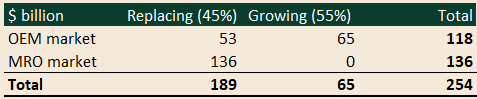
The full MRO market is not HEICO’s addressable market. It includes labor, line maintenance, heavy airframe checks, complete engine shop visits, life-limited parts, modifications, logistics, and many other products and services FSG does not provide.
Engine and component MRO represented approximately 68% of global MRO spending in 2024, according to IATA and Oliver Wyman, but even this figure is far too broad. HEICO does not overhaul complete engines, manufacture most life-limited parts, or participate in every component category. FSG addresses selected replacement parts, component repairs, distribution, and specialized manufacturing within the wider ecosystem.
The market can therefore be viewed as a series of progressively narrower layers:
Global commercial MRO spending
Maintenance material, components, and replacement parts
Categories addressed by HEICO through parts, repair, and distribution
Approved alternative material
Independently developed PMA parts
PMA is only the final and narrowest layer. FSG’s practical addressable market is broader because it also earns revenue from proprietary repairs, distributed OEM and third-party parts, component exchange, and specialty products.
No exact industry figure exists for annual PMA market value. Commercial research estimates currently differ by more than fourfold: one places the global commercial-aircraft PMA market at approximately $2.6 billion in 2025 and $2.8 billion in 2026, while another estimates $11.8 billion in 2025. The studies are evidently measuring different scopes.
Some estimates appear to focus on factory-new, independently developed commercial-airline PMA parts. Others may include licensed PMAs, general and business aviation, military applications, PMA content embedded in larger repairs or components, and other forms of alternative material.
A PMA issued under a licensing agreement may use the authorization and design data of the original type-certificate holder. Economically, this differs fundamentally from HEICO independently developing a lower-cost competitor, yet both appear in FAA PMA records.
Raw approval counts therefore do not measure the independent alternative-parts market, and approvals differ greatly in commercial value. One may cover a low-priced part used on a small or aging fleet; another may relate to an expensive, frequently replaced component installed across thousands of aircraft.
A rough comparison with TransDigm illustrates the difference. TransDigm’s portfolio is estimated at more than 300,000 parts—roughly 15 times HEICO’s approximately 20,000—yet its commercial aftermarket parts business generates only somewhat more than $2.8 billion of aftermarket revenue, versus an estimated roughly $2 billion for HEICO including HDG. Although necessarily approximate, the comparison suggests that HEICO generates substantially more revenue per portfolio item on average.
This also helps explain why the companies compete less directly than their aftermarket exposure suggests. Much of TransDigm’s portfolio consists of low-volume or low-revenue parts for which PMA development and certification would offer limited returns. Airlines likewise have little reason to qualify a second source when potential savings are small. HEICO concentrates development on products where installed volume, replacement frequency, and OEM pricing create an attractive opportunity.
For these reasons, I would not anchor the investment case to a precise PMA market estimate. The evidence supports a multi-billion-dollar market growing faster than the commercial fleet, but published figures are too inconsistent to justify one definitive total addressable market.
HEICO’s market position:
HEICO calls HPG the world’s largest independent supplier of FAA-approved engine and aircraft-component replacement parts. Its portfolio contains more than 20,000 FAA-approved products, and the group develops more than 500 additional highly engineered parts annually.
Dividing an estimated $2.0 billion of aftermarket revenue by any published PMA market estimate would be misleading. The $2.6 billion estimate implies a share approaching three-quarters—a figure often cited by investors—while the $11.8 billion estimate implies roughly one-sixth.
Management’s comments provide a more useful view of market structure. Victor Mendelson has described PMA as only a very small part of the broader replacement-parts market:
“PMA parts constitute somewhere around 1%-2%, we believe, of the market, so it’s tiny.” — Victor H. Mendelson, Gabelli Funds 30th Annual Aerospace & Defense Symposium, September 2024
Because the denominator was not formally defined, the 1–2% figure should be treated as a broad management estimate rather than a measured statistic. The message matters more than the precise percentage: OEM parts continue to dominate the commercial aerospace aftermarket.
Three market-share concepts must therefore be kept separate:
First, PMA’s share of the entire replacement-parts market remains in the low single digits according to HEICO management, leaving the overwhelming majority with OEMs.
Second, HEICO is clearly the leading independent PMA supplier, but no reliable public dataset allows its share of that market to be calculated.
Third, HEICO’s share of an individual part market after introducing an approved alternative is a separate concept. Management has historically targeted an attractive minority rather than complete OEM displacement.
HEICO’s approximately 20,000 approved part numbers might appear to cover roughly 3–4% of the parts installed on a modern aircraft, but this is only a rough indication and not a reliable measure of penetration. HEICO’s approvals span many aircraft, engine, and component platforms, whereas aircraft part-count estimates include every physical item, many of which have no PMA relevance. One HEICO part number may be installed several times on an aircraft or approved for multiple platforms, while only a fraction of the portfolio applies to any one aircraft type. The percentage therefore illustrates the enormous remaining product universe rather than HEICO’s share of the economically addressable aftermarket.
8.7. The remaining growth runway
HEICO already sells to virtually every major airline and has built the dominant independent PMA platform, which can make FSG appear mature. Its remaining runway differs from that of a young company still seeking its first customers.
Growth should come primarily from selling more to existing customers, adding products to the catalog, entering adjacent technical categories, and making the combined HEICO-Wencor platform more useful across customer maintenance activities.
The first opportunity is product breadth. A modern aircraft contains an enormous number of components, while HEICO’s catalog remains selective. Even after decades of development and acquisitions, the company addresses only a fraction of the aftermarket. It can continue expanding into structures, avionics, interiors, and other component categories where customer demand and expected returns justify the investment.
“But again, we just continue to broaden the capabilities. Ten years ago, nobody would have ever thought that HEICO would control the Aircraft Information Management System of the 737NG or the 777. And we couple that with our 20,000 PMAs and whatever it is, nearly 10,000 DERs, and it’s a pretty broad offering, which just continues to grow step by step every quarter.” — Eric A. Mendelson, Q1 2025 earnings call
The second opportunity is penetration. An airline may already be a HEICO customer while buying only a small share of the products available for its fleet. Adding one approved part across a large installed base can create meaningful recurring revenue without winning a new customer.
The sales organization is therefore critical. Product development creates the opportunity, but airline approvals and purchasing decisions convert it into revenue. Sales teams must understand each customer’s fleet, maintenance program, contracts, and technical concerns. A broad catalog gives them many reasons to continue the conversation.
The third opportunity is fleet age. New aircraft typically generate little PMA revenue during their first years because OEM support is strongest, maintenance needs are lower, and contractual restrictions are more common. The addressable opportunity expands as platforms mature and operators focus more closely on maintenance economics.
The aircraft shortage extends the lives of older platforms. Delayed deliveries force airlines to retain aircraft that might otherwise retire, higher utilization accelerates wear, and supply constraints increase the value of a second source. These dynamics support both parts and repair demand.
The fourth opportunity is international adoption. HEICO already operates globally, but acceptance still varies by airline, region, ownership model, and product category. Historically lower penetration outside established markets leaves additional room for growth:
“Historically, we had less penetration in the international markets. So we saw that there was a bigger opportunity for us there and we’re continuing to mine that opportunity” — Eric A. Mendelson, Q3 2010 earnings call
Adoption is closely linked to fleet maturity. Airlines receiving many new aircraft generally receive greater OEM attention, face lower maintenance requirements, and initially need fewer alternatives. As deliveries slow relative to the installed fleet and maintenance costs rise, PMA’s economic value becomes clearer.
Eric Mendelson described how this pattern repeatedly turned initial resistance into substantial customer relationships across all major regions:
“What we found with PMA acceptance is directly correlated to the sort of the age of the airline, the age in sophistication. When airlines are taking a lot of deliveries of new equipment, they get a lot of attention from the OEMs and they don’t really see the need or the value proposition in the beginning. And then of course as those deliveries as a percentage of the fleet go down, they sort of get less attention and they realize that these machines are extraordinarily expensive to maintain. And that’s where we get in there and we’re able to show our value. So, I history over the last 30 years that’s absolutely been the case. I mean, without mentioning names, but I can tell you that airlines in all regions of the world, whether it’s North America, South America, Europe, Asia, where in the beginning they were refusing and not interested in using PMA parts. And then as time went on, we go in and show why this makes sense and they become very good customers.” — Eric A. Mendelson, Q2 2019 earnings call
International expansion is therefore less about entering entirely new regions than gradually deepening penetration as individual airlines become more receptive. Once an operator understands the approval process, recognizes the savings, and gains positive operating experience, a cautious initial relationship can become a meaningful recurring source of demand.
Emerging markets offer additional long-term potential:
“The majority of our business comes out of the Americas and Europe, and we expect that to continue for, you know, quite some time. We are picking up a nice chunk of business in the emerging markets as well. There’s a lot of interest in our products, and I anticipate further growth there.” — Eric A. Mendelson, Q4 2018 earnings call
The fifth opportunity is availability. Supply-chain problems have pushed customers to qualify alternatives they might otherwise have postponed. An airline unable to obtain an OEM part may undertake the internal work required to approve HEICO; successful use can turn an emergency purchase into a recurring relationship.
Wencor adds another layer to each opportunity by increasing the products, repair capabilities, distribution lines, customer relationships, and engineering categories available to the combined group. HEICO can grow before developing anything new simply by placing existing Wencor products with HEICO customers and vice versa.
Execution still constrains the runway. HEICO cannot develop every product at once; engineering and regulatory capacity is finite, airlines approve alternatives gradually, and inventory must be built before demand is certain. The company must continue selecting opportunities that earn acceptable returns rather than pursuing catalog size for its own sake.
OEM behavior is another constraint. HEICO has benefited from rational competition and its small share of the overall aftermarket. An OEM can selectively reduce prices, use contractual leverage, or make a particular product less attractive to copy. HEICO must continue choosing its battles carefully.
Taken together, these drivers should allow the relevant commercial aftermarket to grow at a mid-single-digit rate. Fleet expansion increases the installed base, while higher utilization, aging, and rising maintenance requirements increase spending per aircraft. PMA should grow somewhat faster as airlines seek lower-cost, more available alternatives, supporting approximately 6–8% annual growth in HEICO’s addressable aftermarket opportunity. Continued product introductions, broader adoption, and market-share gains may allow HEICO to grow organically around 8–10% over a full cycle, broadly consistent with history. This is a directional framework rather than a precise forecast because the drivers overlap and annual performance will fluctuate.
2.8. Growth and economics
FSG’s long-term development shows how far HEICO has moved beyond its original engine-parts business. Quarterly revenue was below $10 million in the mid-1990s; three decades later, it is approaching $1 billion.
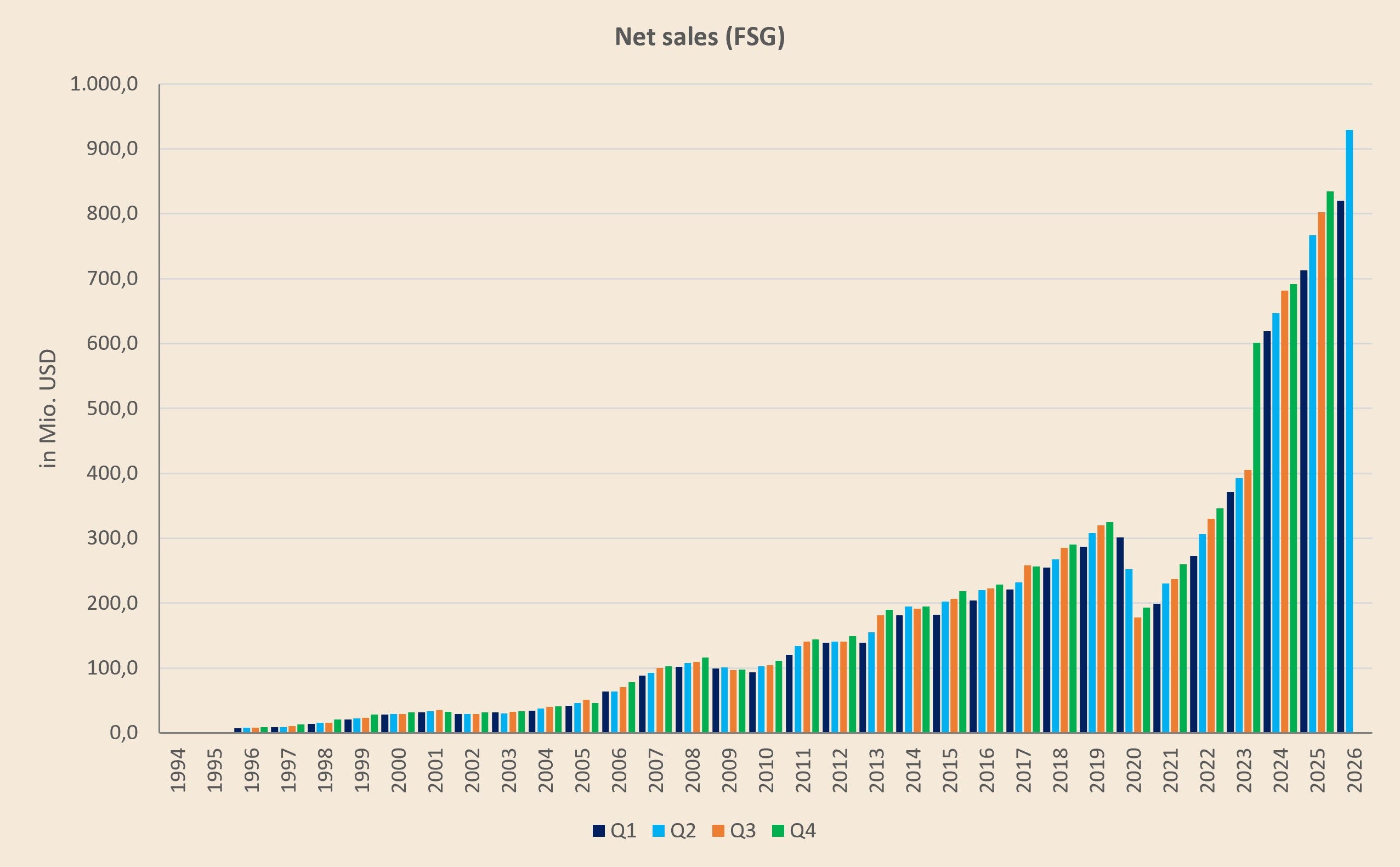
The path was not linear. FSG experienced weaker periods after 9/11, during the Global Financial Crisis, and in the collapse of commercial aviation during COVID-19. Each downturn was followed by renewed growth, with the revenue base eventually moving well beyond its previous peak.
The COVID-19 impact is especially visible. Flight activity collapsed, causing revenue to fall sharply over the following three quarters, with the trough extending into early fiscal 2021. As utilization recovered, so did demand for replacement parts and component repairs. By fiscal 2022, quarterly revenue had exceeded its pre-pandemic level.
The next major step change came in the fourth quarter of fiscal 2023, when HEICO began consolidating Wencor. Quarterly FSG revenue rose from approximately $405 million to around $600 million. This was primarily an acquisition-driven expansion rather than a sudden acceleration in legacy operations. Wencor added a large PMA catalog, repair capabilities, and a substantial distribution platform, permanently raising FSG’s scale.
Revenue mix:
Since fiscal 2018, HEICO has disclosed quarterly FSG revenue in three product categories, making changes in segment composition more visible.
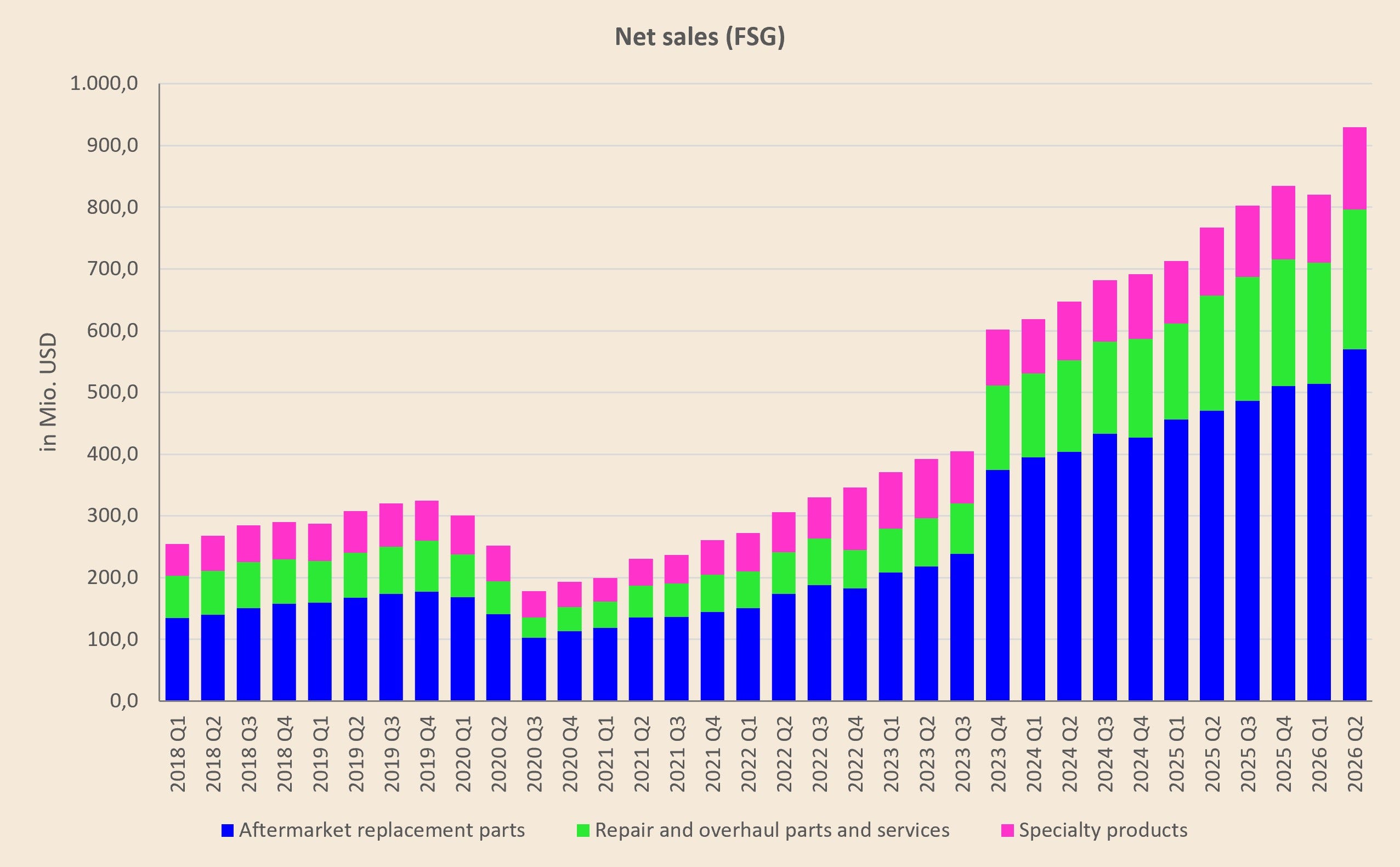
The reported categories do not correspond exactly to FSG’s four organizational groups, but the following simplified mapping is useful:
Aftermarket replacement parts broadly include PMA products developed by HPG and comparable Wencor activities, together with OEM and third-party replacement parts sold through HDG and Wencor distribution.
Repair and overhaul parts and services broadly correspond to HRG and Wencor’s component-MRO activities, including replacement parts consumed during repairs and overhauls.
Specialty products largely reflect SPG.
The mapping is only approximate. Distribution is not disclosed separately, Wencor spans several activities, and products developed by one group may be sold or consumed through another. HEICO reports by product and service category rather than internal organizational unit.
Aftermarket replacement parts have consistently been the largest and fastest-growing category, recently contributing around 61% of FSG revenue. Repair and overhaul account for approximately 24%, with specialty products representing the remaining mid-teens percentage. Replacement parts remain FSG’s financial center.
COVID-19 affected all three categories, although not equally. Lower utilization most directly reduced replacement-parts and component-repair demand. Specialty products were somewhat less dependent on airline activity because they also serve original-equipment, defense, and space customers. Recovery spread across the portfolio as aircraft returned to service and supply constraints increased the value of alternatives and independent repair capacity.
Organic growth and acquisitions:
The following chart separates revenue growth into its components.
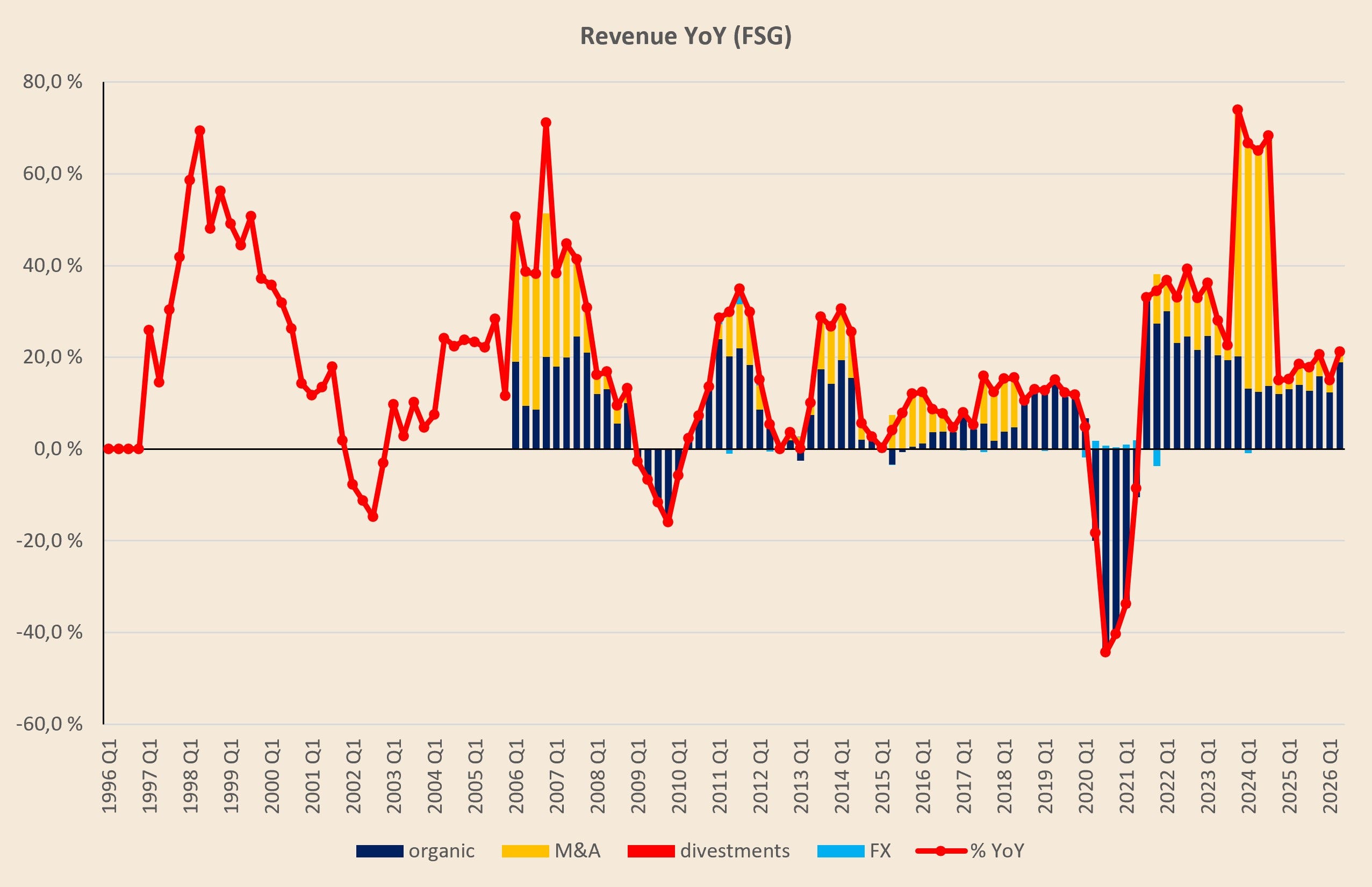
The organic-growth series confirms strong underlying expansion, recently supported by record demand. Drivers include higher utilization, fleet aging, new PMA and DER-approved repairs, broader customer adoption, greater use within existing fleets, increased repair activity, and the gradual ramp of earlier product cohorts. Distribution can also grow organically through new product lines, deeper relationships, and more inventory to support demand.
Organic growth was strong before the Global Financial Crisis, turned negative during the aviation downturn, and then recovered. COVID-19 produced a far more extreme cycle: quarterly organic growth fell by approximately 45% as flight activity collapsed before rebounding above 30% during the recovery.
These swings distort a simple average. Based on the quarterly series, arithmetic average organic growth from fiscal 2006 through the second quarter of fiscal 2026 was approximately 8%. The median was higher at roughly 11%, because a small number of exceptionally weak COVID-19 quarters pulled down the mean.
Excluding the acute decline and unusually strong reopening comparison—from approximately the second quarter of fiscal 2020 through the second quarter of fiscal 2022—the average was close to 10%, with a median of roughly 11–12%. A reasonable cycle-normalized interpretation is therefore that FSG has historically generated organic growth of approximately 10%, or low double digits, over time.
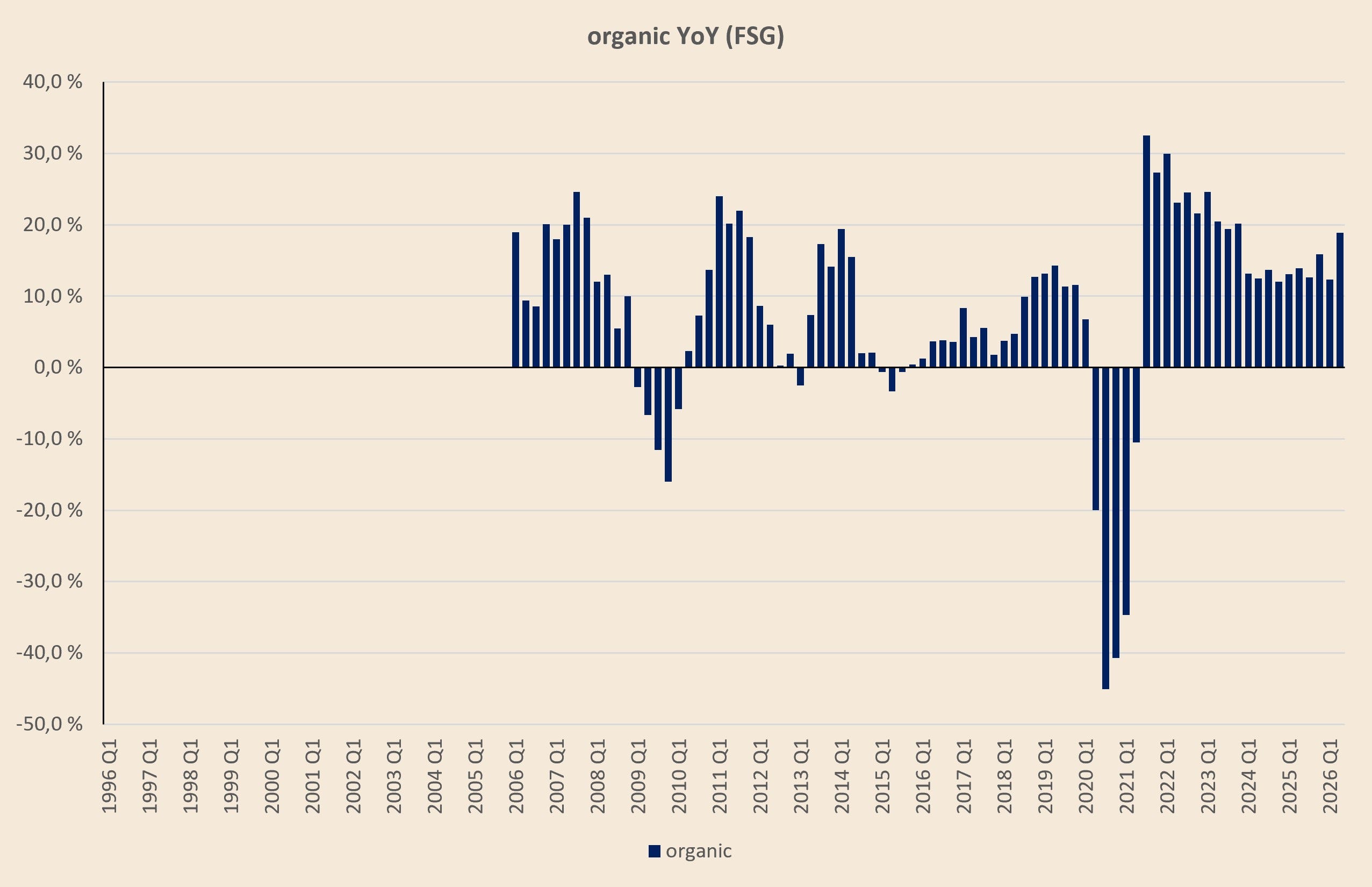
M&A contributions have always been lumpy. Some periods show almost no acquired growth, while individual transactions create large temporary increases. This is consistent with HEICO’s discipline: management does not transact on a fixed schedule and walks away when price, business quality, or the leadership team fails to meet its requirements.
Clusters of higher acquired growth reflect distinct waves. Transactions completed from 2006 to 2008 made a meaningful contribution, followed by further additions during the 2010s. The contribution increased again from fiscal 2022 and reached a different scale with Wencor in fiscal 2024.
A large acquisition contributes to reported year-over-year growth for four quarters and then disappears mechanically from the bridge, even though its revenue remains permanently within the segment.
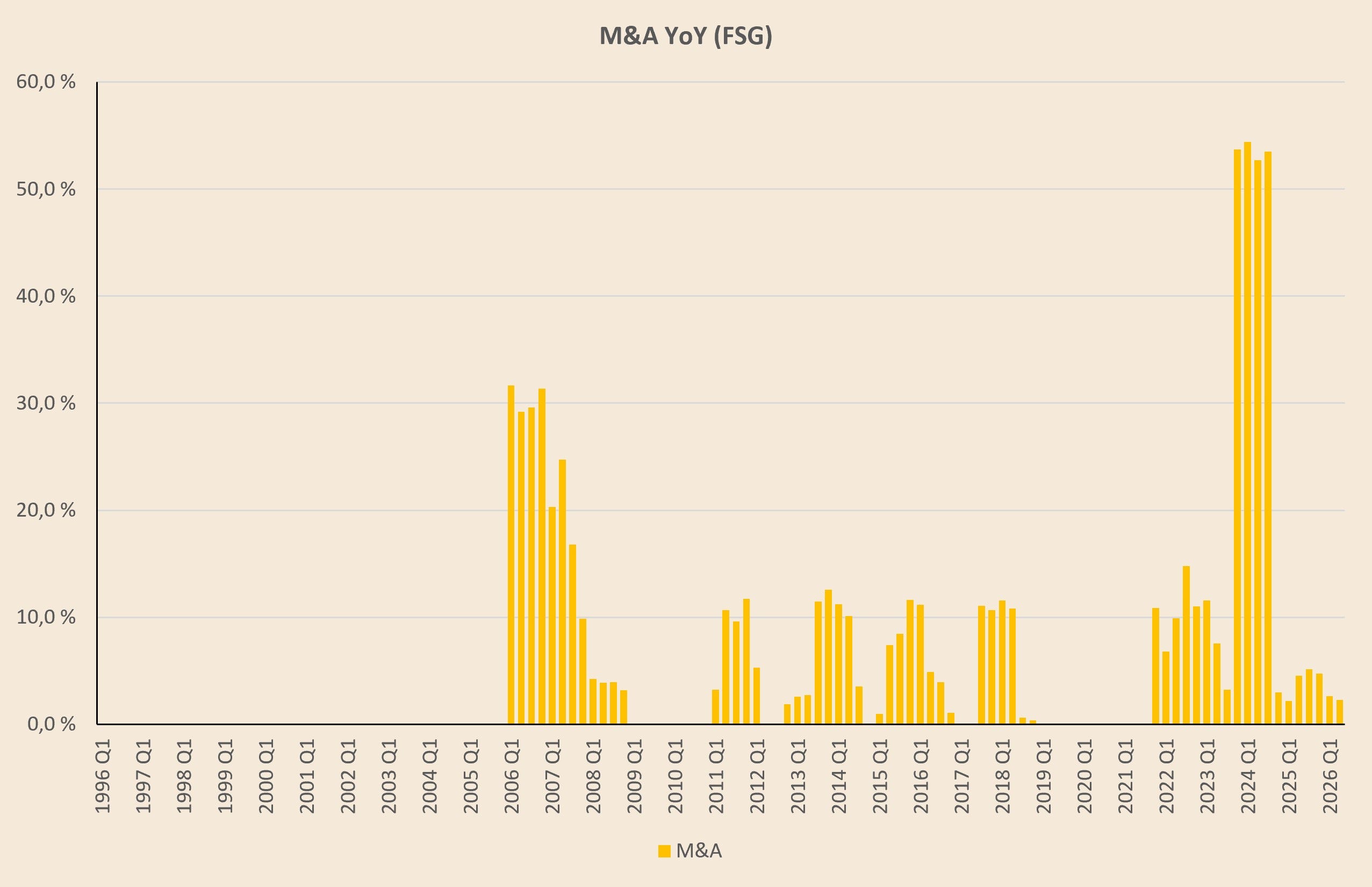
Margin development:
Growth has been accompanied by attractive profitability. The exceptionally high late-1990s margins are not a useful baseline for today’s FSG because the business was still small and concentrated in a limited number of engine PMAs. Until 2001, HEICO’s PMA activities were entirely engine-focused; it then deliberately broadened the portfolio.
The subsequent normalization should not be attributed primarily to the move from engine to non-engine PMAs, whose profitability management describes as broadly comparable. The more important shift was FSG’s expansion beyond proprietary replacement parts into component repair, specialty manufacturing, and, more meaningfully after the 2005 Seal Dynamics acquisition, distribution.
Distribution has a different economic profile from proprietary PMA manufacturing. It can add substantial revenue because the distributor records the full value of products sold, but margins are generally lower because the manufacturer retains part of the economics.
The decline from the unusually high margins of the late 1990s therefore reflects a broader change in business mix rather than deterioration in HEICO’s core PMA economics.
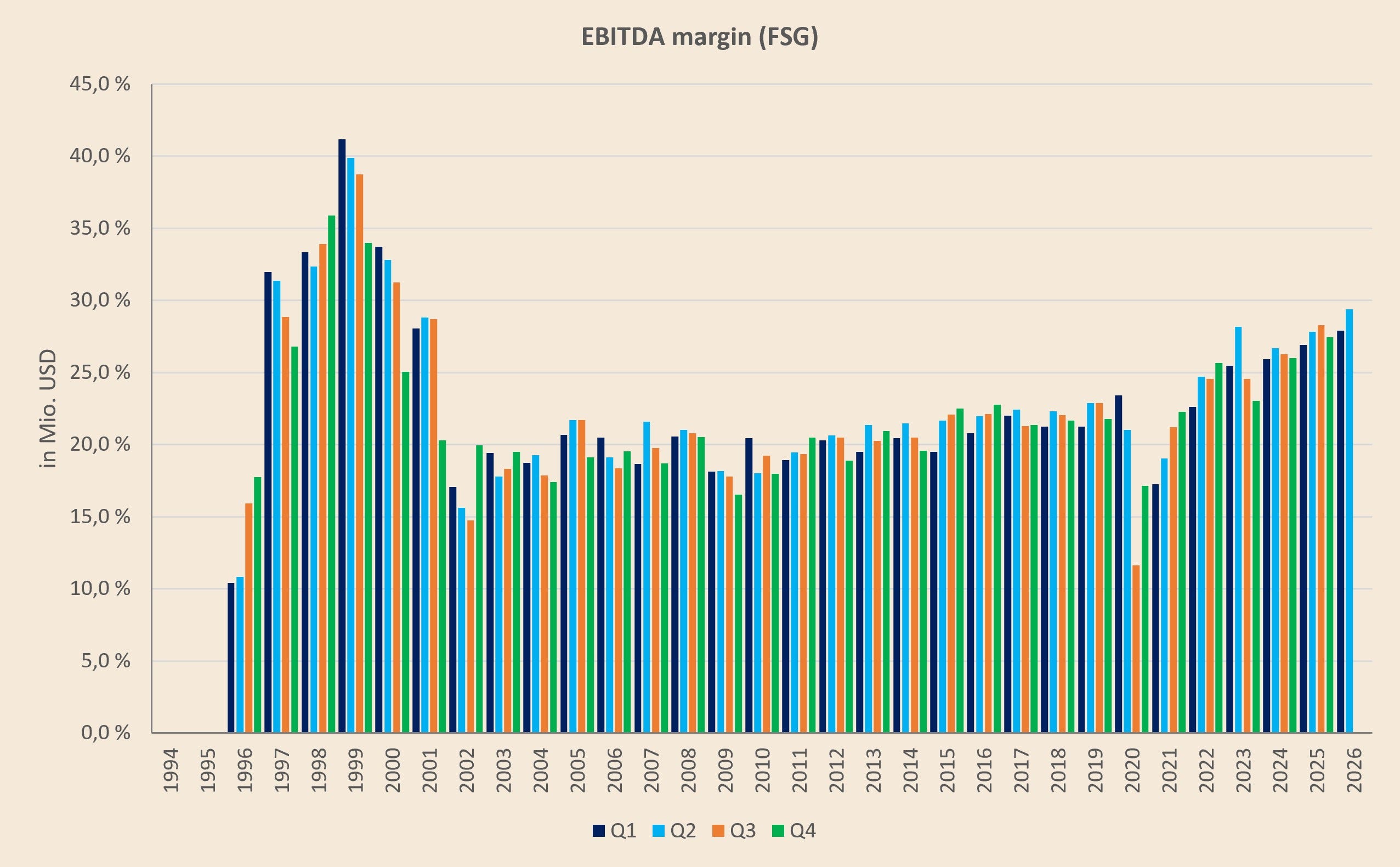
For much of 2002–2020, FSG’s quarterly EBITDA margin remained in the high teens to low twenties, roughly 17–23%. This is attractive for a business that manufactures physical products, operates repair facilities, carries substantial inventory, and includes lower-margin distribution. The margin reflects the value FSG creates: PMA parts can be sold at substantial discounts to OEM products while still generating attractive profitability.
Business mix nevertheless matters. Proprietary PMA parts generally carry stronger economics than third-party distribution, while repair and specialty-product margins depend on quarterly work and product mix. Changes in relative contribution can therefore move segment margins even when each operation performs well.
The recent 29.4% record should not automatically be treated as a permanent baseline. Quarterly margins fluctuate with product mix, customer demand, acquisition integration, and the relative contribution of PMA, repair, distribution, and specialty products. The current aviation environment is also unusually favorable, with high utilization, limited aircraft availability, and persistent supply-chain constraints.
Part 3 explained how HEICO turned the aircraft aftermarket into the crown jewel of its business. The question now is how the company extended that model beyond replacement parts—and how ETG, decentralization, and a disciplined acquisition playbook became the second engine of the compounding machine. That is exactly what we will unpack in Part 4.