
HEICO Deep Dive (Part 4): The Second Engine and the HEICO Operating System
How ETG, decentralized ownership, and a disciplined acquisition playbook extend the compounding model far beyond aircraft parts.

In 5 articles, you’ll get a deep dive of HEICO Corp. (186 pages).
It will be structured in five Parts:
Part 2: Why the Aircraft Aftermarket Creates a Structural Opportunity
Part 4 (today): The Second Engine and the HEICO Operating System
Part 5: The Economics Behind the Compounding Machine
All parts are now available in one PDF. You can download it below.
👔 Company Name: HEICO Corporation (“HEICO”)
🔎 ISIN: US4228061093 (Common Stock) and US4228062083 (Class A)
🔧 Business model: Aerospace and electronics serial acquirer
🌍 Geographic exposure: global (~62% U.S. and ~38% international sales across approximately 130 countries)
📈 Stock Price: HEI Common Stock: $339 | HEI.A Class A Common Stock: $253
💰 Market Capitalization: ~$40 billion
👨💼 Number of CEOs since foundation: 2 (one transition — Laurans Mendelson to Eric and Victor Mendelson)
since 1990
👨👩👦 Founder-/Owner-operator: Yes — owner-operated by the Mendelson family
📅 CEO tenure: Since 1990
🥇 Insider ownership: ~21.0% of shares
📊 10Y EPS CAGR: ~16%
🔁 Reinvestment profile: High
💸 Capital intensity: Low — capex-light, but inventory-intensive
🏰 Moat: Regulatory approvals, customer trust, installed-base scale, price and availability, culture
🧨 Main risks: Valuation, acquisition execution, aviation cyclicality, OEM countermeasures
🌳 Slow Compounding fit: Yes – high-quality (niche) serial acquirer
Business Model in a Nutshell: HEICO is a decentralized aerospace and electronics serial acquirer. Its Flight Support Group provides lower-cost aircraft parts, repairs, and distribution services, while its Electronic Technologies Group supplies highly engineered components for aerospace, defense, space, medical, and other demanding markets. Growth comes from new product development, market-share gains, and disciplined acquisitions of niche businesses that retain significant operational autonomy.
9. Electronic Technologies Group (ETG): The Second Engine
ETG receives far less attention than FSG. Flight Support has an intuitive proposition and identifiable competitors: HEICO develops approved alternatives to expensive OEM parts. ETG is harder to summarize because it owns dozens of specialized businesses selling electronic, microwave, electro-optical, and power-related products into aerospace, defense, space, medical, and other high-reliability markets.
The variety can make ETG appear to be a collection of unrelated industrial assets. A laser-rangefinder receiver seems to have little in common with an underwater locator beacon, satellite power converter, cockpit display, or high-voltage connector used in a CT scanner. The common thread is the function these products perform and the environments in which they operate. They are generally small, highly engineered components embedded in much larger systems, where reliable performance matters far more than the cost of the individual part.
ETG is less visible than FSG but far from secondary. In fiscal 2025, it generated $1.41 billion of revenue and $325 million of operating income, for a 23.0% margin. The segment contributed approximately 30% of consolidated revenue and roughly 30% of segment operating income before corporate costs.
Its importance extends beyond reported numbers. ETG exposes HEICO to defense, space, and other markets that do not depend directly on commercial flying, generates cash that can be redeployed across the group, expands the acquisition universe, and provides technical and manufacturing capabilities that may support Flight Support companies.
Victor Mendelson has led ETG since its establishment in 1996. While FSG grew from HEICO’s original aerospace-parts business, ETG was deliberately assembled as a second platform through acquisitions and subsequent product development. It applies the same broad philosophy—niche products, demanding applications, high margins, and strong cash flow—to markets where the advantage does not depend on PMA.
9.1. A broad portfolio with a common economic logic
HEICO describes ETG’s strategy as designing and manufacturing highly engineered, mission-critical subcomponents for small niche markets. These products often operate under severe heat, vibration, radiation, pressure, or electromagnetic conditions and are integrated into much larger systems used for power, targeting, tracking, identification, testing, communication, medical imaging, and other essential functions.
The portfolio can be grouped broadly into data and microwave technologies, electrical products, and electro-optical systems. The categories overlap but provide a more useful framework than cataloging every subsidiary and product.
Data and microwave products include radio-frequency amplifiers, transmitters, receivers, filters, switches, antennas, electronic-intercept equipment, memory modules, and other components that transmit, receive, process, or store information. They are used in satellites, spacecraft, aircraft, unmanned aerial systems, electronic-warfare equipment, and communications platforms.
A microwave switch or amplifier may represent only a small fraction of a satellite’s value, but failure can compromise communication or the entire mission. The asymmetry is especially pronounced in space, where a defective component cannot simply be removed after launch. Established designs, extensive testing, and a proven supplier record therefore carry substantial value.
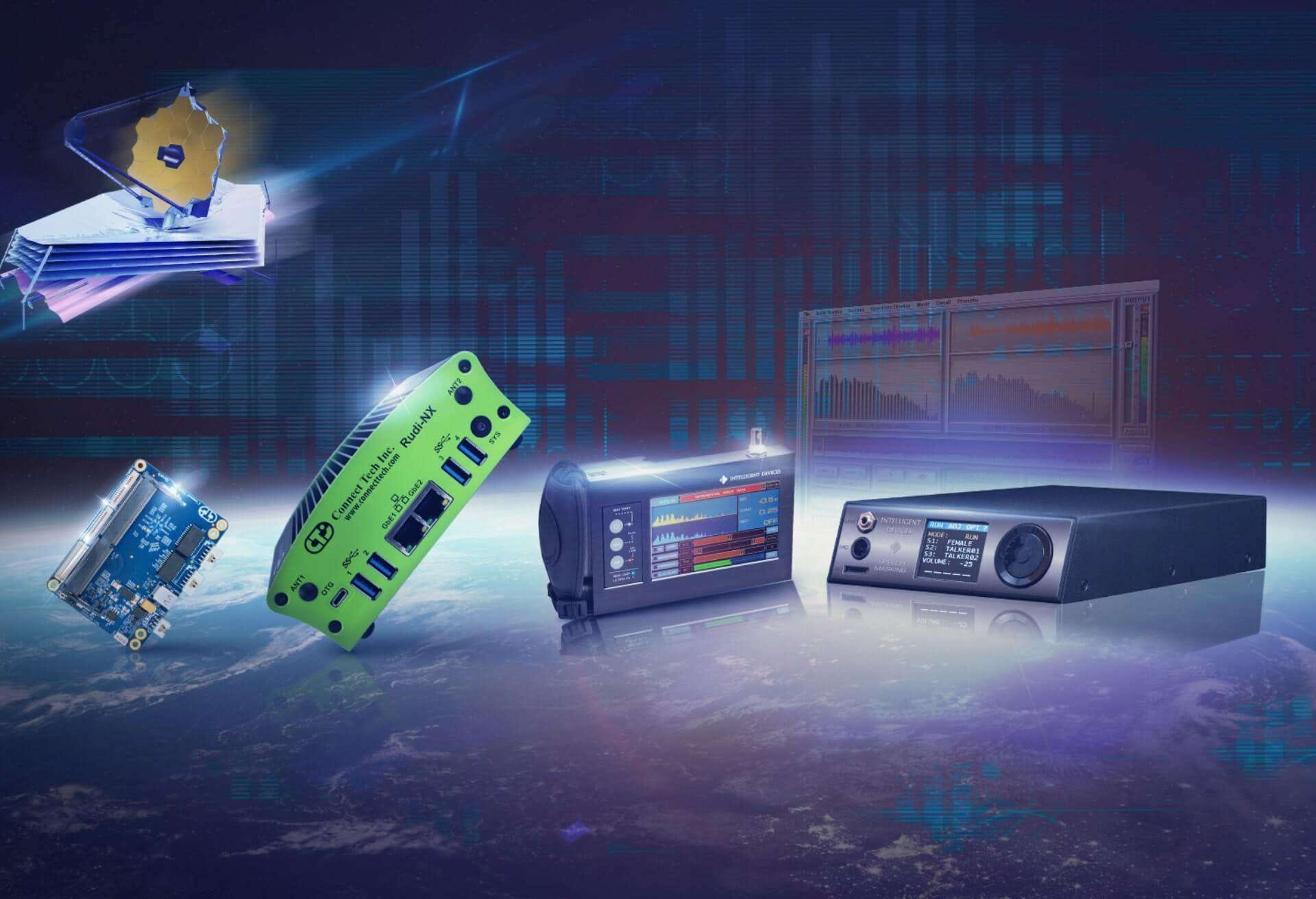
Electrical products include power supplies and converters, high-voltage connectors, cable assemblies, circuit protection, power-distribution systems, backup batteries, harsh-environment connectors, and fuel-system products. ETG companies supply satellite and military-avionics power converters, backup power for cockpit voice recorders and emergency aircraft systems, and high-voltage components for medical imaging and industrial equipment.
The end user rarely notices these products. A passenger never sees the backup power supply keeping a flight recorder active, and a patient never notices the high-voltage connection inside a CT scanner. Yet the larger system may fail if that component does not work.
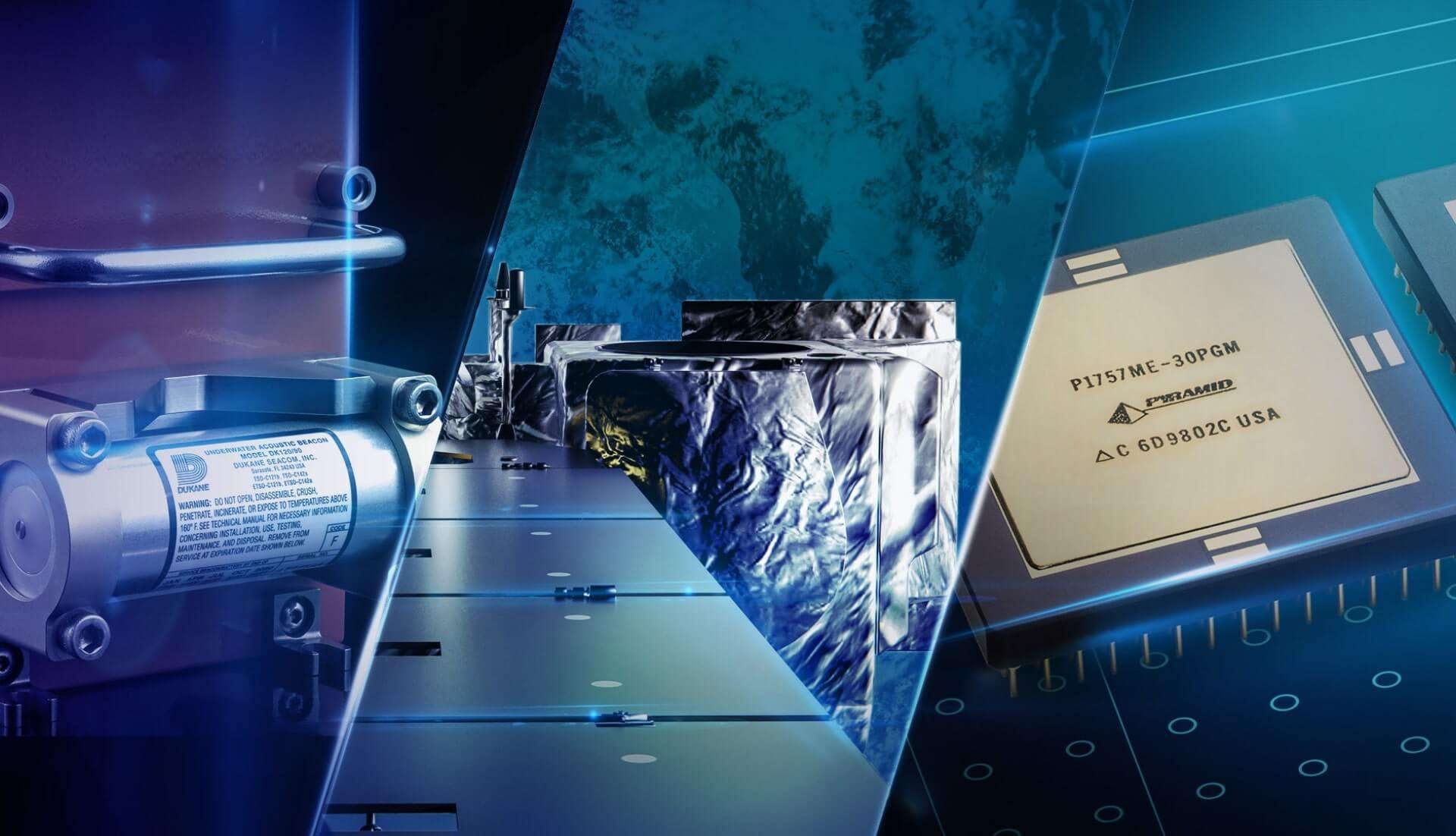
Electro-optical products convert, detect, simulate, or process light and infrared signals. ETG manufactures laser-rangefinder receivers, photodetectors, infrared test systems, and related products used in targeting, reconnaissance, missile testing, medical lasers, and other applications. Infrared simulation equipment allows customers to test missile seekers and sensor systems in a controlled environment rather than repeatedly conducting expensive live-fire tests.
A laser rangefinder illustrates ETG’s role. A targeting system emits a pulse toward an object; the receiver detects the reflected light, allowing the wider system to calculate distance and confirm targeting accuracy. The receiver is only one component inside a much larger weapons or observation system, but its performance is essential.
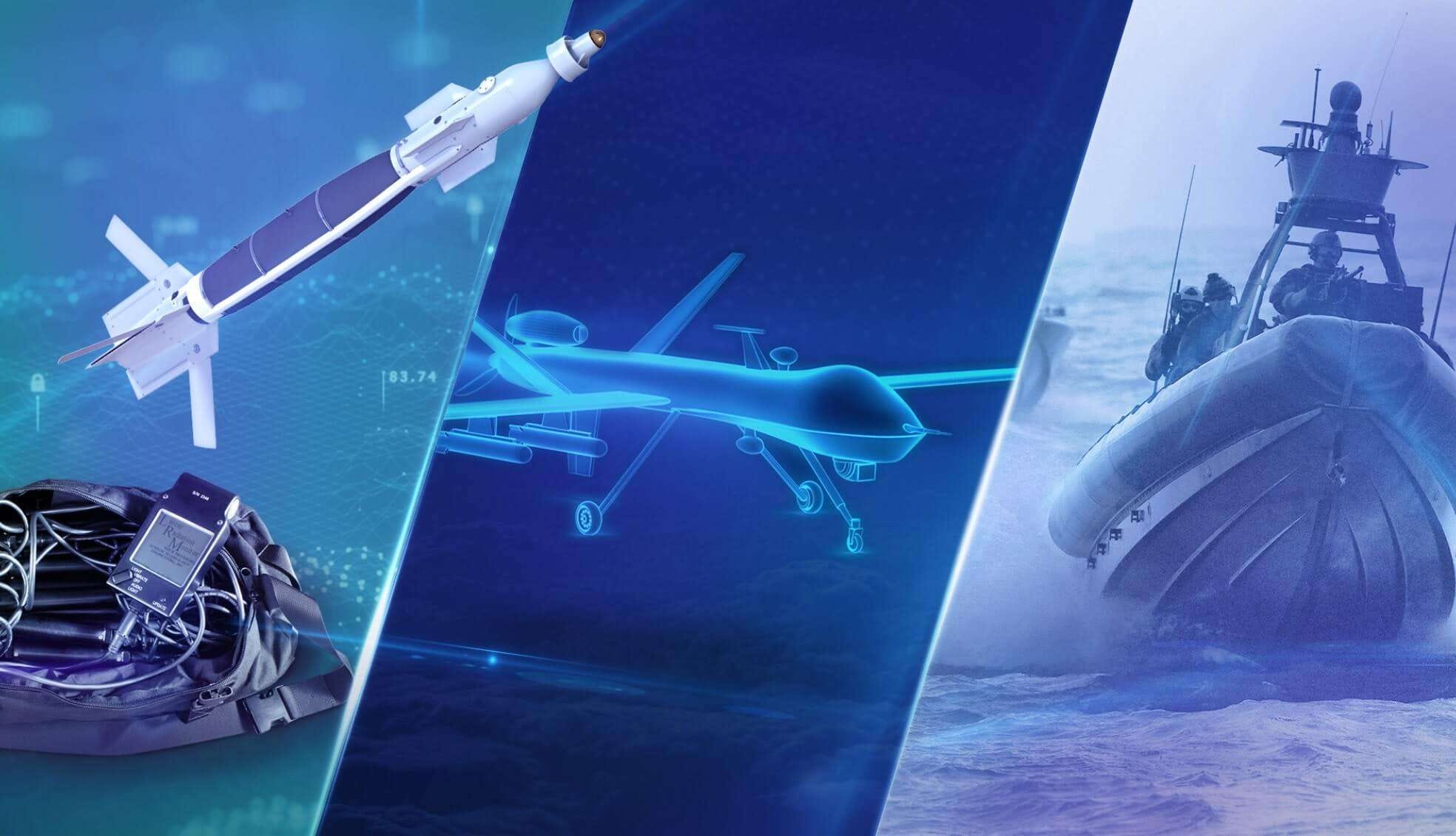
HEICO describes ETG as “making the things that make things work.” The shorthand is apt. ETG does not generally manufacture an entire satellite, missile, aircraft, scanner, or communications system; it supplies selected components that enable those platforms to perform critical functions.
This positioning creates attractive economics. The component usually represents a small share of the customer’s total bill of materials, while failure or redesign can be costly. A defense prime contractor has little reason to save a small amount on a connector, converter, or microwave component if switching requires additional engineering, testing, qualification, and documentation.
The supplier’s position becomes particularly durable once the component is designed into the larger system. During development of an aircraft, satellite, missile, or medical device, the customer selects parts meeting defined requirements. The supplier provides samples, engineering support, test data, and production documentation. Once the design and larger platform are qualified, replacing the component may require part of that work to be repeated.
The switching cost therefore sits primarily in the surrounding system rather than in the physical difficulty of copying the part. A capable competitor may be able to manufacture a similar connector or power supply; the more important question is whether the customer wants to redesign, retest, and requalify a complex platform to save a relatively small amount on one subcomponent.
This is especially relevant in defense and space, where programs may remain active for decades. Once a HEICO component is incorporated and performs reliably, the company can supply it through production and, in some cases, the aftermarket. Unlike PMA, ETG can participate from the beginning of the platform lifecycle rather than waiting for an aircraft to mature.
Products also tend to be manufactured in relatively small volumes. A large defense prime may possess the engineering capability to produce many internally, but doing so across thousands of specialized part numbers would consume resources better used on the higher-level system. ETG occupies a layer in which individual products are too small to attract broad attention but collectively generate attractive revenue, margins, and cash flow.
Portfolio breadth is deliberate. Demand for a specific satellite component, medical device, or defense program may fluctuate, but ETG spans numerous products, platforms, and customers. Its resilience comes from owning many small positions inside long-lived systems.
Organic product development remains important even though ETG was largely assembled through acquisitions and is more sector-agnostic than FSG. Existing businesses must adapt products to new platforms, improve performance, and develop adjacent technologies. HEICO has historically reinvested a portion of revenue in new products across both operating groups:
“Significant ongoing new product development efforts are continuing at both Flight Support and ETG as we continue to invest between 3% 4% of each sales dollar into new product development in order to support our future growth strategies.” — Laurans A. Mendelson, Q3 2014 earnings call
An acquisition provides the initial technical capability, customer relationships, and portfolio; continued development allows the business to expand after the transaction.
ETG’s competitive position therefore rests on reinforcing elements: specialized engineering, product qualification, long platform lives, proprietary technology and processes, small but critical components, demanding operating environments, and customer reluctance to introduce unnecessary risk into a functioning system.
9.2. Defense and space
Defense and space form ETG’s core. In fiscal 2025, they generated approximately $717 million, or just over half of segment revenue. Aerospace contributed another $276 million, while approximately $421 million came primarily from medical and other electronic markets. HEICO also reports that roughly 51% of ETG revenue derived from military agencies, defense prime contractors, and commercial or defense satellite and spacecraft manufacturers.
The categories overlap substantially. An airborne antenna may be classified as aerospace but installed on a military aircraft; a microwave component may serve a commercial satellite or electronic-warfare system; and a high-voltage power supply can be used in both medical and defense imaging. ETG technologies often cross markets because reliability and performance requirements are similar.
Within defense, HEICO deliberately concentrates on technologically intensive applications rather than businesses tied primarily to troop deployments or the daily operating tempo of a military campaign.
Victor Mendelson described the focus in 2022:
“About defense. I’m also optimistic about our defense businesses. Long term, the world is not going to be a safer place, unfortunately, and that’s just a sad reality. Free people like we are in this country need to defend ourselves, and we need to help our allies defend themselves. The things that we do at HEICO generally focus on higher technology, defense products and systems, things like electronic warfare detection, threat detection, reconnaissance, surveillance and standoff warfare, as opposed to, let’s say, the operations tempo, the proverbial boots on the ground. And we think that that will continue to be important as we see some of these major nation state threats in addition to the terrorist threats that we were dealing with not long ago.” — Victor H. Mendelson, Fernway Insights interview, 2022
Electronic warfare involves detecting, disrupting, or protecting against electromagnetic signals. Reconnaissance and surveillance systems collect information from sensors, aircraft, satellites, or unmanned platforms. Standoff warfare allows targets to be detected or engaged from a distance rather than moving personnel directly into the threat area. These applications rely heavily on sensors, antennas, microwave systems, power electronics, computing, and communications—the types of components ETG produces.
HEICO therefore participates in defense spending without manufacturing the largest visible platforms. It need not win the contract for an entire missile, aircraft, or satellite; its companies supply selected components to government laboratories, OEMs, and prime contractors building those systems.
This position can create long revenue tails. Defense programs often require years of development before production, followed by many years of deliveries, upgrades, spares, and sustainment. Once qualified, a component supplier may remain associated with the platform as long as performance, quality, and delivery remain acceptable.
Low component cost relative to the total system reduces the incentive to switch. A prime contractor might replace a HEICO product to capture additional margin, but potential savings may be immaterial beside the cost of redesign, documentation, testing, and the technical and schedule risk of replacing a proven supplier.
Defense-contract structures may further reduce pressure to squeeze every subcomponent. Early development contracts can reimburse part of the contractor’s costs, while later production contracts often become more fixed. By the time cost incentives strengthen, components are already embedded in a qualified system. Re-engineering the platform to save a small amount on one part may offer an unattractive risk-adjusted return.
HEICO also benefits from a fragmented defense supply chain. Large platforms rely on thousands of specialist suppliers, many small and founder-led. These businesses may possess valuable intellectual property and long customer relationships but lack the scale, capital, or succession plan to remain independent indefinitely, creating a continuing acquisition universe for ETG.
The current defense environment provides an additional tailwind. Governments have increased procurement, expanded certain priorities, and sought to replenish equipment and munitions consumed or transferred in recent conflicts. This demand reaches ETG through the order books of prime contractors and platform manufacturers.
Management was seeing this directly by the second quarter of fiscal 2026:
“In defense, our country and its allies have recognized the need to invest more in defense and to replace depleted stocks. We are now experiencing this in our defense sales, in our defense orders, and in our defense backlog. We expect this to continue and to have a multi-year tail for which we are very well-prepared.” — Victor H. Mendelson, Q2 2026 earnings call
The effect varies by product and program. Higher national budgets do not translate equally into every HEICO subsidiary: funds can shift among programs, projects may be delayed, and inventory may move unevenly through the supply chain. ETG’s broad exposure reduces dependence on any one platform but does not eliminate program-level volatility.
Space follows similar economics with a different demand base. ETG supplies microwave equipment, memory modules, power converters, radiation-tolerant electronics, antennas, and other components used in satellites, launch vehicles, and spacecraft.
The operating environment imposes unusually demanding requirements. Products must withstand launch vibration, wide temperature changes, radiation, and long periods without physical maintenance; weight, power consumption, and size may also be critical. A failure after deployment may be impossible or uneconomic to repair.
HEICO components have appeared in prominent programs. Subsidiaries supplied critical parts for the Curiosity Mars Rover, while another ETG company provides power converters for newer GPS satellites. HEICO does not build the rover or satellite, but selected systems inside them depend on its technology.
Commercial space has broadened the customer base beyond traditional government programs. More launches, earth-observation systems, communications constellations, and privately developed spacecraft create additional demand for high-reliability electronics. The pace can be uneven, however, as launch delays, funding issues, and changes to constellation plans shift revenue between periods.
Victor Mendelson summarized the opportunity alongside defense:
“And then in space, space is a growing market, growing business. You see it all the time. New products, launches, satellites, earth sensing spacecraft as well. So that’s a nice growing business for us.” — Victor H. Mendelson, Fernway Insights interview, 2022
Defense and space are attractive because they combine structural demand, long product cycles, and high switching costs, but they are also political and program-dependent. The U.S. government is the ultimate end customer for a substantial share of ETG revenue, and changes in budgets, procurement priorities, export rules, or program schedules can affect individual businesses.
9.3. Growth and economics
ETG’s financial history reflects how the segment was built. Unlike FSG, which grew from an existing aftermarket business, ETG was assembled largely through acquisitions. Each transaction added a technical capability, product family, or customer relationship, after which the acquired companies continued developing organically under HEICO ownership.
By the second quarter of fiscal 2026, ETG generated approximately $460 million of quarterly revenue.
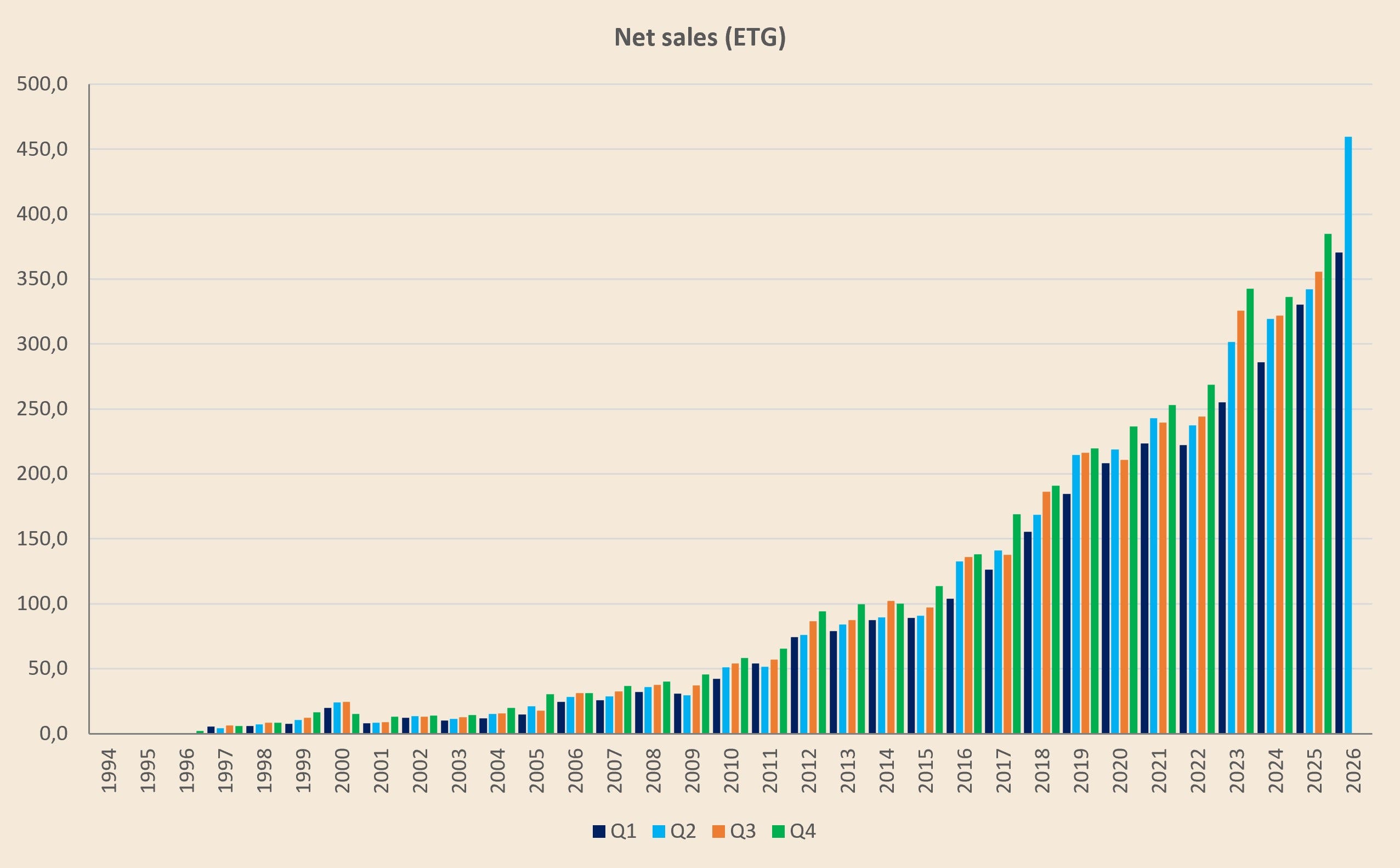
The long-term trajectory is striking but uneven. Early percentage growth partly reflects a small starting base, when one acquisition could double or triple quarterly revenue. Growth moderated as the segment became larger.
The history also illustrates ETG’s diversification value. Commercial aviation downturns have generally affected it much less than FSG. ETG weakened during the early-2000s downturn and Global Financial Crisis but did not collapse during COVID-19 because defense, space, medical, and other electronics demand followed different drivers and stabilized the segment.
Since fiscal 2018, HEICO has disclosed ETG revenue in two broad categories: defense, space, and aerospace equipment; and other industries.
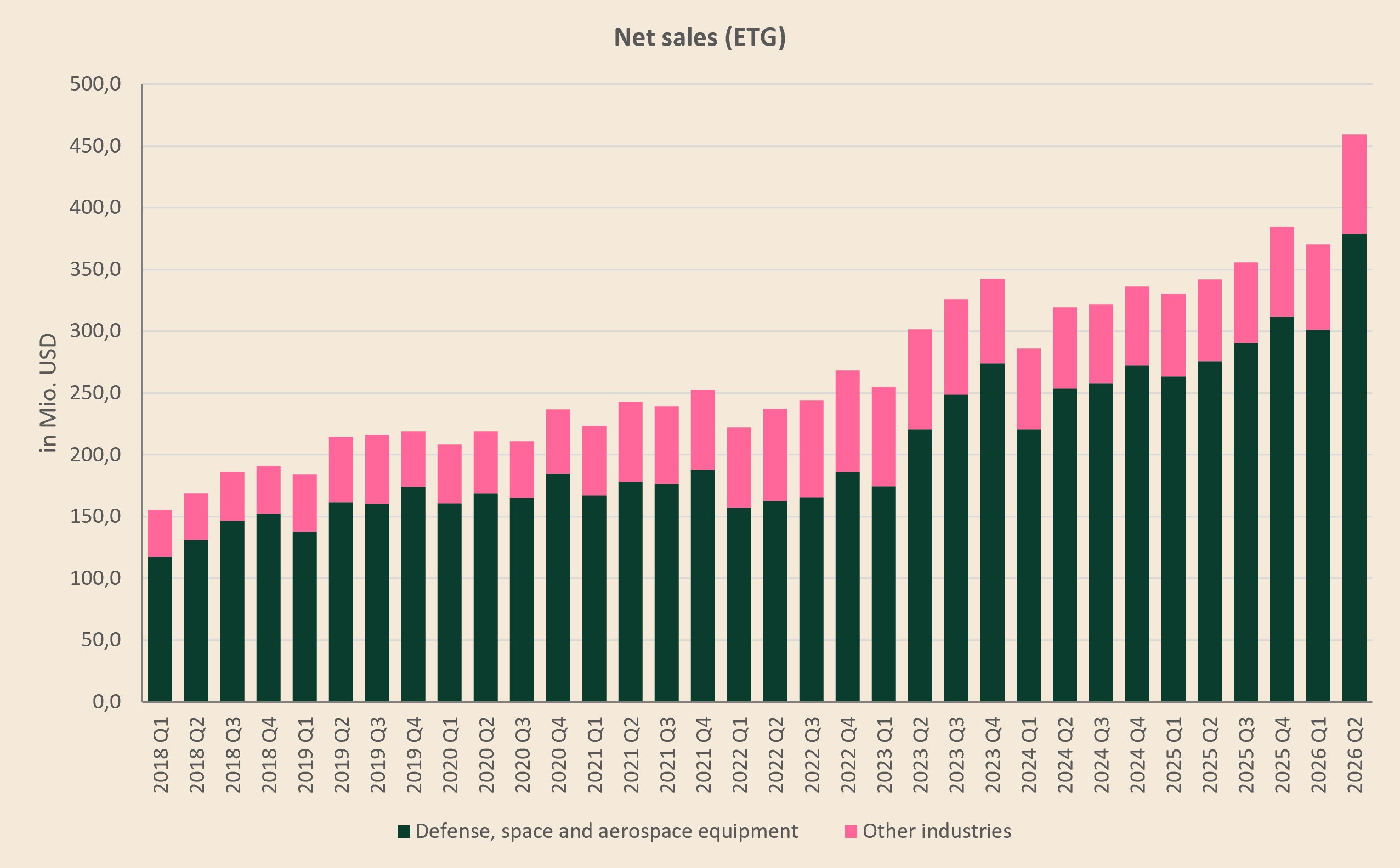
Defense, space, and aerospace equipment represent the clear majority, recently contributing roughly 80% of ETG revenue. The remaining 20% comes primarily from medical, telecommunications, and specialized electronic and industrial applications.
The first category is broader than it appears. It includes products sold to military agencies, defense primes, aircraft manufacturers, satellite companies, and spacecraft programs. The same microwave component, power converter, or high-voltage connector may be used in a military aircraft, commercial satellite, or another demanding aerospace application.
“Other industries” is similarly diverse, including medical imaging, industrial electronics, telecommunications, and other markets requiring highly reliable power, sensing, interconnect, or electro-optical products. These activities are smaller but add customer and end-market diversification.
The growing share of defense, space, and aerospace revenue helps explain recent acceleration. Defense customers and primes have increased orders, space activity has expanded, and commercial aerospace production has recovered, exposing ETG to several structural growth markets at once.
Organic growth and acquisitions:
Reported ETG growth combines organic development, acquisitions, occasional divestitures, and foreign-exchange movements.
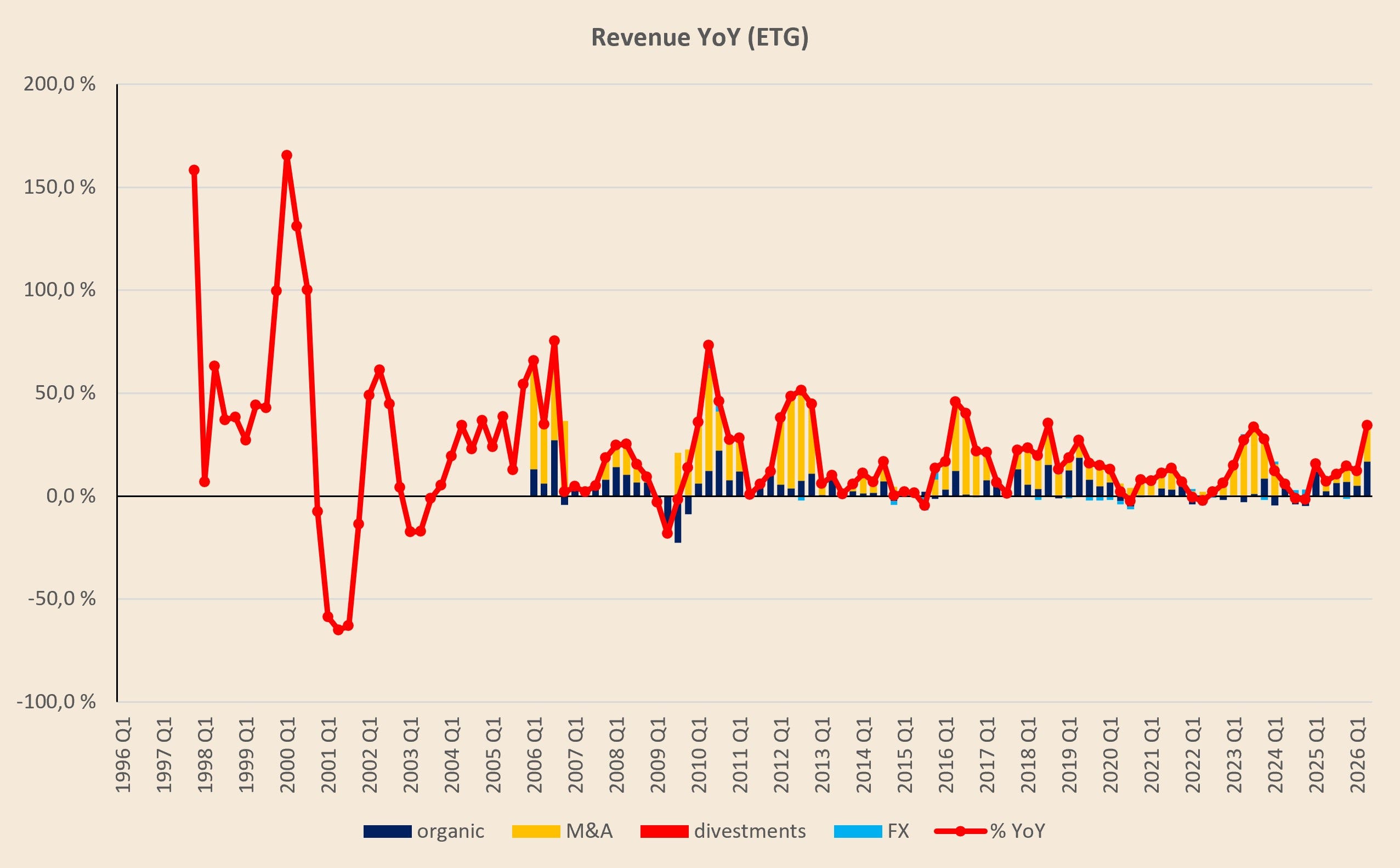
Acquisitions have played a larger and more persistent role in ETG than in FSG. In many periods, acquired growth equaled or exceeded the organic contribution because M&A created the platform and remains central to its development.
The extreme growth rates of the late 1990s and early 2000s require caution. ETG operated from a very small base, so modest transactions produced unusually large percentages. As the segment grew, acquisition contributions became less dramatic but remained frequent.
Organic growth has been more modest and volatile.
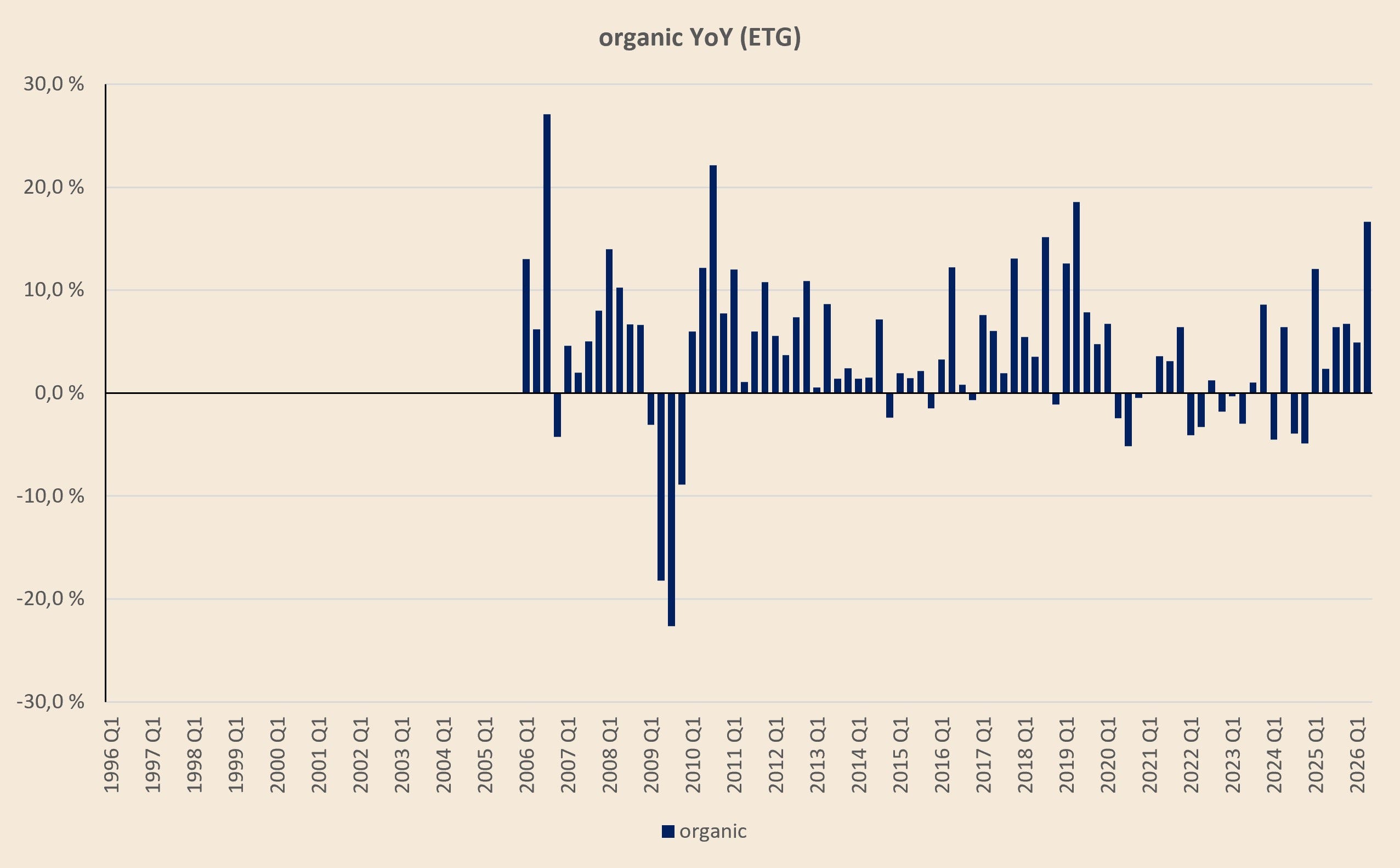
Based on the quarterly series, ETG’s organic growth has generally been in the mid-single digits and much more erratic than FSG’s. The arithmetic average appears to be approximately 5%. A reasonable normalized range is 5–7%, with individual years capable of materially stronger or weaker results.
This is below FSG’s roughly low-double-digit normalized rate. ETG depends more on new platform wins, production schedules, defense procurement, program timing, and customer order releases.
Organic growth is consequently uneven. Strong demand or a defense or space program ramp can produce double-digit growth, while project delays and weaker markets can push the figure below zero. The Global Financial Crisis produced the most severe historical decline, with organic revenue falling more than 20% in one quarter.
COVID-19 was much less damaging. Organic growth weakened and turned negative in some periods, but declines were comparatively modest and partly offset by M&A. This resilience supports ETG’s role in reducing HEICO’s dependence on commercial flight activity, although the segment remains exposed to economic and program-level cycles.
Recent quarters show renewed momentum. Defense, space, and aerospace demand have strengthened, while commercial aerospace production has recovered. Organic growth reached double digits in several periods and accelerated sharply in the second quarter of fiscal 2026.
Such quarterly strength is not a permanent baseline. Shipment timing for a relatively small number of customers can affect ETG’s organic growth, and strong periods may be followed by normalization. A mid-single-digit long-term assumption is more consistent with the broader history than extrapolating the latest result.
Acquisitions provide the second and historically more important growth layer.
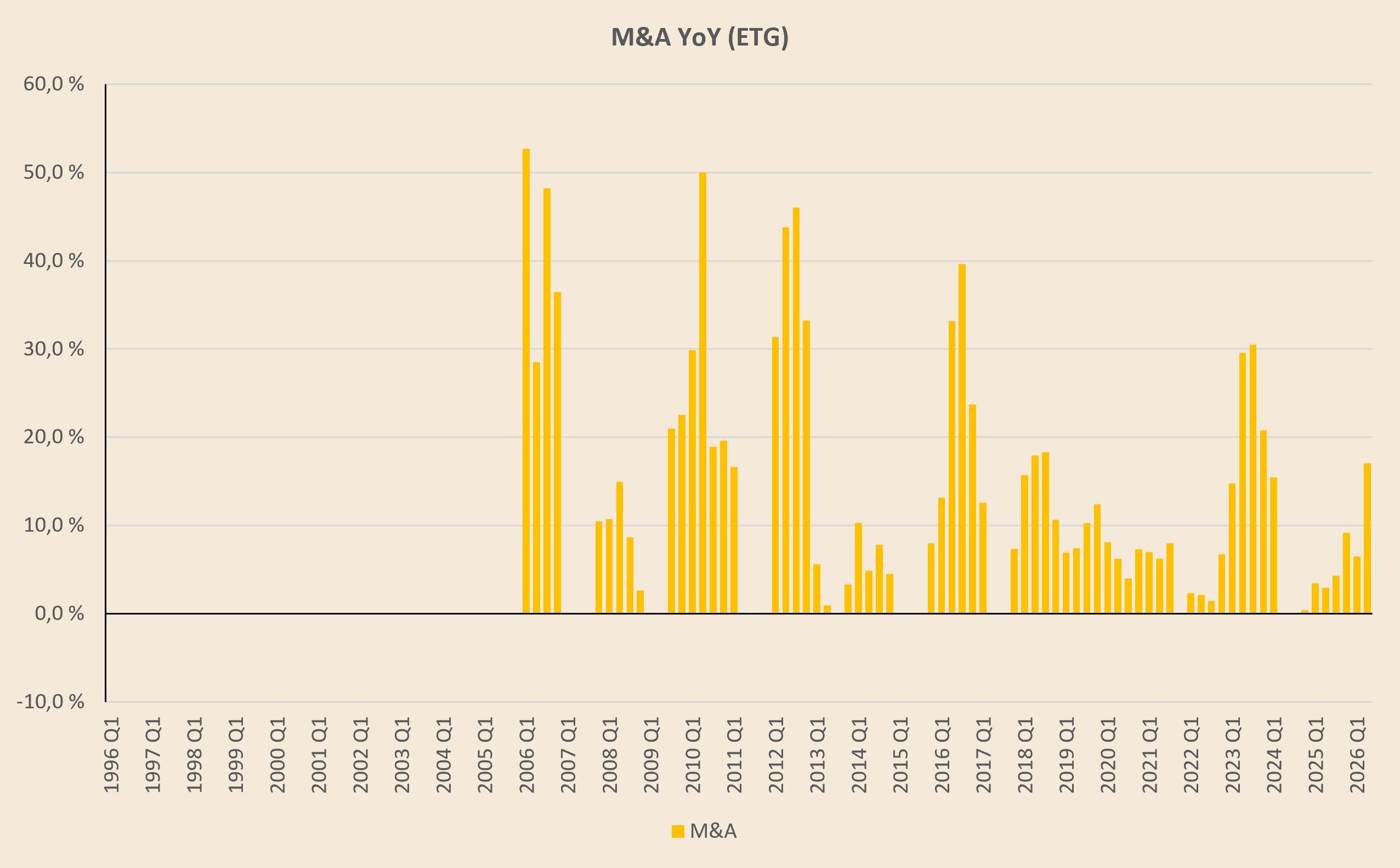
The acquired contribution has appeared in repeated waves, with major increases around fiscal 2006, 2010, 2012, 2016, and 2023 and smaller additions in many other periods. Unlike Wencor in FSG, no single ETG acquisition dominates the chart. Growth has instead come from repeatedly adding specialized businesses over many years.
This pattern reflects fragmented target markets. Defense electronics, microwave components, connectors, power supplies, sensors, and other high-reliability products are often made by small, founder-led companies. No single acquisition must transform HEICO; the accumulation of niche positions gradually expands revenue, technology, and customer relationships.
Reliance on M&A also creates risk. ETG’s future depends partly on HEICO continuing to find specialized businesses at prices that produce attractive cash returns. Competition from private equity and strategic buyers can raise valuations, while technical complexity makes due diligence critical. HEICO must retain key engineers, managers, and customer relationships after closing.
Margin development:
ETG combines long-term growth with unusually attractive profitability.
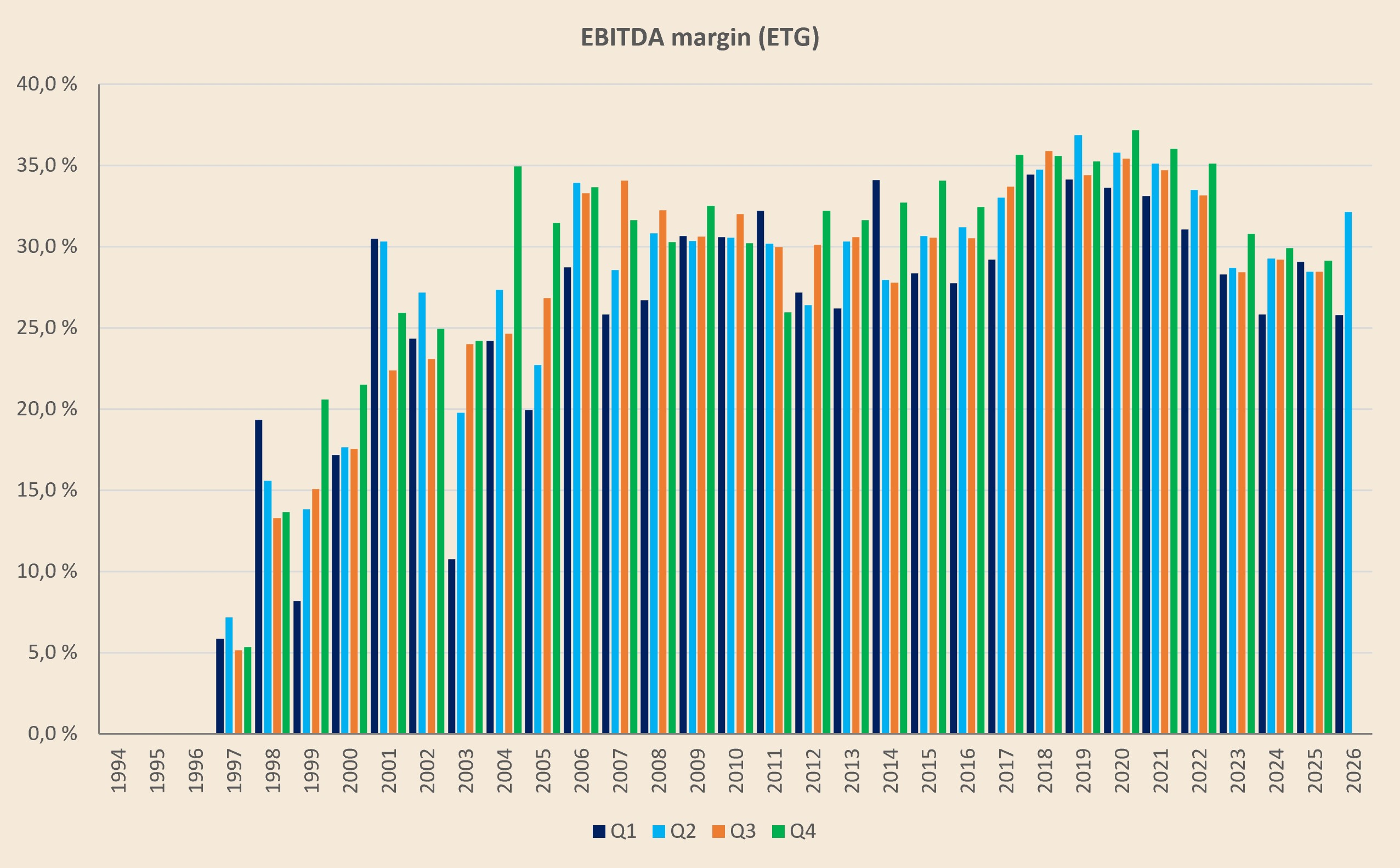
The earliest margin figures are highly volatile because ETG was still small and a limited number of companies, products, or acquisition effects could materially change the result. From the mid-2000s onward, the profile becomes more representative of the mature platform.
For much of 2005–2022, ETG’s quarterly EBITDA margin remained around 30% or higher.
The margin reflects ETG’s position inside customer systems. Its products are usually small relative to the value of the aircraft, missile, satellite, medical scanner, or communications platform, yet may be critical to operation. Customers therefore focus less on absolute component price than on reliability, qualification, technical performance, and delivery.
Recently, a temporary slowdown in certain higher-margin satellite components weighed on ETG, partly offset by stronger growth in lower-margin defense products.
Once an ETG product is designed into a platform, replacement may require engineering, testing, customer approval, and documentation. Potential supplier-switching savings can be small relative to the cost and risk of requalifying the larger system. These switching costs support pricing and margins without requiring ETG to manufacture the end product.
The EBITDA margin recovered to approximately 32% in the second quarter of fiscal 2026 as revenue accelerated, demonstrating the operating leverage available when higher volume flows through ETG’s existing engineering and manufacturing base.
10. The HEICO Operating System: “Do the Right Thing”
HEICO’s operating system explains how the company expanded from one aircraft part into more than one hundred specialized businesses without losing the economics that made those businesses attractive.
“How was our 36 year, 23% compound annual growth rate and share price possible, especially when we were rarely leveraged at more than 2 times EBITDA? First, we have to thank God for these results. Second, we realized that Dad always had a saying, “Do the right thing,” which was our mantra 24/7, 365 for the past 36 years. It wasn’t just a saying, it was embedded in every single decision, every part sold or repaired, every company acquired, and simply everything we did. Obedience to the unenforceable became our DNA from the time Victor and I were small children to now, when we are 60 and 58 years old. Doing the right thing means making honorable choices when nobody’s looking.
It means spending tens of millions of dollars on quality systems, not because our customers or regulators require them, but because we know it’s a good investment that protects our brand. It means properly reserving for obsolete or excess inventory, not because our auditors require it, but because we know it’s needed and mistakes must be learned from, recognized, and never repeated, not swept under the rug in order to protect reported earnings. These are just two of the many things that HEICO has done routinely over decades, and why we’ve never had a one-time unusual charge to earnings, whereby the economic earnings of the upcycle are largely erased following a black swan event, and investors don’t realize much of the earnings never existed in the first place.
HEICO was built for long-term and sustainable cash generation, which permits our earnings and cash flow to compound decade after decade, not just year after year. We are not into programs of the year, buzzwords, or comparing ourselves to others, hoping to get a higher multiple on our shares. We’re designed for long-term, challenging, but sustainable earnings increases” — Eric A. Mendelson, Q1 2026 earnings call
The group combines family ownership, decentralized operating responsibility, subsidiary-level incentives, and centralized capital allocation. Acquired companies generally retain their identity, management teams, and customer relationships. Headquarters controls the balance sheet and allocates capital, while day-to-day decisions remain with the people closest to the product and customer.
Culture and structure are closely linked. Decentralization works only when managers are capable, properly incentivized, and trusted to act in the business’s long-term interest. HEICO’s acquisition process therefore screens not only for attractive products and financial characteristics but also for owners and management teams capable of operating with limited supervision after the transaction.
M&A reinforces this culture. HEICO generally acquires small entrepreneurial businesses, preserves their autonomy, and often leaves a minority interest with the seller. The group thus adds companies that already possess the small-business mentality it wants rather than trying to impose that mentality on a large centralized organization afterward.
This combination is the HEICO operating system. It allows a public company with more than 11,000 employees to retain many characteristics of a collection of family-owned businesses.
10.1. Ownership, culture and decentralization
The Mendelsons approached HEICO as owners from the beginning. The family invested a meaningful portion of its own capital, fought for control of the company, and remained exposed to the consequences of every major decision.
Family control is balanced by a demanding internal decision-making process. Although operating responsibilities are clearly divided within the family, major decisions are not made unilaterally:
“All major decisions must be unanimous.” — Laurans Mendelson, Forbes interview, 2020
Requiring agreement may occasionally slow decisions, but it also provides an internal check on large acquisitions, financing choices, and other commitments affecting the family’s capital alongside that of outside shareholders. Each major decision must withstand scrutiny from several owner-managers with different responsibilities.
The family’s principal financial outcome comes from the value of its HEICO shares rather than from maximizing annual salaries or bonuses. A transaction that increases reported revenue but destroys per-share value would therefore work directly against its interests.
“In our case, we own a large number of shares. So, if the stock goes up 10 points […], we make $140 million or $200 million in equity value. Now do I care if my salary goes up $3 million? Of course not. So, to answer your question, we will make transactions that generate cash flow, accretion and stock value.” — Eric A. Mendelson, Q4 2020 earnings call
The figures in that historical statement are no longer current, but the incentive remains: the family is rewarded primarily through long-term equity appreciation. Outside shareholders participate in the same outcome.
This ownership perspective also explains management’s focus on cash flow. Acquisition accounting, amortization, working capital, and other assumptions can influence reported earnings without necessarily reflecting the cash available to reinvest. HEICO follows the required accounting rules but evaluates internally whether its businesses are actually producing cash.
“So it’s to me and to us and our team, it’s all about the cash flow return. And that is more important than the earnings per share. Although we know if we have cash flow, we will have earnings per share. We can have earnings per share, but no cash flow, as you very well know. So that’s what we will continue to focus on that strategy.” — Laurans A. Mendelson, Q3 2020 earnings call
The ownership culture extends beyond the Mendelson family. HEICO consistently refers to employees as “team members,” reflecting the role it expects them to play. A team member should understand that individual decisions affect customers, colleagues, and the value of the wider company.
“And as always, we’ll continue to focus on intermediate and long term growth strategy with an emphasis on acquiring profitable businesses. And just one personal comment, what doesn’t appear in 10 ks’s, 10 Qs, financial statements and presentation is the incredible capability of our team members. These are the people that make these results possible. These are the people that strive for growth. Of course, we incentivize them with what we believe are great incentive plans, but these are exceptionally talented people.” — Laurans Mendelson, Q2 2017 earnings call
HEICO reinforces this culture through financial ownership. Its U.S. retirement plan has historically matched employee contributions with HEICO shares. Over decades, the appreciation of those shares has created substantial wealth for factory workers, shipping clerks, administrative staff, and other employees far below the executive level.
Victor Mendelson described the effect in 2018:
“But it’s also how you treat the team members, the employees. And I think you know this, a number of years ago, we sold a block stock to the 401(k). People defer 6%. They can defer 6% in the 401(k).
They have a whole menu of mutual funds that they invest in. And we match that annually with 5% in HEICO stock. And the thing that and the reason […] why I’m bringing this out and why it’s so important. We have […] approximately 4,000 U.S. employees. Most of them are in the 401(k). 10% or a little more have between $750,000 and $1,500,000 in their 401(k), principally as a result of their gift or of HEICO stock to the 401(k). Another 40 or 50 of them have between $1,500,000 $6,500,000 in their 401(k), principally HEICO stock. I am not talking about senior executives. I am talking about shipping clerks, factory workers, secretaries and people who work hard for manual labor for a living. Now what has happened is that we now have a good majority of those 4,000 people think of HEICO as their company. It’s no longer, ‘oh, yeah, well, we’re working for some rich guys on Wall Street and mutual funds and the CEO, he’s getting all this money, we’re getting nothing.’
When I retire, I have social security, I can’t even make ends meet and so forth. And the last thing I want to tell you is that about 6 months ago when I sent out the quarterly reports, I received an email back from one of our secretaries. And the comment, I’ll paraphrase, ‘Dear Larry, thank you so much for sending the report. We are doing so well.’ We meant she. It wasn’t HEICO. She didn’t write ‘HEICO is doing so well’. We are doing so well. And she further went on to say, ‘and it’s wonderful to know that someday when I retire, I will retire as a millionaire as a secretary’. So when you put that in perspective and understand that the people who are building this company and supporting it and doing the great things that we can do, they look at it as their company.” — Victor H. Mendelson, Q3 2018 earnings call
The most important part of this story is not the exact number of employee millionaires. It is the difference between asking employees to think like owners and giving them a meaningful economic reason to do so. When the value of a person’s retirement savings depends partly on the company’s long-term success, product quality, inventory management, customer satisfaction and operating cash flow become more personal.
Eric Mendelson explicitly connected HEICO’s incentive system to its willingness to deemphasize lower-margin business, while also making clear that higher profitability should not come at the expense of the customer value proposition:
“Our team members and our leadership are incentivized and focused on operating income. We try to keep things very simple. And they’re not focused on revenue. They don’t get compensated on revenue, they get compensated on earnings. So I think what we continue to see is a shift where we deemphasize lower margin products and we focus more on higher margin products. And I think that really is the driver of the improvement in the operating income that we’ve seen […] We continue to maintain a very low price increase model, so we make sure that our customers appreciate it and that they want to come back and want we’re the vendor of choice and they want to develop more items with us.” — Eric A. Mendelson, Q1 2020 earnings call
Ownership alone cannot create the culture. A widely distributed stock plan inside a heavily centralized organization would still leave most decisions far from the people who understand them. HEICO combines ownership with small operating units.
The typical subsidiary is far smaller than the consolidated company; many employ roughly 75 to 100 people. The president knows the products, customers, engineers, and production team. Employees know one another, and poor execution is difficult to hide inside a large bureaucracy.
Victor Mendelson explained how this preserves a small-business mentality:
“So as opposed to being an employee number 5722 at some big company, the team members are one of typically, on average, about 75 or 80 people at a subsidiary and facility, that team member is valued and known. Their opinions are important, they are close to the product, they’re close to the customer. The president of the business who sold us the company and in many instances still owns 20% or even more, is watching everything. They still have that ownership mentality. It’s that small business ownership mentality that’s shared across the enterprise, and they feel it. If a shipment is late, if it doesn’t go out, if there’s an issue of any sort, everybody feels badly because they’re letting someone else down in a small organization and there’s nowhere to hide.” — Victor H. Mendelson, Fernway Insights interview, 2022
This structure places operating decisions close to the relevant information. A subsidiary president generally understands the business’s demand outlook, customer relationships, production bottlenecks, and employee capabilities better than an executive at headquarters could.
HEICO therefore avoids building a large hierarchy of group executives between corporate management and the subsidiaries. Eric Mendelson described the organization as a collection of entrepreneurial business heads rather than a centralized company awaiting instructions:
“You know, that rather than having a highly centralized organization where people are waiting on instructions from the corporate office on what to do, we’ve got 60 decentralized, entrepreneurial, hardworking, aggressive business heads and their staff out in the field figuring out every day what they need to do.” — Eric A. Mendelson, Q1 2022 earnings call
The number of business heads has increased since that comment, but the principle remains. Local management decides how to serve customers, run production, manage inventory, hire employees, and invest in product development.
Headquarters still plays an important role. HEICO allocates capital, approves acquisitions, manages the balance sheet, establishes financial controls, and monitors performance. It also designs incentives, provides access to capital, and encourages cooperation where useful.
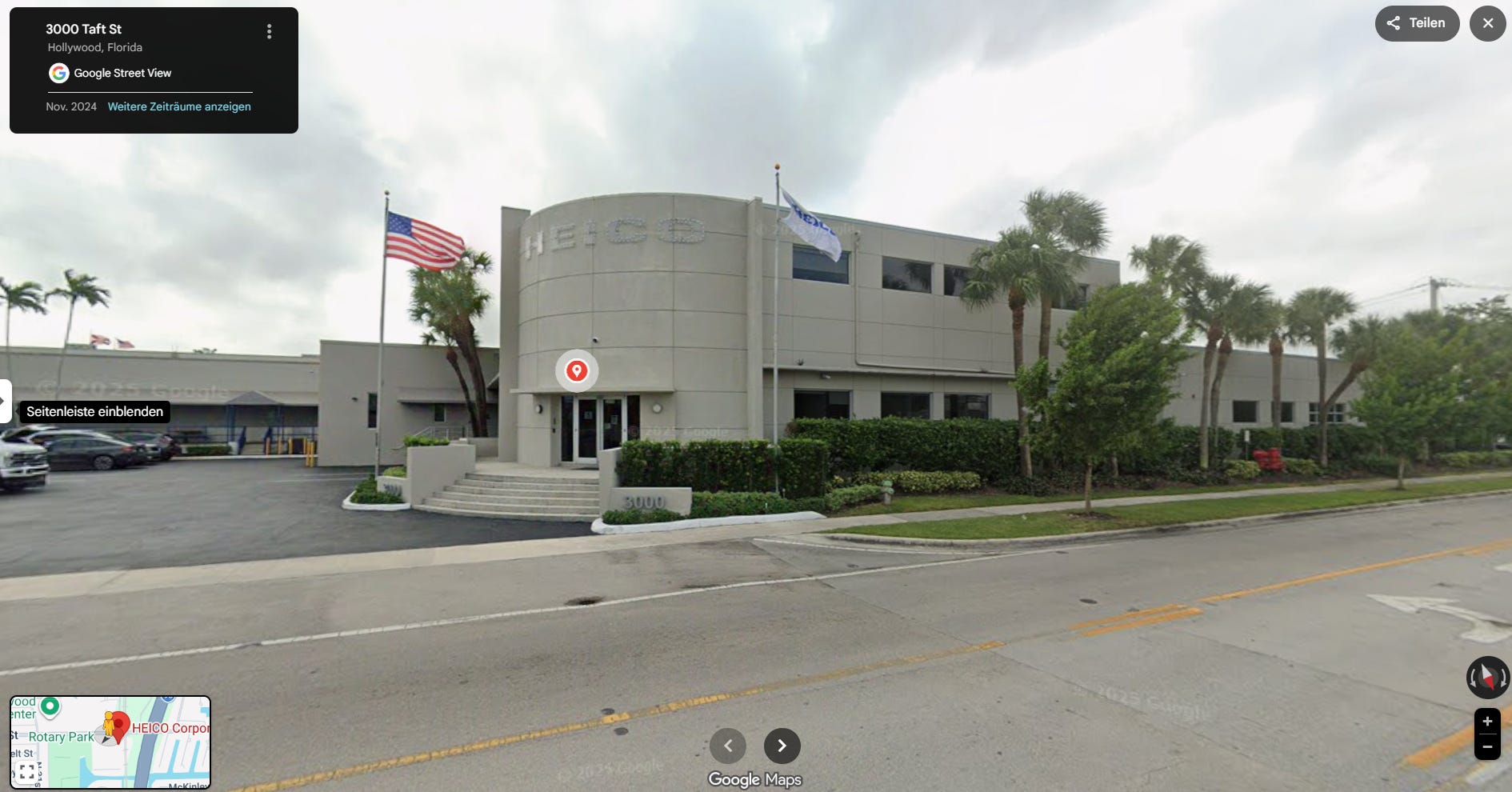
The same restraint is visible at HEICO’s headquarters in Hollywood, Florida. Despite overseeing a multibillion-dollar global group, the company operates from an unassuming office and manufacturing building rather than an elaborate corporate campus. The building alone does not prove financial discipline, but it fits a culture of limited overhead, little interest in prestige, and a preference for directing capital toward products, people, and acquisitions.
Headquarters provides resources and accountability rather than detailed operating instructions. The parent does not claim to understand every microwave component, repair procedure, PMA product, parachute system, and customer program better than the managers running those businesses.
This creates an unusual allocation of responsibility: corporate management decides which businesses HEICO should own, while local management decides how each acquired business should operate.
The model therefore depends heavily on selecting the right company. If HEICO acquires a weak business, the wrong management team, or an incompatible culture, decentralization offers fewer mechanisms for correcting the problem afterward. Management repeatedly returns to the principle that the best way to manage an acquisition is to buy the right one.
“We really don’t direct our companies to take actions. We expect them to do what’s right for the business. That doesn’t mean we don’t have discussions with them about it. But ultimately, we expect them to be the same companies they were pre acquisition. And you’ve heard us say that the key is buying right, that if you buy the right business and you buy the right kind of company that does the right things, then you don’t have to direct them post acquisition.” — Victor H. Mendelson, Q2 2020 earnings call
COVID-19 provided the clearest stress test of this structure. Commercial aviation demand collapsed with little warning, but the appropriate response differed across subsidiaries. Some businesses faced an immediate decline of approximately 80%, while defense, space, and other electronics operations remained relatively stable or continued growing.
A centralized response would have required headquarters to determine staffing, working hours, and cost structures for businesses facing very different conditions. HEICO instead allowed subsidiaries to respond locally through measures such as temporary furloughs, reduced hours, and shorter workweeks. Corporate executives and directors also reduced their compensation.
“And so what we’ve noticed is that these folks at these subsidiaries, because we allow them to operate in a decentralized fashion, they do make good decisions and they do tighten their belts when they need to. They’re very aware of and conscientious of working capital management, of listening to their customers, understanding demand as best that they can during this time period. And so we haven’t we don’t have a need or we haven’t felt the we haven’t felt it necessary that we’d be heavy handed in these circumstances. They have done the right things. It just so happens that with them doing what they need to do to manage their businesses, we have also contributed at the corporate level by taking some pay reductions by the executives and the corporate staff and also our Board of Directors.” — Carlos L. Macau, Jr. (CFO), Q2 2020 earnings call
HEICO made layoffs where management believed certain product lines would not recover, but it avoided the large-scale reductions implemented elsewhere in aerospace. Retaining technical and production capabilities allowed the businesses to respond more quickly when demand returned. The company also continued developing products during the downturn rather than protecting short-term profit by cutting investments needed for future growth.
Measures varied by business and included layoffs, temporarily reduced working hours, and pay reductions. The burden was not limited to operating employees: HEICO’s executive management team and Board of Directors also accepted a temporary 20% reduction in compensation.
This highlights another element of the culture: decentralization supports long-term decisions rather than merely lowering corporate overhead. Local managers can invest in inventory, employees, and product development when they believe the future return justifies the spending.
The model also creates trade-offs. Separate subsidiaries may duplicate administrative functions, and performance and culture can vary across businesses. HEICO may capture fewer immediate cost synergies than a centralized acquirer, while investors receive limited information about individual subsidiaries and depend heavily on corporate management to identify problems.
HEICO accepts these costs because it believes centralization would be more damaging. In niche businesses, local knowledge often matters more than the savings from standardizing every process. Central procurement or reporting systems can create efficiencies but may also distract managers, slow decisions, or weaken customer relationships.
Cooperation is encouraged rather than imposed. Subsidiaries can share suppliers, manufacturing capabilities, products, and customers when both sides benefit. Wencor can ask other HEICO businesses to quote manufacturing work, repair stations can use PMA parts produced elsewhere in the group, and distribution operations can introduce products to new customers. Each company nevertheless remains responsible for its own economics.
Even the positioning in this group photograph offers a small illustration of the culture. Victor, Eric, and Laurans Mendelson stand behind other team members rather than placing themselves at the center. A single photograph should not be overinterpreted, but the arrangement is consistent with HEICO’s emphasis on giving operating teams visibility, responsibility, and credit for the company’s success.
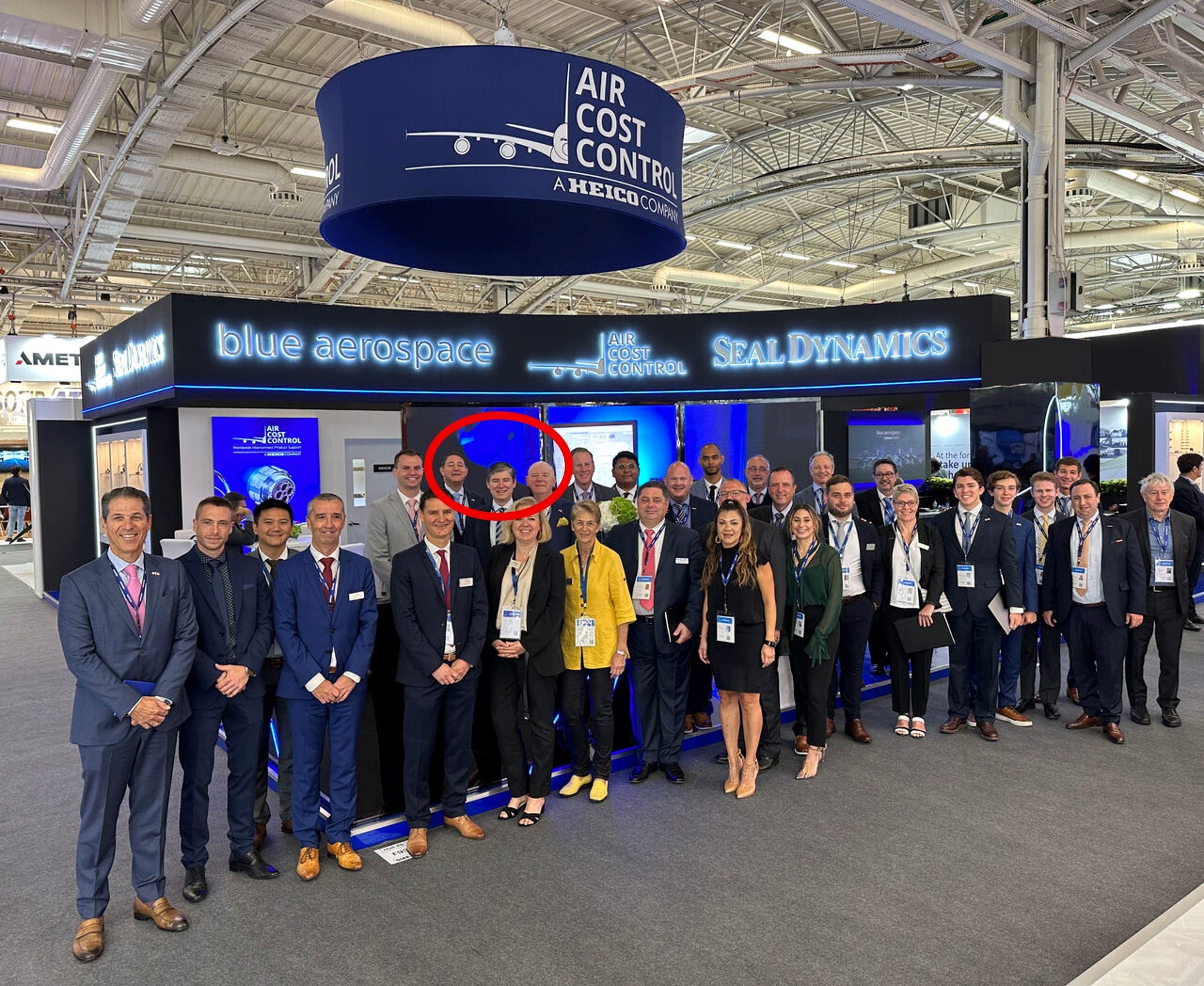
The operating system is built around trust, but it is not passive. Managers are measured, incentivized, and held accountable. Autonomy means the right to decide, not freedom from financial consequences.
10.2. The acquisition playbook
Since the Mendelson family took control in 1990, HEICO has completed more than one hundred acquisitions. M&A expanded the PMA catalog, created the Repair and Distribution groups, built ETG, and introduced HEICO to markets beyond its original aircraft-parts business.
Management focuses more on a business’s characteristics than on whether it fits within a narrowly defined sector.
Victor Mendelson explained this flexibility:
“So in the early days, we started making acquisitions. We would have a roadmap we’d lay out, but we couldn’t get the acquisitions in that roadmap, any one of a number of reasons. It could have been price, it could have been the seller wouldn’t sell, etcetera. So we had to look elsewhere and we look at adjacencies, and if the business met certain characteristics, we would acquire it. And I think that’s really been the key for us, has been the characteristics of the business.” — Victor H. Mendelson, Fernway Insights interview, 2022
Across industries and product categories, HEICO’s acquisition criteria remain consistent. Management seeks businesses that can be acquired at a sensible price, operate in defensible niches, and are led by people HEICO is prepared to support for decades:
“When we look to make acquisitions, we’ve got a number of criteria. 1, that they’re fairly priced. Number 2, that they’re in very good businesses with strong barriers to entry. And number 3, superior leadership teams. And the type of people who we want to be in business with and we want to work with for 3 decades.” — Eric A. Mendelson, Q2 2013 earnings call
These three criteria frame the rest of the acquisition process. The price must leave room for an attractive cash return, the business must possess durable competitive advantages, and the management team must be capable of operating with substantial autonomy after the transaction.
The preferred company usually sells a niche product or service that solves an important customer problem. High margins provide an initial indication that the business is doing something difficult or valuable. A company consistently earning an operating margin of roughly 20% is likely selling more than undifferentiated manufacturing capacity.
HEICO has repeatedly said that it generally looks for targets with operating margins of at least 20%:
“But we’ve said publicly we don’t make acquisitions typically unless there’s at least a 20% operating margin” — Victor H. Mendelson, Q1 2016 earnings call
A high-margin business can still be unattractive if it requires excessive capital, depends on a temporary program, or has poor customer relationships. HEICO looks for cash generation, modest capital requirements, defensible products, and a long runway for reinvestment.
HEICO focuses on the cash return generated by the purchase price.
“Also, I should point out that over the years, we bought companies with different growth rates, some on the fairly low side, but very strong and stable, and others that are faster growth. So what we’re looking at is within our typical mix in that regard. Howard, the key the bottom line key to this is number 1, strong cash flow return for what we invest.
I can go out and buy things that have big CapEx and working capital requirements and then go to the bank or go to the investment bankers and raise equity and to pay for it. That anybody can do that and some companies do to raise the top line and show, oh, we’re growing the top line. We don’t do that. We want to be since we’re the largest shareholders, it’s our money at stake and every investor in HEICO is our partner.
That’s our philosophy. That’s the basic philosophy. And if we see a great company and it’s 20% or 25% return on investment, hey, we’re going to buy that company because that’s a wonderful return. And if it doesn’t grow that much, okay, it doesn’t grow that much. But that’s a wonderful return and we take that money and put it towards acquisitions of faster growing ones as Victor said.” — Victor H. Mendelson, Q2 2015 earnings call
This leads to a broader point: growth is valuable only when purchased at an acceptable price and converted into cash. Management is willing to acquire a slower-growing company if the initial cash return is high and durable. The resulting cash can later be reinvested in faster-growing businesses or internal product development.
The desired businesses are generally small or medium-sized, founder-led, and technically specialized. Their advantages may lie in engineering knowledge, certifications, customer approvals, proprietary processes, intellectual property, or qualified positions on long-lived aerospace or defense platforms.
HEICO also looks closely at the people. During due diligence, management observes how owners treat employees and interact with the organization. A founder who understands the factory, knows long-serving employees, and values the company’s reputation is more likely to fit HEICO than one focused mainly on extracting the highest short-term profit.
“One of the things, for example, we look at when we look for acquisitions is when we walk through the facilities, how does the owner interact with his or her people? And are they looking to take care of their people, or are they looking to make money by slicing out a layer each time on their people? We like companies that look to make money by adding products and market share, as opposed to just squeezing the people.” — Victor H. Mendelson, Fernway Insights interview, 2022
HEICO therefore looks for evidence before the transaction that the seller shares its view of employees. Management assesses whether the owner genuinely knows and values the people who built the company rather than treating the workforce merely as a cost base.
“The first thing we do in acquisition, the most important, is really scrutinize, analyze, get to know the person who is selling the company to us and how he manages. If he treats his people well, this is very important. As an example, if he goes through the factory and he sees somebody, and they said, he tells us, ‘Oh, that’s a machine operator, that’s a this and that and that,’ that’s not very impressive. Some of these people go through the factory and they say, They stop at a machine and say, ‘Charlie, here, these are Mendelson’s. How’s Anne?’ Meaning his wife. ‘Family okay? Everything good? Charlie, how long have you been working for 22 years.’ This means an awful lot.” — Laurans A. Mendelson, Q4 2022 earnings call
The two parts of the quote belong together. HEICO prefers businesses whose owners know and value their employees, while offering those employees a structure in which they can participate financially in the company’s future. Culture therefore acts both as an acquisition filter and as part of the seller proposition.
This cultural diligence is economically important because HEICO often wants the seller to continue running the company. Attractive historical financials matter less if the founder leaves immediately and takes essential technical knowledge or customer relationships.
The process is deliberately thorough. HEICO uses internal teams to examine finances, customers, products, quality systems, management, and operating practices. It does not assume that the seller’s adjusted EBITDA or projected synergies will materialize.
Laurans Mendelson described the company’s approach in 2010:
“And we do, as you know, a very, very thorough due diligence with our own staff, our own in house staff, really scrubs the business, scrubs the financial. We go out and we speak to their customers and we really try to cover the waterfront.
We’ve been very successful in our acquisition program by being extremely thorough. Now the corollary to that is that when we dig and dig and dig, sometimes we find things we don’t like and then the deal collapses and we walk away” — Laurans A. Mendelson, Q3 2010 earnings call
Walking away is part of the model. HEICO has no acquisition quota and does not need to complete a specific number of deals to satisfy quarterly expectations. The existing businesses already generate cash and can continue investing organically, making no transaction preferable to buying a weak company at an excessive price.
“And then once we get into the due diligence and start kicking the tires and everything else, we probably drop we look at 100 companies and we may buy 1. We look we do a very thorough due diligence and most companies we drop after the due diligence because people as you very well know, people who promote the companies, they give you information, which is always a hockey stick and then when you go in and kick the tires and you discover there are a lot of pitfalls there.” — Laurans A. Mendelson, Q2 2013 earnings call
This selectivity means HEICO will let a transaction fail late in the process rather than compromise its standards. Management has repeatedly emphasized that neither market expectations nor the desire to support short-term results will cause the company to rush an acquisition:
“We’re spending a lot of time in the due diligence processes and we’re not going to rush a closing of an acquisition in order to meet Wall Street expectation or hope and try to financially engineer our results. We’re going to do due diligence in a very thorough manner the way we always do it and make sure that we’re not buying a pig in the poke.” — Laurans A. Mendelson, Q3 2014 earnings call
HEICO’s acquisition record provides evidence that the approach has worked. Management acknowledges that individual acquisitions have performed differently: some exceeded expectations, while others delivered less than anticipated. What the company says it has avoided is a major failure that forced it to conclude that the original investment thesis was fundamentally wrong:
“So some are better than others. Some are a little less than we expected. But we’ve never had a disaster where we had to say, oh my God, we just made a terrible mistake. So that is our strategy. And I think it’s from an acquisition point of view, it’s worked for us.” — Laurans A. Mendelson, Q3 2020 earnings call
The absence of a major failure does not mean every acquisition was equally successful. It suggests that extensive due diligence, conservative underwriting, and a willingness to walk away have limited the downside when individual businesses developed less favorably than expected.
Historically, HEICO often acquired businesses at mid- to high-single-digit cash-flow or EBIT multiples. Valuations have risen as private equity and strategic buyers became more active in aerospace and defense. Management has accepted higher multiples for exceptional companies but continues to reject transactions that do not produce an adequate return.
Acquisition valuations remain one of the clearest constraints on capital deployment. Private equity and strategic buyers can sometimes justify prices that do not fit HEICO’s return framework, particularly when their thesis depends on leverage, cost reductions, or a later sale at an equally high multiple. HEICO generally expects to own the asset indefinitely, so the acquired business’s cash flows must support the purchase price.
Laurans Mendelson explained both the limitation and the advantage of this model:
“We’re doing a lot of due diligence. I can tell you the big issue that we face is competition from, say, private equity or corporate buyers who will pay 17 times EBITDA. We can’t compete. Our model doesn’t work at 17 times EBITDA. We were with an investment banker who you probably know fairly well or you would know, and he came for a meeting to talk about an acquisition. In the conversation, he said, “You realize that 90% of all acquisitions are not successful.” You know, it’s easy to make acquisitions, it’s easy to buy, but it’s not so easy to make them work out. Our model requires us to buy a company, continue it, and keep it in the portfolio virtually forever. We don’t the old expression, we don’t buy a company, put lipstick on the pig and dump it in three years, so we make a profit on it because we increased the multiple or cut expenses by a few bucks. That’s not our model. We’re competing with people who have a different model than we do. Now, saying all that, we are still able to find companies who are very anxious to join HEICO because of the HEICO culture […] If they want the highest dollar, we tell them at the get-go, “We’re not your buyer.” I would say this is the most difficult part that we’re facing. However, there are many people, as I say, ‘cause look, we’ve made 89 acquisitions, and we give lists of people that sold companies to us. We give you lists to see if we’ve done what we said, how we’ve treated people, how we treated their team members and everything else, and that’s very positive.” — Laurans A. Mendelson, Q1 2022 earnings call
The quote captures the trade-off at the center of HEICO’s strategy. Its return requirements prevent it from winning auctions based solely on price, but its culture and permanent ownership can attract sellers who value more than the highest immediate consideration.
Management has historically described ordinary acquisition multiples in the range of approximately five to seven times EBIT and has said that ten to twelve times EBITDA often priced HEICO out of a transaction. Those ranges are not rigid limits; the appropriate price depends on growth, margins, capital intensity, strategic fit, and the durability of cash flow.
“We have a number of transactions that we are in active due diligence on. They are all priced within our normal pricing, 5-7x EBIT, not EBITDA. […] Unfortunately, because of our strategy, we are priced out of some of the very expensive opportunities where they want 10-12x EBITDA.” — Laurans A. Mendelson, Q3 2010 earnings call
HEICO repeated essentially the same range in 2012. Over time, however, the wider market became more expensive, and the multiples paid by HEICO increased as well. Victor Mendelson acknowledged this development in 2017:
“And multiples have moved up a bit and I think the multiples we pay are slightly higher than they were, let’s say, 10 years ago or 5 years ago. Although I think we pay a very fair price for businesses.” — Victor H. Mendelson, Q4 2017 earnings call
By 2021, management described approximately 8-10x EBIT as a fair initial purchase price. Yet HEICO does not evaluate the multiple only at closing. The company tracks how much of the original investment is subsequently recovered through cash generated by the acquired business:
“So we look at things as a return as you would as a wise investor, which you are, as return on investment. And we like to get our money back within, say 10 years. And our model is that and we pay fair prices, we’ll pay 8-10x EBIT. And what we want to see the cash flow coming back so that if we mentally say we pay whatever we pay for it by the time we’re into the 4th or 5th year of owning a company. We have received enough cash back to make that company costing us in our portfolio, say, 4-5x EBIT. So it becomes a no brainer. And that has been our strategy.
But if we have to pay prices that take us 20 years to do that, all of a sudden we wind up going to the banks and getting heavily indebted, which we don’t again, our strategy is to be relatively low leverage and we can’t do that if it takes us 20 or 25 years to recoup our investment.
So but there are a lot of companies going to 14-16x EBITDA, and you make all kinds of assumptions. I mean, you can justify any acquisition. You can justify a 20x EBITDA price if you assume that the synergies are going to be god knows what. We’re a little more conservative, and we don’t do that. I can’t tell you is that the smartest thing. I don’t know, except that we’ve done 80 some acquisitions and we’ve never had one blow up on us and our history is very clear.” — Eric A. Mendelson, Q3 2021 earnings call
Price discipline is especially important when capital markets encourage aggressive bidding. Paying a high multiple can convert an excellent business into a poor investment if future growth or margins fall short of expectations. HEICO regularly walks away from transactions priced at 14–20 times EBITDA. Such prices leave little room for disappointment and often depend on aggressive assumptions about growth, cost savings, or synergies. HEICO generally underwrites the existing cash-generating capability rather than assuming that restructuring or a later resale will rescue a high initial multiple.
This does not mean HEICO will never pay a double-digit multiple. Wencor carried a significantly higher headline valuation than the company’s traditional smaller transactions. Management acknowledged that the competitive auction pushed the price above the level HEICO initially wanted to pay because Wencor had previously been owned by private equity:
“We don’t feel that we paid a low price. We feel that actually, I feel that I paid a high price and much higher than we had really wanted to pay. The auction pushed us up, we paid what I consider and we consider a market price.” — Eric A. Mendelson, Q2 2023 earnings call
Wencor was an exception supported by its scale, strategic fit, complementary portfolio, and unusually large revenue-synergy opportunity. The transaction broadened the prices HEICO would consider for a unique asset, but management’s language makes clear that it did not establish a new norm for ordinary acquisitions.
HEICO usually funds acquisitions with internally generated cash and conservative borrowing. Equity is treated as expensive because issuing shares transfers part of the company’s future economics to the seller. Stock has been used selectively, particularly for a transaction as large as Wencor, but cash remains the preferred consideration for ordinary acquisitions.
Low leverage gives HEICO flexibility during weaker markets, when sellers become more receptive, private equity financing becomes less available, and strategic buyers may focus on protecting their balance sheets. HEICO can continue reviewing or closing transactions because it has not exhausted its borrowing capacity during the preceding boom.
Not every transaction follows the same post-acquisition structure. Victor Mendelson estimated in 2022 that approximately 20% of historical acquisitions had been consolidations, essentially asset deals. These involve purchasing a product line or troubled operation and placing it inside an existing HEICO company.
Most transactions, however, follow the decentralized model. The acquired company retains its management, employees, facilities, and identity. HEICO provides capital, governance, and access to the wider group without imposing a predetermined restructuring plan.
This distinction matters when assessing the historical record. HEICO can integrate and consolidate businesses when necessary, but cost reduction is rarely the primary thesis. The usual objective is to preserve a good business and allow it to continue compounding.
10.3. Why sellers choose HEICO
The seller proposition is one of HEICO’s most important competitive advantages in M&A, especially among programmatic serial acquirers.
“I would say at least four out of five leadership teams tell us that HEICO is their preferred acquirer.” — Eric A. Mendelson, Q3 2015 earnings call
A private business owner choosing a buyer evaluates more than the headline purchase price. The decision may determine what happens to the company’s employees, name, facilities, customers, and reputation after the transaction.
The founder may have spent decades building the company, working with many of the same employees, and serving customers who depend on its products. Selling to the highest bidder may maximize the immediate payment while placing the company’s future in the hands of an owner with very different priorities.
HEICO offers liquidity without requiring the founder to abandon the business. The seller can monetize most of the equity, remain as president or CEO, and frequently retain an ownership interest of approximately 20%.
Eric Mendelson described the typical structure:
“And you know the acquisitions that Eric’s referring to are companies where the seller wants to have a liquidity event, however, wants to remain active, is very knowledgeable about his industry. So he winds up with a minority interest of roughly 20% And it’s a win win for us. We’re normally not an acquirer that wants to buy a company and then take that and shrink it down and get rid of personnel and fire people and so forth. But that’s normally not our model. In a few cases, we have purchased companies or product lines and put them in, but we prefer to keep the personnel, keep the company, to keep the management and to work cooperatively.” — Eric A. Mendelson, Q3 2015 earnings call
The retained minority stake addresses an incentive problem that can arise after a sale. A founder receiving tens or hundreds of millions of dollars no longer needs the salary. If HEICO acquired 100% and removed the founder’s economic participation, the person most important to the business might have little reason to continue with the same intensity.
Retaining approximately 20% allows the seller to diversify personal wealth while continuing to benefit from the company’s growth. The founder remains an owner but gains access to HEICO’s capital, customer relationships, regulatory knowledge, and acquisition capabilities.
The arrangement also protects HEICO. It reduces the upfront cash requirement and keeps the seller financially exposed to the business’s quality and the accuracy of the projections. If the company performs well, both parties benefit; if expected growth fails to materialize, the seller shares part of the disappointment.
HEICO can offer this structure because it has no exit date. Private equity firms generally acquire a business expecting to sell it again within several years. That model can work, but it introduces recurring changes in ownership, financing, and strategic priorities. Management teams may face restructuring before the first sale and another transition when the next owner arrives.
HEICO instead presents itself as a permanent home:
“We’ve been disciplined to not, as we say, overpay for a business, to not get out of our lanes and to make sure that whatever we buy, we’re ready to own forever. We don’t have an exit strategy and we don’t have an exit strategy for our businesses, unlike a lot of private equity firms do. We are owners to own. We buy to own.” — Victor H. Mendelson, Fernway Insights interview, 2022
Permanent ownership changes the investment horizon. HEICO can fund product development that takes years to generate revenue without worrying that the expenditure will depress EBITDA immediately before an exit. It can retain inventory, employees, and technical capabilities through a downturn when those resources matter to the business’s long-term position.
Permanent ownership also allows the seller to make promises to employees with greater confidence. The company is unlikely to be sold again as part of a predetermined fund cycle, and its name, facilities, and operating approach can continue as long as the business performs.
HEICO does not promise complete freedom. A subsidiary must meet financial standards, maintain quality, comply with regulatory requirements, and generate cash. Capital expenditure and larger strategic decisions are discussed with the group. Autonomy operates within a framework of financial accountability.
The company also acknowledges that it is often not the highest bidder:
“I think that the right kind of company that we like to acquire does view us as the preferred acquirer because of the way we run the companies. When we compete with a private equity firm that buys and sells by the pound every 3 to 5 years, managements really find that very stressful. So when they have a say, as some input, we’re always preferred buyer. When a seller who wants to have a liquidity event wants to protect his employees, continue running very often continue in the position of President, CEO of his company, we are definitely the preferred buyer. And very often and we tell people we cannot be the highest price, But we and we’ll also do a transaction where we’ll buy 80.1%, leave somebody with roughly 20%. So if their projection of growth is correct over the next 3, 5, 7 years, they will benefit significantly by the growth of their own company, while at the same time pulling money out and having a liquidity event,” — Eric A. Mendelson, Q4 2015 earnings call
This creates a form of proprietary deal flow. A seller focused only on maximizing the immediate cash price will probably choose another buyer. A seller who also values employees, autonomy, legacy, and future participation may prefer HEICO even at a slightly lower valuation.
Decades of completed acquisitions provide evidence that the promise is credible. HEICO can introduce a potential seller to founders who previously joined the group. Those references can explain whether management retained autonomy, employees were treated as promised, and the minority interest continued creating value.
Laurans Mendelson highlighted this reputational advantage:
“Many private owners would rather sell to us at a slightly lower price than to sell to, say, one of the other companies or private equity guys, because they know that the culture. They will stay with the company. They will be able to share in the future profits.” — Laurans A. Mendelson, Q1 2022 earnings call
Reputation compounds in acquisitions much as trust compounds in customer relationships. Each successfully preserved company makes the seller proposition more credible to the next founder. That credibility can reduce competitive tension, improve access to businesses not broadly auctioned, and partly offset HEICO’s refusal to pay the highest multiple.
The proposition is also operationally self-reinforcing. The best founders are more likely to choose a buyer that preserves their autonomy. They then continue managing the subsidiaries, making HEICO’s decentralized model more effective. Their subsequent experience provides another reference for future sellers.
The acquisition process is therefore less about purchasing anonymous financial assets than about adding owner-managed businesses to a network of other owner-managed businesses.
Each successful acquisition strengthens HEICO’s reputation as a trusted long-term home for the next entrepreneur or management team.
“I think what’s becoming more and more consistent to us is that HEICO seems to be an acquirer of choice for these folks because of our operating style, because we treat people fairly, both customers and team members, shareholders.
I mean, that’s all part of our DNA. And when they have the opportunity to select with whom they are going to work, whether it is an entrepreneur who’s built up a business or a management team, they or even a private equity firm that feels that HEICO can write a check and close, we continue to be I think favored in that area. And we just got to make sure that we find businesses that match with our DNA and that can be acquired at fair prices where it’s fair for the seller, it’s fair for the seller’s leadership team and employees and also it’s fair for HEICO.”
— Laurans A. Mendelson, Q1 2013 earnings call
10.4. Can the model continue at a larger scale?
HEICO’s operating system has worked across more than one hundred acquisitions, two operating groups, and a wide range of aerospace, defense, space, medical, and industrial products. The central question is whether it can continue working as the company grows.
The acquisition opportunity remains substantial. Aerospace and defense supply chains contain thousands of specialized manufacturers, repair shops, distributors, and electronic-component companies. Many are small, privately owned, and exposed to founder succession. Their products may be attractive even when the businesses lack the scale or capital to remain independent indefinitely.
HEICO also has more resources than during the earlier stages of its acquisition program. Free cash flow, borrowing capacity, reputation, and an internal management network allow it to consider a wider range of targets. Subsidiary presidents can complete smaller acquisitions within their product markets, reducing the burden on the Mendelson family and headquarters.
The decentralized structure is scalable in one important respect: HEICO does not need a central organization capable of operating every acquired business. Each company arrives with management, technical knowledge, and customer relationships. Adding another subsidiary does not require headquarters to learn how to manufacture every product.
The model is not infinitely scalable, however. Capital allocation remains centralized, and every acquisition requires judgment about the people, products, financials, culture, and purchase price. Monitoring the quality of those decisions becomes more difficult as the number of subsidiaries grows.
The capital required to move consolidated results also rises with the company. A $20 million acquisition that once made a meaningful contribution now has limited impact. HEICO can respond by completing more small transactions, pursuing larger acquisitions, or combining both approaches.
More transactions increase demands on due diligence and management attention; larger transactions increase the financial consequence of a mistake. Wencor showed that HEICO can finance a transaction far larger than its traditional bolt-ons while preserving substantial operating autonomy, but it also raised the stakes. A poor outcome from a $20 million deal can be absorbed; a poor outcome from a transaction exceeding $2 billion would affect the entire group.
Valuations create another constraint. Private equity has become increasingly active in aerospace and defense supply markets, raising prices for attractive companies. HEICO’s reputation may help it win selected transactions without the highest bid, but not every seller values legacy or autonomy enough to accept less.
Management has repeatedly said it will wait rather than change the model’s economics. This discipline makes acquisition growth uneven: some years contain many transactions, while others contain few. Investors expecting smooth annual deployment may mistake patience for a lack of opportunity even when refusing to transact creates more long-term value.
Culture also becomes harder to preserve as the group grows. The direct connection between the Mendelsons and each subsidiary naturally weakens, new managers join without experience of the earlier years, and large acquisitions bring employees whose expectations were shaped under different owners.
HEICO must therefore institutionalize a culture that developed around three members of one family. Incentives, decentralization, and retained founder ownership help, while the subsidiary structure keeps local employees close to their immediate leadership. Future generations of corporate and subsidiary managers must nevertheless understand why HEICO operates this way rather than merely copying the visible mechanics.
The greatest risk would be preserving decentralization as a slogan while changing the incentives beneath it. If headquarters begins prioritizing consolidated revenue, short-term margins, or deal volume over cash returns and customer relationships, the operating system would gradually lose coherence.
The same applies to acquisitions. Paying too much because HEICO needs a larger transaction, replacing founders with centralized managers, or cutting investment to produce immediate accretion would make the company resemble the buyers from which it has historically distinguished itself.
Victor Mendelson’s comments on HEICO’s future show that management recognizes this danger:
“One, it isn’t easy. It’s never been easy. And just because we’ve had past success, we know that that’s not necessarily indicative of future success. And we keep that in mind every day here. And for us, we have to treat it as though today is the day we took over the company and we’re looking at a clean slate. And what happened and what we were successful with is not going to repeat itself. And that’s an important mindset for us to have. And we’ve got to be as hungry today. We always were. And I don’t believe for a moment that just because we’ve been fortunate so far, that we’ll automatically be fortunate. We have to make it each day and prove it each day. That’s number one, keep that mindset. Don’t become arrogant. Don’t think we’ve cracked the code.” — Victor H. Mendelson, Fernway Insights interview, 2022
HEICO’s acquisition model is sometimes summarized as buying high-margin niche businesses and leaving them alone. That description captures the visible structure but misses the work beneath it. HEICO must find the right people, pay an acceptable price, design the incentives, maintain financial discipline, and earn enough trust for local managers to use their autonomy responsibly.
The model works because its parts reinforce one another. Family ownership supports a long time horizon; employee and founder ownership spread that perspective through the subsidiaries; decentralization preserves local knowledge and accountability; and the seller proposition attracts businesses that already fit the culture. Those businesses generate cash, which management reallocates to product development and further acquisitions.
HEICO’s products may appear difficult to connect from the outside, but the operating logic is consistent. The company acquires specialized businesses, keeps decisions close to customers and products, measures success through cash generation, and holds assets for the long term.
That operating system may ultimately be more difficult to replicate than any individual product HEICO manufactures.
Part 4 explained how HEICO extended its model beyond aircraft parts through ETG, decentralization, and a disciplined acquisition playbook. The question now is what this compounding system has produced financially—and whether HEICO’s economics, competitive advantages, risks, and valuation still support attractive long-term returns. That is exactly what we will unpack in Part 5.
Great Job!