

Note that Part 3 of the HEICO Deep Dive will be published on Sunday, August 9.
Kinsale’s second quarter once again shows why top-line growth alone provides an incomplete picture of the business, as investment income is becoming an increasingly important driver of overall profitability.
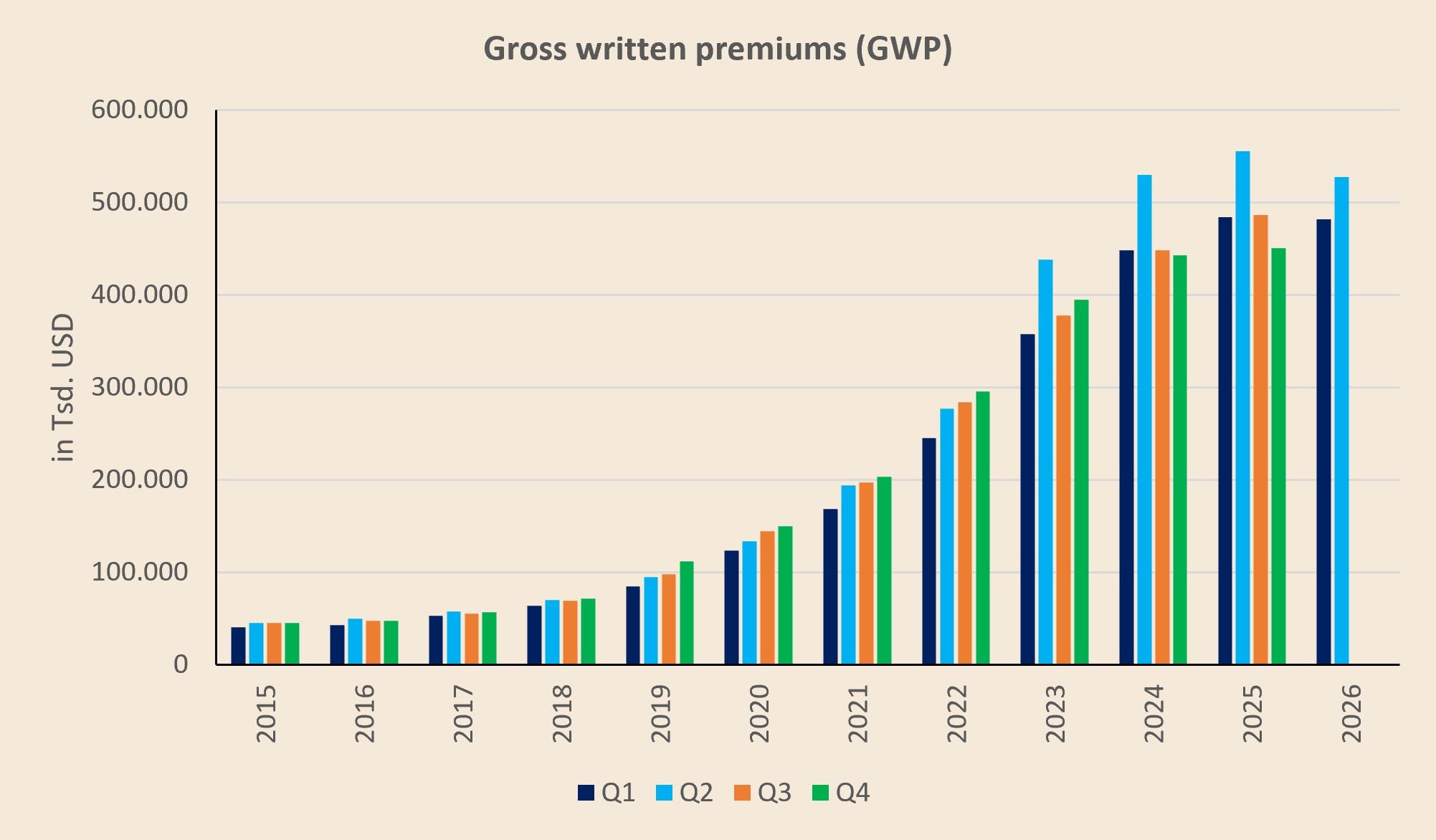
At first glance, Kinsale’s second-quarter results did not look particularly exciting. Gross written premiums declined by 5%, mainly because Commercial Property premiums fell by almost one-third. As the chart shows, growth in gross written premiums has decelerated sharply since 2023, with GWP now declining for the second consecutive quarter.
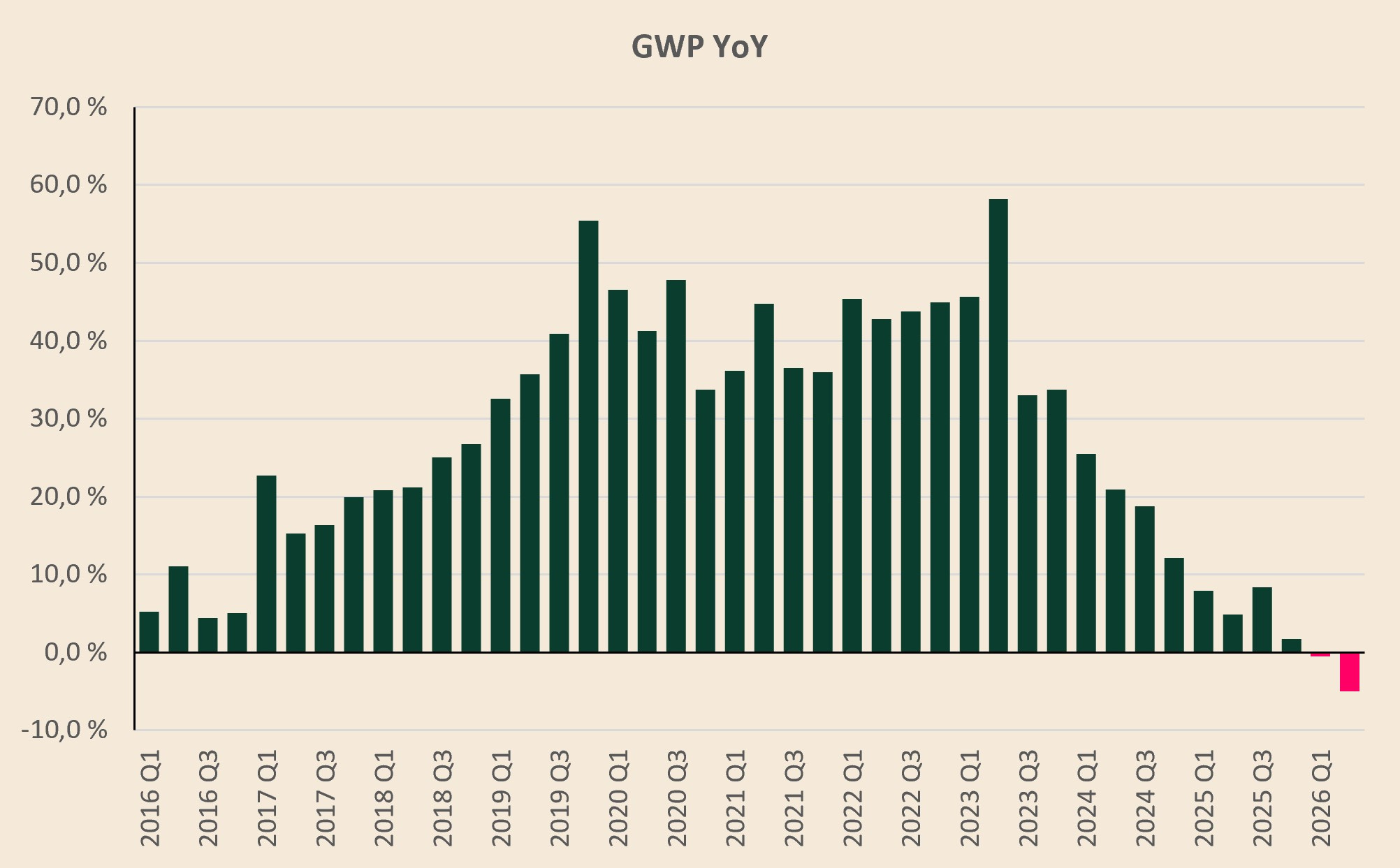
Yet this is only one part of the picture.
Net earned premiums increased by 8.9%, underwriting income grew by 10.5%, net investment income was up almost 20%, and diluted operating earnings per share increased by 15.9%. The combined ratio remained excellent at 75.5%.
In other words, Kinsale wrote less new business but still earned considerably more money.
This is the result of business written in previous periods continuing to flow through earned premiums, Kinsale retaining a larger share of the risks it underwrites, and management refusing to follow competitors into business that no longer meets its return requirements.
The quarter also included an important change in capital allocation. Kinsale repurchased $100 million of its own shares, and Michael Kehoe described the stock as not merely good value, but “a very good value.”
That is probably the most interesting sentence from the entire earnings call.
As usual, Part 1 of this update focuses on Kinsale’s quarterly results and the most important developments in the business. Part 2 takes a step back from the quarter and looks at a question that came up while reviewing the company’s longer-term financials: how does Kinsale manage to generate such consistently high returns on equity?
Part 1: 2026 Q2
Diluted EPS: $7.72 (+34.0% YoY)
Gross Written Premiums (GWP): $527.6 million (−5.0% YoY)
Net Written Premiums (NWP): $452.5 million (−1.4% YoY)
Combined Ratio: 75.5% (loss ratio 53.8%, expense ratio 21.7%)
Underwriting Income: $105.4 million (+10.4% YoY)
Net Investment Income: $55.7 million (+19.9% YoY)
Return on Equity (RoE): 35.2%
Book Value per Share: $89.34 (+20.8% YoY)
Kinsale reported record quarterly net income of $175.9 million, up from $134.1 million in the prior-year period.
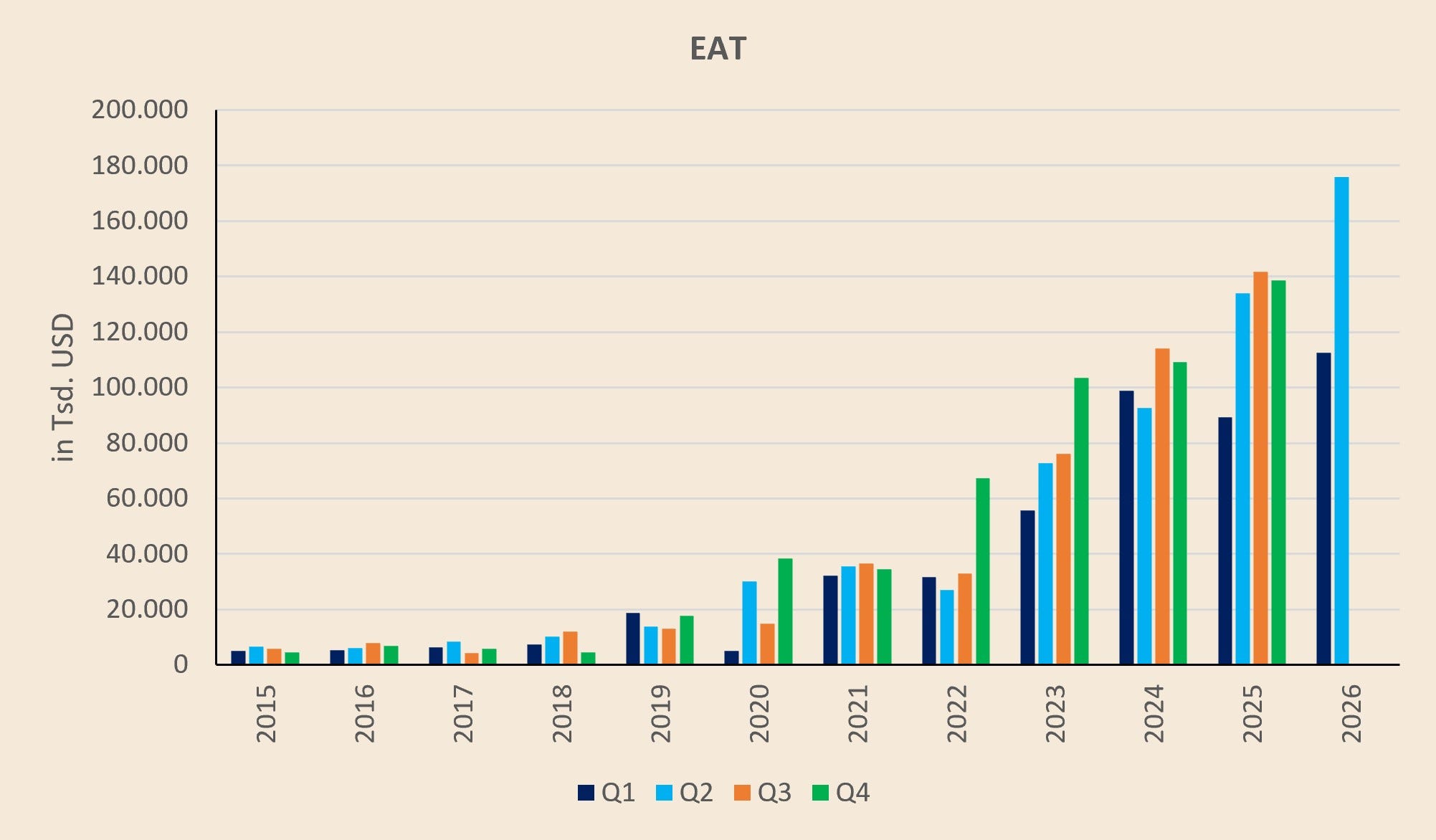
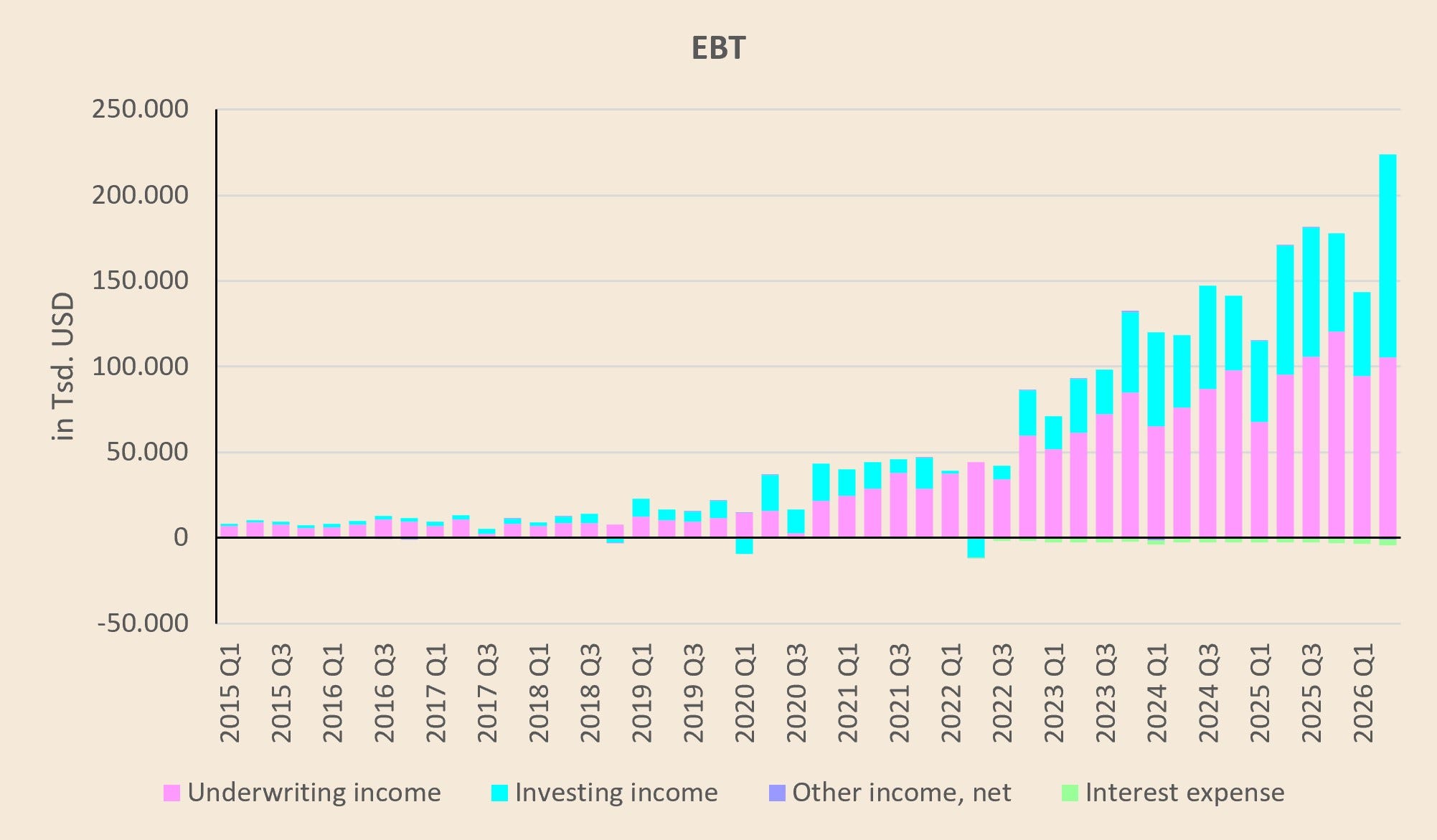
As we will discuss in this update, the increase was driven by both underwriting income and, to an even greater extent, investment income.
Growth
The main drag in the quarter once again came from Commercial Property, one of Kinsale’s largest divisions. Gross written premiums in the division declined by 32.7%, as intense competition continued to drive material rate decreases. Excluding Commercial Property, Kinsale’s gross written premiums grew by 3.7%, compared with 6.0% in Q1. The slowdown is no longer confined to Commercial Property. Premium growth across the remainder of the portfolio has now decelerated from 14.3% in Q2 2025 to 6.0% in Q1 2026 and just 3.7% in Q2.
If the broader shift toward a softer market persists, it may only be a matter of time before GWP growth excluding Commercial Property turns negative as well.
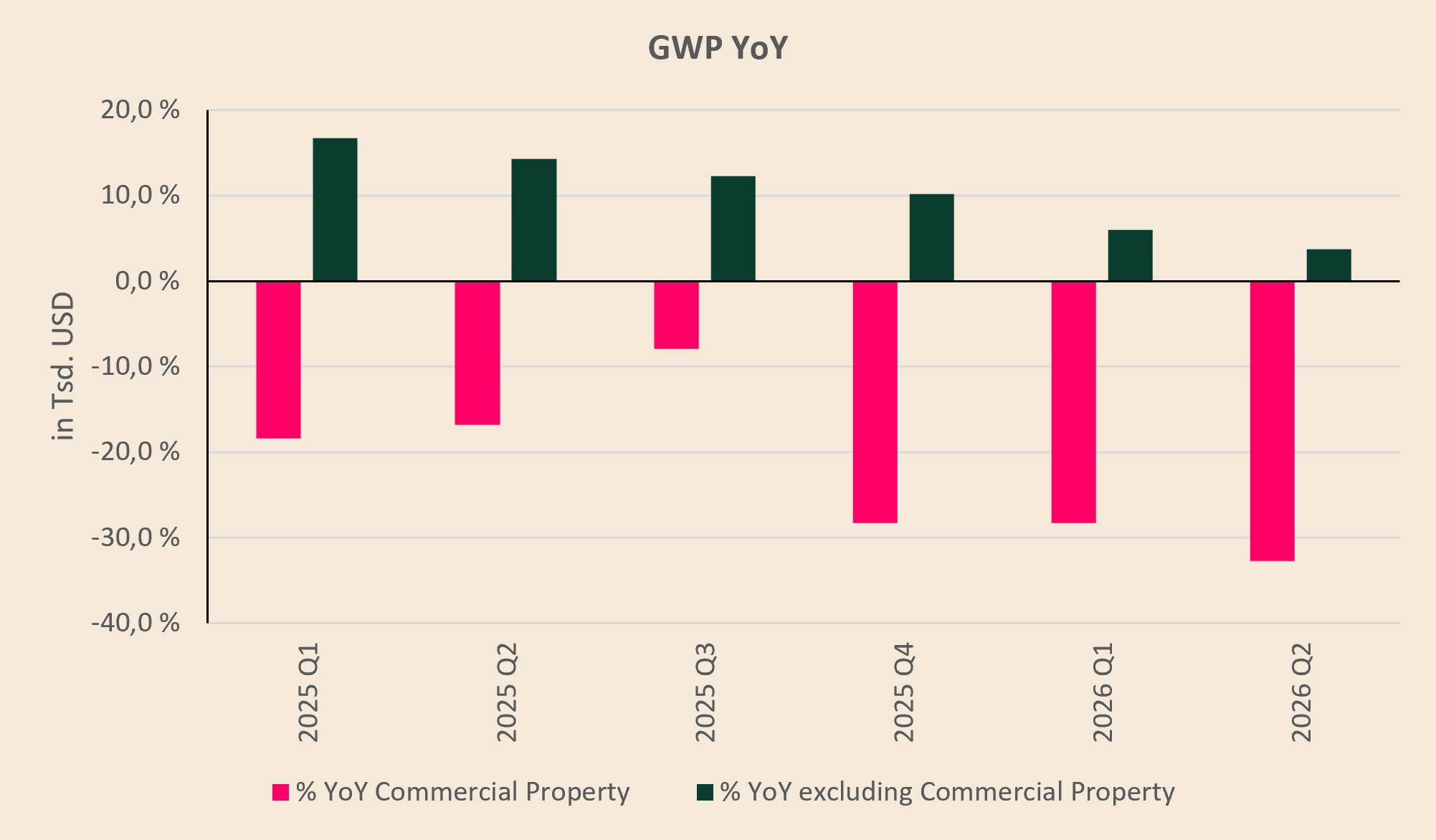
Only a few years ago, this division was benefiting from severe capacity shortages, substantial price increases and unusually attractive terms. Kinsale leaned into that opportunity and grew rapidly. However, the situation has since reversed, as insurance is a cyclical industry.
Management described the current Commercial Property market as a clear “buyer’s market.” More capacity has entered the market, rates are falling, and coverage is expanding. Much of the additional competition appears to be coming from London-based capacity.
Premium growth can always be increased by accepting lower prices, offering broader terms or writing larger limits. None of this is particularly difficult. The difficult part is maintaining discipline when competitors are willing to accept returns that do not meet your own requirements.
Management was unequivocal on this point. Kinsale will not sacrifice profitability for the sake of top-line growth.
“Staying disciplined on price and terms means that there will be business that we choose not to write, and we are comfortable with that. The long-term health of the portfolio matters more than any individual account. That mindset is embedded in how we evaluate every risk that comes through the door. When the market softens and competitors begin to stretch on terms and conditions to hold onto accounts, we’re going to stay disciplined to our underwriting standards. If we lose accounts due to competition, whether it’s pricing or terms that no longer meet our profitability threshold, we view that as the model working as intended. What we will not do is sacrifice profitability for the sake of top-line growth.” (Michael Kehoe, 2026 Q2)
The Commercial Property decline should also be viewed in the context of the unusually strong comparable period. Approximately 60% of the division’s 2025 premiums were written during the first half of the year. As a result, the year-over-year comparison should become somewhat easier during the remainder of 2026, as management has emphasized during the earnings call.
That does not necessarily mean that the division will return to GWP growth soon. The timing of a market improvement is impossible to predict, and the current level of competition may persist for some time.
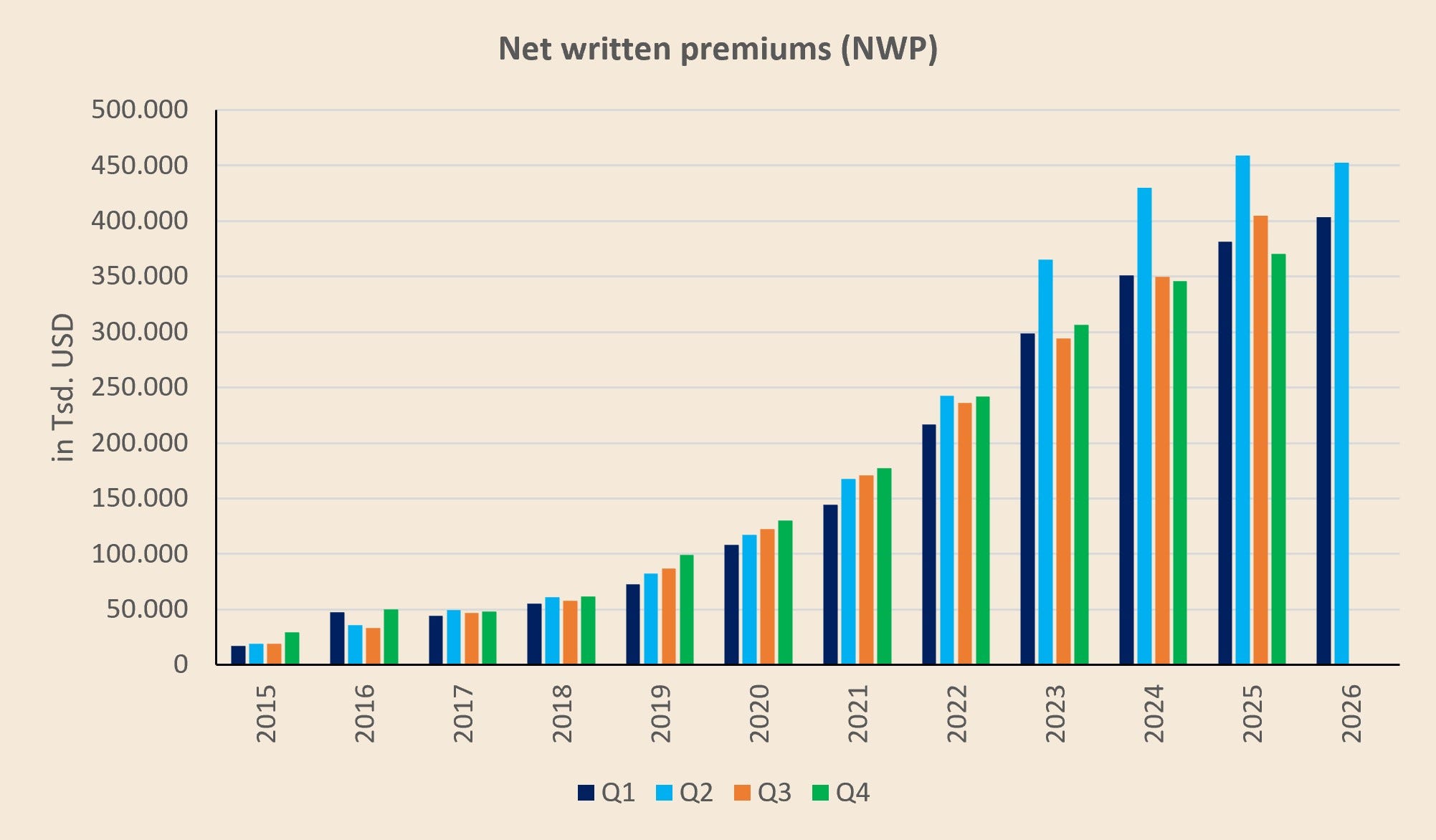
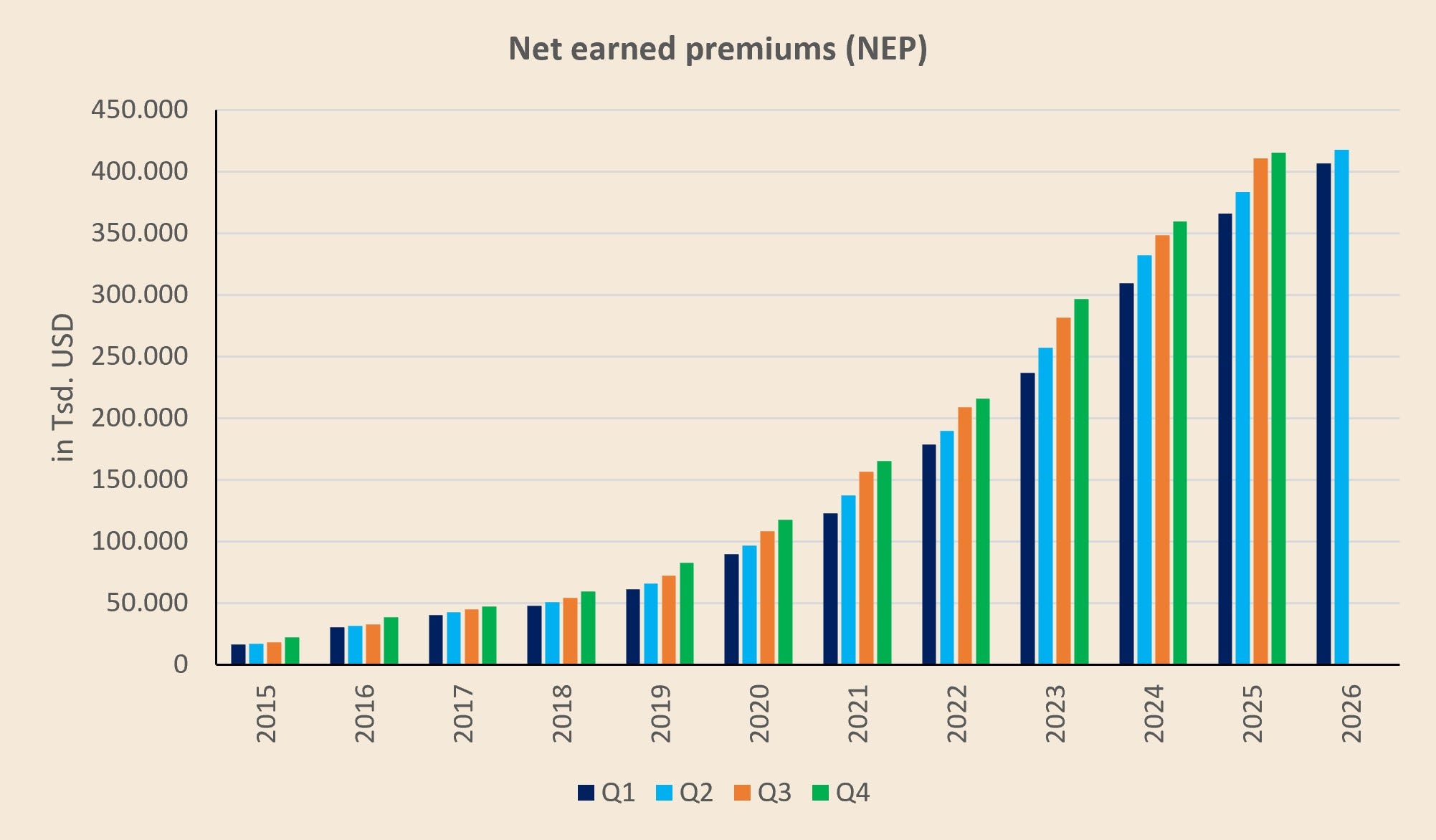
The three following charts show Gross and Net written premiums as well as Net earned premiums. As a reminder, they reflect different stages of the insurance business. Gross written premiums represent all premiums written before reinsurance, while Net written premiums show the portion retained by Kinsale after premiums ceded to reinsurers. Net earned premiums, in turn, recognize these retained premiums over the period in which the insurance coverage is provided. This timing difference explains why net earned premiums can continue to grow even when current written premium growth has already slowed or turned negative.
Underwriting Income
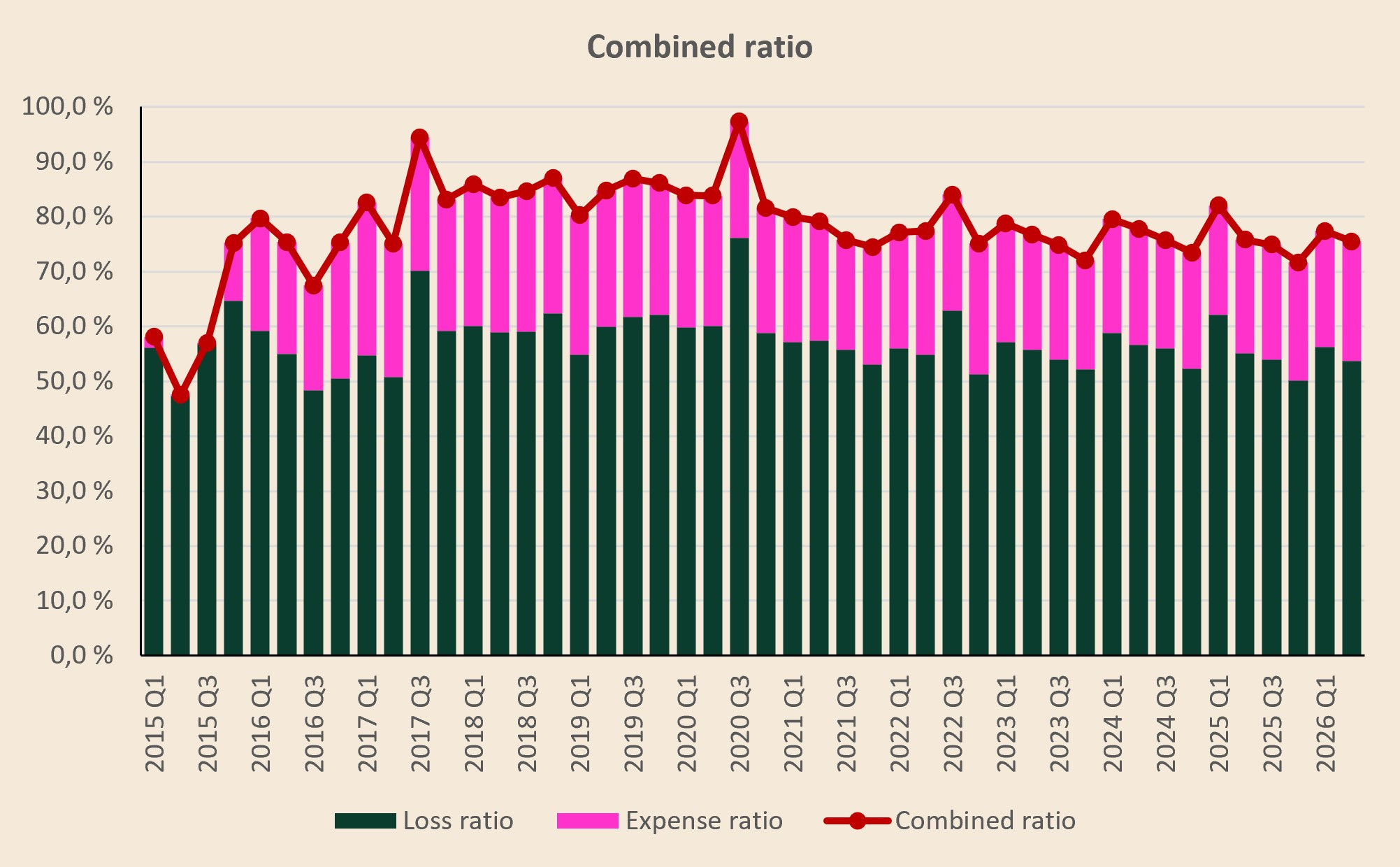
Despite writing less GWP, Kinsale increased underwriting income by 10.5% to $105.4 million. The combined ratio improved slightly from 75.8% to 75.5% YoY.
The loss ratio declined from 55.1% to 53.8%. This included 4.5 percentage points of favorable prior-year reserve development, compared with 3.9 points in the previous year. Catastrophe losses amounted to 1.3 percentage points, modestly above the 0.9 points recorded in Q2 2025.

The expense ratio increased from 20.7% to 21.7%. On its own, that might look like a deterioration in Kinsale’s cost advantage, but the underlying reason is largely economic rather than operational.
As Kinsale retains a larger share of the premiums and risks it writes, Kinsale cedes less business, and as a result, Kinsale receives lower ceding commissions. Since these commissions reduce reported underwriting expenses, lower commissions mechanically increase the expense ratio.
Kinsale gives up part of the commission income, but in return retains more underwriting profit and more insurance float.
Investment Income
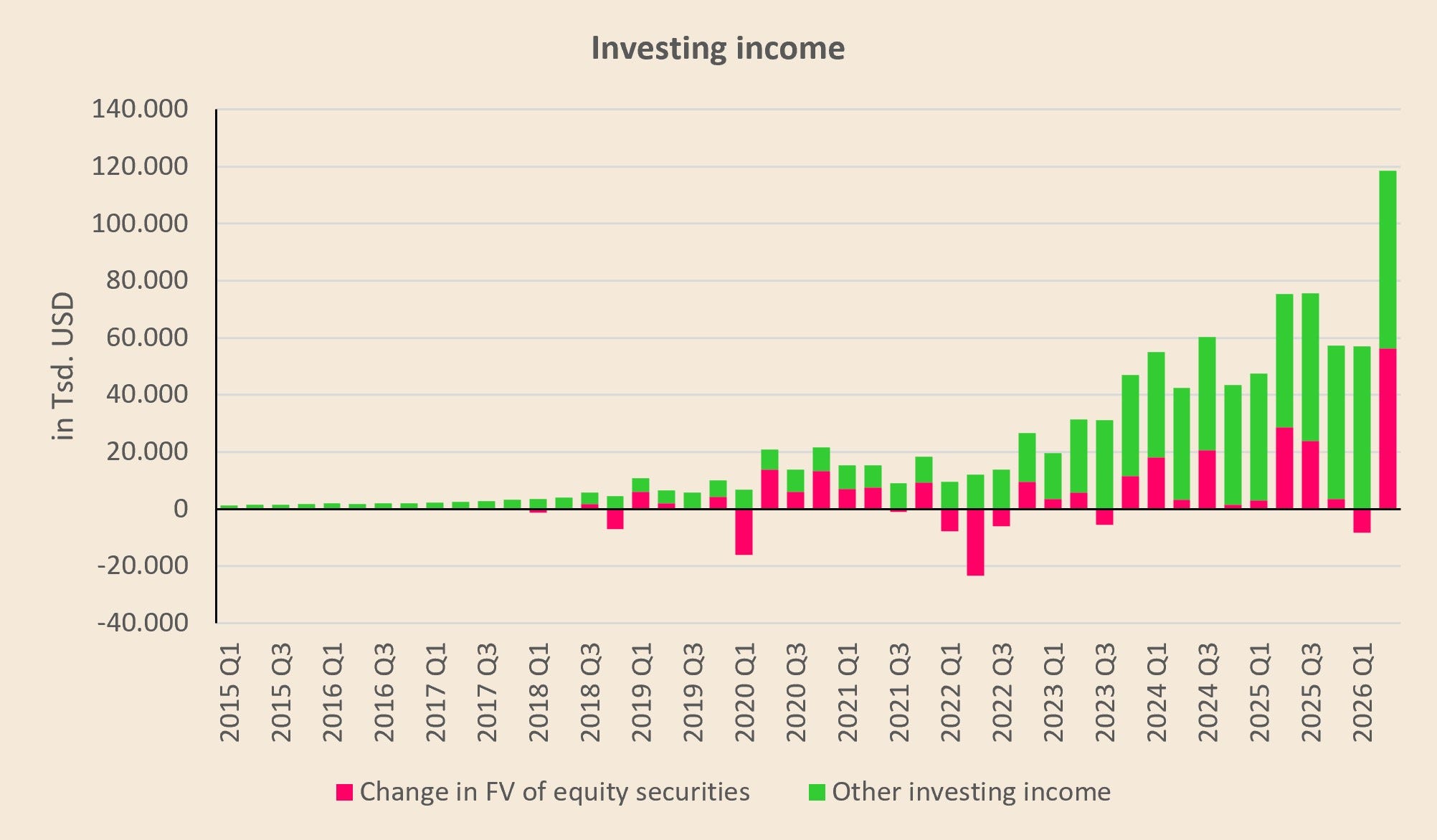
Net investment income increased by 19.9% to $55.7 million. Cash and invested assets reached approximately $5.5 billion.
The strong increase was driven to a significant extent by gains on Kinsale’s equity portfolio. These gains are economically relevant and flow directly through net income, but they can fluctuate considerably from quarter to quarter and should therefore not be treated as recurring earnings.
The remaining investment result has developed much more steadily, supported by the continued growth of the investment portfolio and the higher yields earned on fixed-income securities. I will take a closer look at the composition of Kinsale’s invested assets—and how the portfolio contributes to the company’s RoE—in the second part of this update.
Kinsale shares represent a (very good) value
Kinsale repurchased 321,055 shares at an average price of $311.47, spending $100 million. The Board subsequently increased the repurchase authorization by another $250 million, leaving total remaining capacity of $337.5 million.
Michael Kehoe’s assessment was unusually direct:
“Kinsale shares represent a good value at today’s price. A very good value.”
Management teams regularly claim that their shares are undervalued. The statement carries more weight when it is accompanied by a meaningful deployment of capital.
The timing also makes sense.
During the hard market, Kinsale had an obvious use for nearly every additional dollar of equity. Premium growth of 30%, 40% or even 50% required more capital to support the growing insurance operation.
That has changed, as current market conditions do not allow Kinsale to deploy capital into Commercial Property at the same attractive returns. At the same time, the company continues to generate substantial underwriting profits and investment income.
Repurchasing shares is therefore a logical alternative, assuming the stock trades below a reasonable estimate of intrinsic value. It also shows that management is willing to adapt its capital allocation to the available opportunity set.
When insurance pricing is attractive, Kinsale reinvests heavily in premium growth. When pricing becomes inadequate, it allows business to leave. When excess capital accumulates and the shares appear undervalued, it buys back stock.
There is no need to force capital into one particular use.
That flexibility is valuable, particularly for a company whose organic growth opportunity can vary considerably over the course of an insurance cycle.
New to Slow Compounding?
I am a professional equity analyst and I publish deeply researched analyses of serial acquirers and other high-quality compounders, supported by extensive historical data. Subscribe for free to receive future company updates and Deep Dives directly in your inbox.
Part 2: How Kinsale Generates Its Return on Equity
The economics of an insurance company differ fundamentally from those of most other businesses. Premiums are collected upfront, while claims are paid months or even years later. When an insurer writes a policy, it therefore recognizes a reserve for future claim payments and related expenses. Until those claims are settled, the corresponding funds remain available to the insurer and can be invested. This capital is commonly referred to as insurance float.
The profitability of the insurance operation itself is captured by the combined ratio. It compares claims and underwriting expenses with earned premiums:
A combined ratio below 100% means that the insurer earned an underwriting profit. A ratio above 100% means that claims and expenses exceeded earned premiums, resulting in an underwriting loss.
Viewed from another angle, the combined ratio indicates the economic cost of the float. When the ratio is below 100%, the insurer is effectively being paid to hold and invest the float because the underwriting business is profitable on its own. When the ratio is above 100%, the underwriting loss represents the cost the insurer incurs to obtain that float.
This distinction is particularly important for Kinsale. The company does not merely receive capital that can be invested for several years; it has historically generated substantial underwriting profits while doing so. Kinsale therefore benefits from two separate return engines. First, it earns a profit from writing insurance. Second, it invests both shareholders’ equity and the float created by the time lag between collecting premiums and paying claims.
For an insurer such as Kinsale, the total RoE can therefore be distilled into two broad components (excluding other interest & overhead expenses):
The Underwriting RoE measures the return generated by the insurance business itself.
The Investment RoE captures the return earned on the investment portfolio, including the portion funded by float.
The chart below breaks Kinsale’s 2025 RoE into its main components. The underwriting business contributed 17.9 percentage points, the investment portfolio added another 11.8 percentage points, while financing and other expenses reduced the return by approximately 0.6 percentage points. Together, these components reconcile to a total RoE of 29.2%, broadly in line with the reported 29.3%.
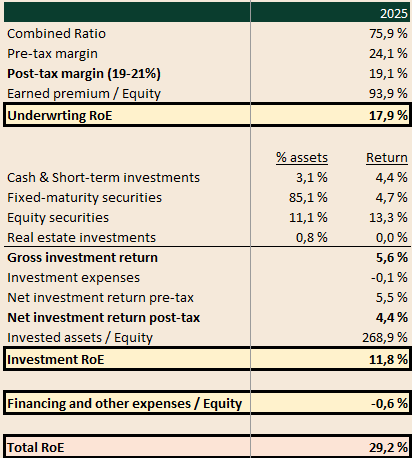
The Underwriting contribution starts with Kinsale’s combined ratio of 75.9%. This corresponds to a pre-tax underwriting margin of 24.1%, or approximately 19.1% after tax (using the actual 2025 tax rate). Since this margin is earned on premiums rather than directly on shareholders’ equity, it must be related to the equity base.
Earned premiums and fees amounted to approximately 93.9% of average equity in 2025. This ratio can be thought of as the underwriting equivalent of a capital-turnover measure: it shows how much premium volume Kinsale generated for each dollar of shareholders’ equity supporting the business.
The after-tax underwriting margin of 19.1% is earned on premiums, whereas RoE measures profit relative to equity. To translate the margin into an RoE contribution, the two therefore have to be linked. In 2025, every $1 of average equity supported approximately $0.94 of earned premiums and fees. Applying the 19.1% after-tax underwriting margin to this premium volume results in an underwriting RoE of 17.9%:
The Investment contribution follows the same basic logic. Based on the mix and returns of Kinsale’s cash, fixed-maturity securities, equity securities and real estate investments, the portfolio generated a weighted gross return of approximately 5.6%. After investment expenses and taxes, the return was approximately 4.4 % (using the 2025 tax rate again).
What turns this seemingly modest return into an 11.8% contribution to RoE is the size of the investment portfolio relative to shareholders’ equity. Kinsale held invested assets equal to approximately 268.9% of average equity, meaning that it had almost $2.70 of invested assets for every $1 of shareholders’ capital:
This is where the economics of insurance float become visible. The investment portfolio is not funded solely by shareholders’ equity, but also by premiums collected before the related claims are ultimately paid. Kinsale therefore earns an underwriting profit while simultaneously investing a pool of assets considerably larger than its equity base. This combination of highly profitable underwriting and returns earned on float is what allows the company to generate such a high overall RoE.
Put differently, Kinsale earns a relatively modest gross return of 5.6% on its investment portfolio. This is largely a function of the portfolio’s conservative composition: fixed-maturity securities account for approximately 85% of average invested assets and generated a return of around 4.7%. The key, however, is the size of the portfolio relative to shareholders’ equity. Supported by insurance float, Kinsale holds invested assets equal to approximately 2.7 times its equity base. As a result, the 4.4% after-tax investment return is magnified by this 2.7-times asset-to-equity ratio, producing an investment RoE of approximately 11.8%.
After accounting for financing and other expenses, Kinsale’s RoE was reduced by approximately 60 basis points in 2025 (called“Other RoE” in the chart below).
How Kinsale’s RoE Has Developed Over Time
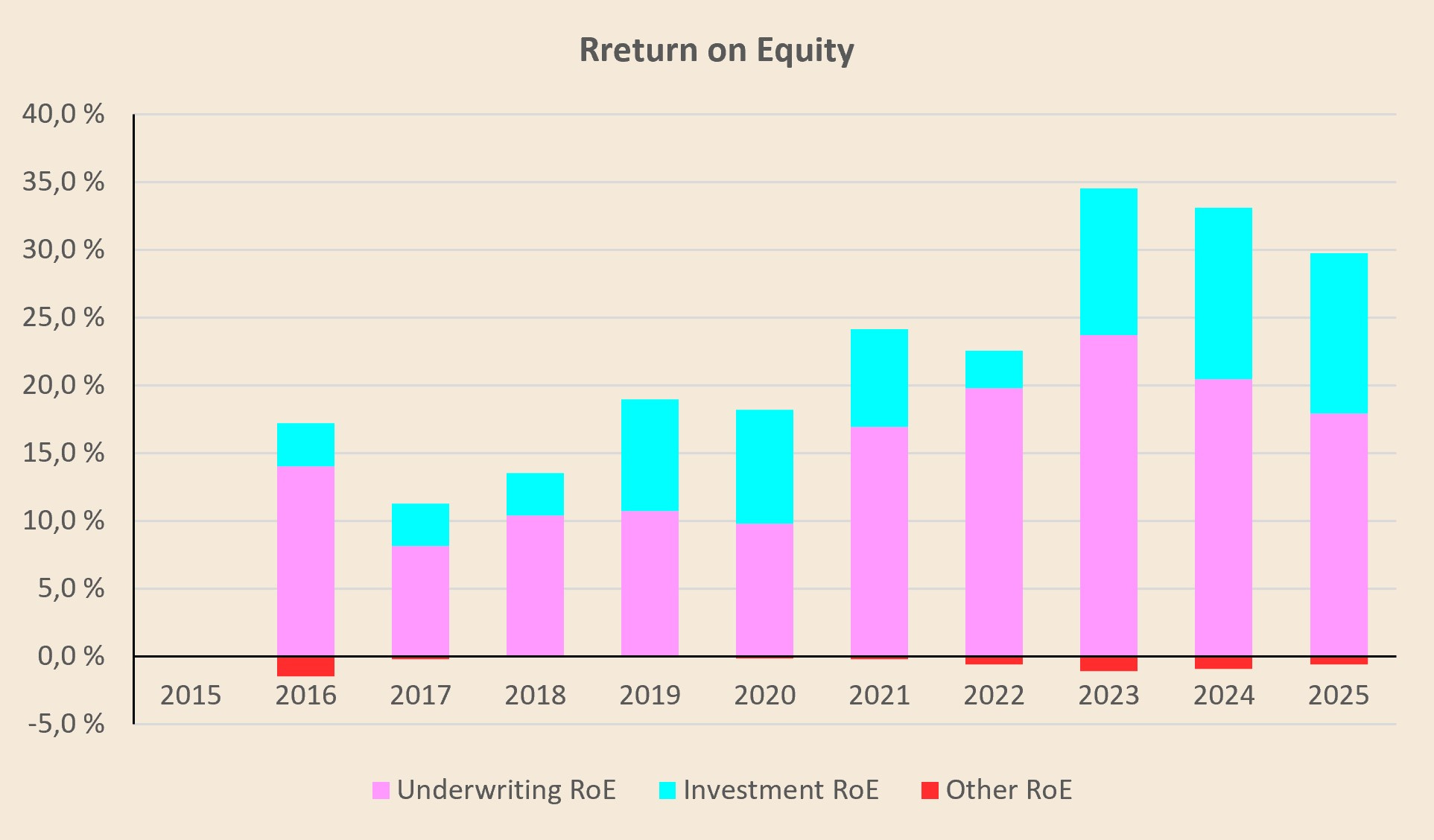
The underwriting business has consistently been the main driver of Kinsale’s RoE. Underwriting RoE peaked at 23.7% in 2023 before declining to 20.4% in 2024 and 17.9% in 2025.
This decline was not primarily caused by weaker underwriting margins. Kinsale’s combined ratio remained broadly stable in the mid-70s. Instead, shareholders’ equity grew faster than earned premiums.
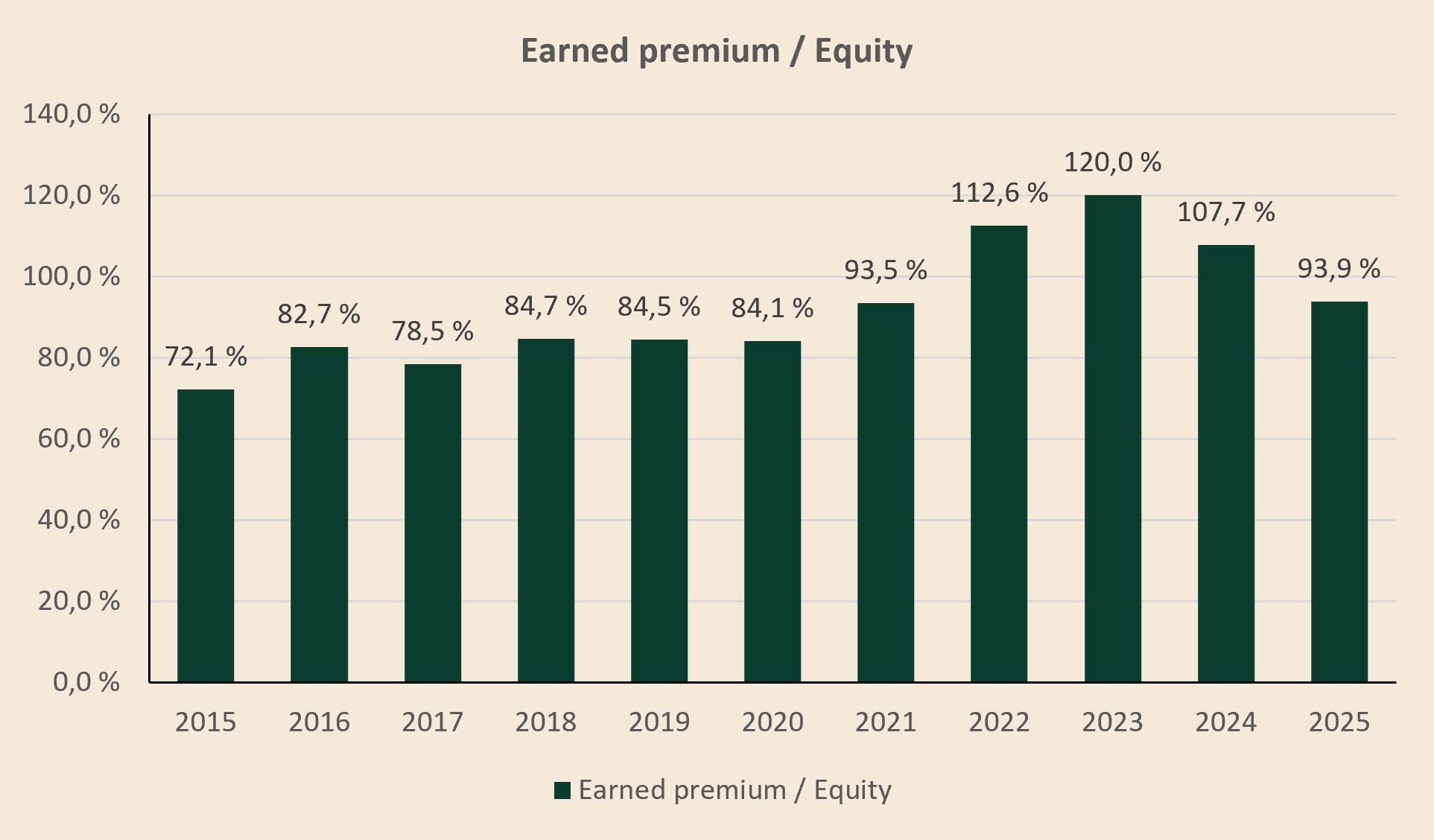
Earned premiums amounted to 120.0% of average equity in 2023, compared with 107.7% in 2024 and only 93.9% in 2025. As explained, this ratio can be viewed as a capital-turnover measure for the underwriting business: it shows how much premium Kinsale generates for every dollar of equity.
Kinsale therefore continued to earn an excellent margin, but on a smaller premium base relative to its growing equity. This explains most of the decline in underwriting RoE since 2023.
The investment contribution is likewise determined by two factors: the return generated by the portfolio and the amount of invested assets relative to equity.
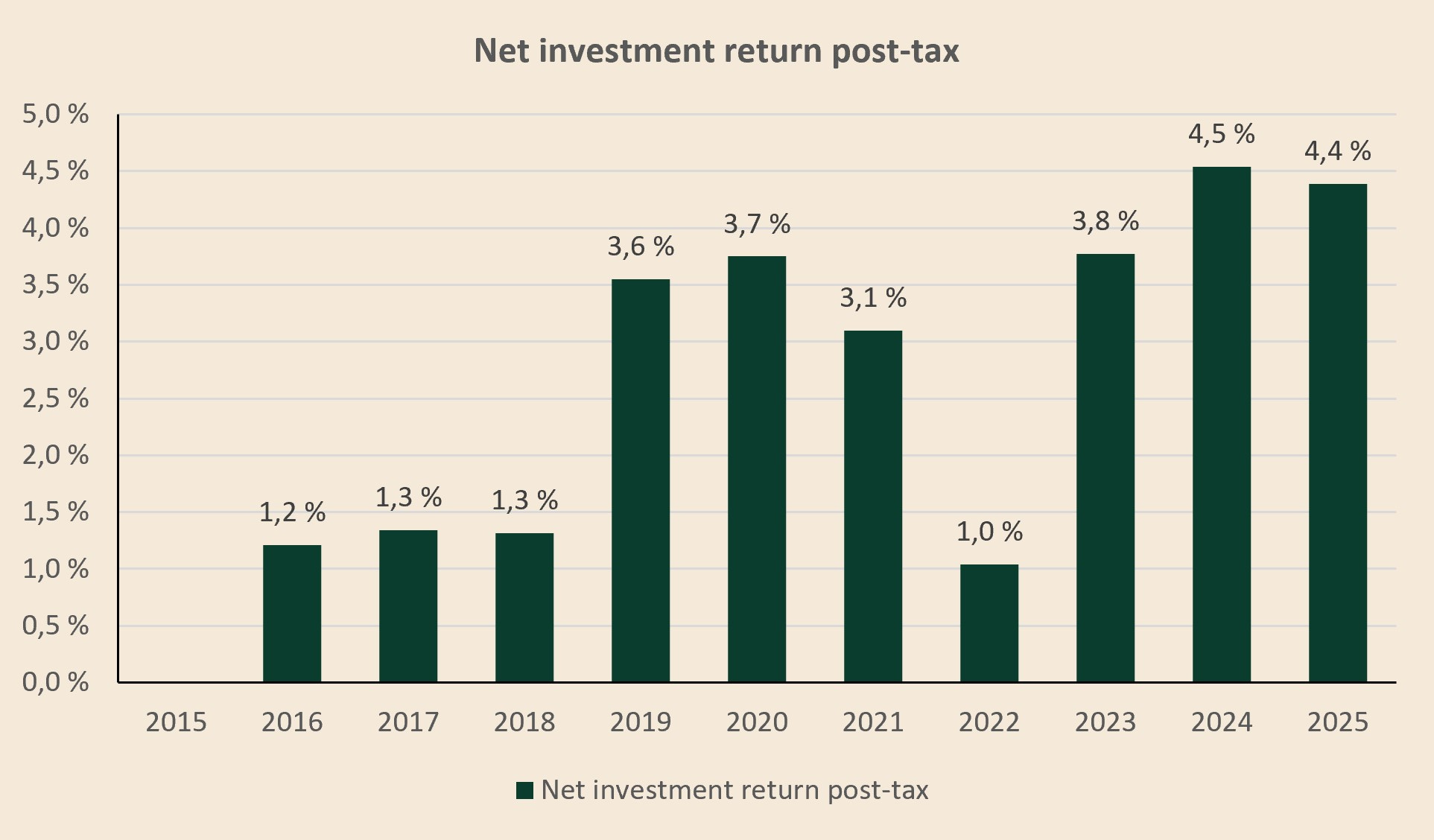
The after-tax investment return increased significantly in recent years, from 1.0% in 2022 to 3.8% in 2023 and 4.5% in 2024, before declining slightly to 4.4% in 2025. The unusually low return in 2018 and 2022 mainly reflected negative fair-value movements in Kinsale’s equity securities.
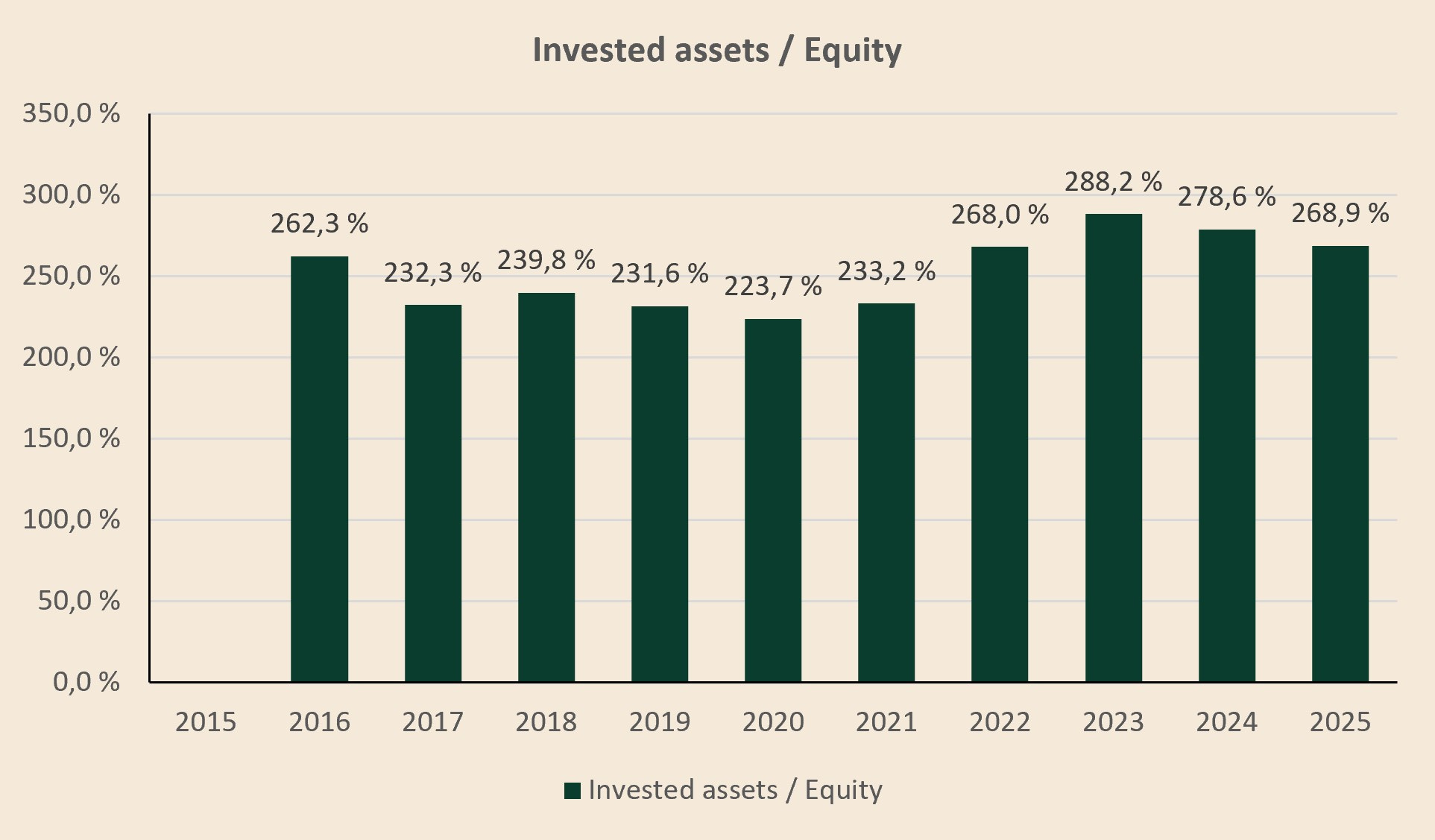
At the same time, Kinsale consistently held invested assets equal to more than twice its equity base. The ratio peaked at 288.2% in 2023 and declined to 268.9% by 2025. Supported by insurance float, Kinsale could therefore earn its investment return on an asset base approximately 2.7 times larger than shareholders’ equity.
Together, these developments explain why total RoE declined from 34.4% in 2023 to 29.2% in 2025. The main reason was not deteriorating underwriting quality, but lower capital utilization: both earned premiums and invested assets declined relative to the growing equity base.
Conclusion
The decomposition makes Kinsale’s return drivers much easier to understand. Despite the growing contribution from investments, Kinsale remains primarily an insurance business rather than a financial holding company with an insurance operation attached (such as Berkshire or Fairfax).
There is nevertheless further potential on the investment side. A gradually higher allocation to equity securities could increase the portfolio’s long-term return, although this would also introduce greater volatility into reported earnings. The investment portfolio may therefore become a more important earnings driver over time, but underwriting remains the foundation of the business.
Management currently runs the business to a 20% RoE or greater, with most product lines reportedly earning returns above that threshold. Looking at the RoE from the bottom up shows why this target appears relatively comfortable.
As long as Kinsale maintains an after-tax investment return above 4% on invested assets exceeding 250% of equity, the investment portfolio alone contributes roughly 10 percentage points to RoE:
Before financing and other expenses, Kinsale would therefore need only another 10 percentage points from underwriting to reach its 20% RoE target. At a combined ratio of 75%, the after-tax underwriting margin is approximately 20%. This means that earned premiums equal to only around 50% of equity would be sufficient to generate a 10% underwriting RoE. Allowing for the roughly 60-basis-point drag from financing and other expenses raises the required ratio only modestly, to approximately 50–55%.
That would still be well below Kinsale’s historical post-IPO low of approximately 78%.
The exercise provides at least a rough indication of how much room management has when balancing underwriting margins, premium growth, investment returns and capital allocation. Kinsale does not need every component to remain at recent peak levels to sustain a 20% RoE.
New to Slow Compounding?
I am a professional equity analyst and I publish deeply researched analyses of serial acquirers and other high-quality compounders, supported by extensive historical data. Subscribe for free to receive future company updates and Deep Dives directly in your inbox.
I like auch ROE decompositions. Industry terms are Investment leverage (Inv/EQ) and underwriting leverage (NPE/EQ).
They wrote less and still earned more, that's the model working. The $100 million buyback is the same discipline on the capital side.