

Quick note before we begin: the previously announced blockbuster Deep Dive is currently scheduled for July 5, one week after this article.
One of the hardest things in investing is recognizing productive reinvestment before it becomes visible in the reported financials. In real time, it rarely looks clean. Revenue may still be growing, but margins compress. Operating income may stall or decline. Analysts lower near-term estimates. Investors begin to question whether management is being disciplined or simply spending too much. The market often struggles to distinguish between a company that is spending defensively to protect a weakening position and a company that is deliberately sacrificing near-term profits to strengthen its long-term competitive position.
This distinction is especially difficult in e-commerce. A platform can spend on shipping, fulfillment, vouchers, technology, seller tools, and customer benefits for years before the payoff becomes obvious. Some of that spending may create durable value by increasing frequency, loyalty, density, and monetization. Some of it may simply subsidize transactions that would disappear as soon as incentives are reduced. The P&L alone rarely tells you which is which at the beginning.
So let us begin with a thought experiment.
The thought experiment
Imagine a young e-commerce company that started from a very small base and then grew at extraordinary rates. Just three years after its founding, the company went public. At the time, it was still tiny, generating only $148 million in net sales. Within a decade of its founding — and seven years after going public — net sales had grown to almost $7 billion. The business was still mostly first-party: it sold products directly to consumers, carried inventory, invested heavily in fulfillment capacity, and absorbed the operating complexity of building a large online retailer from scratch.
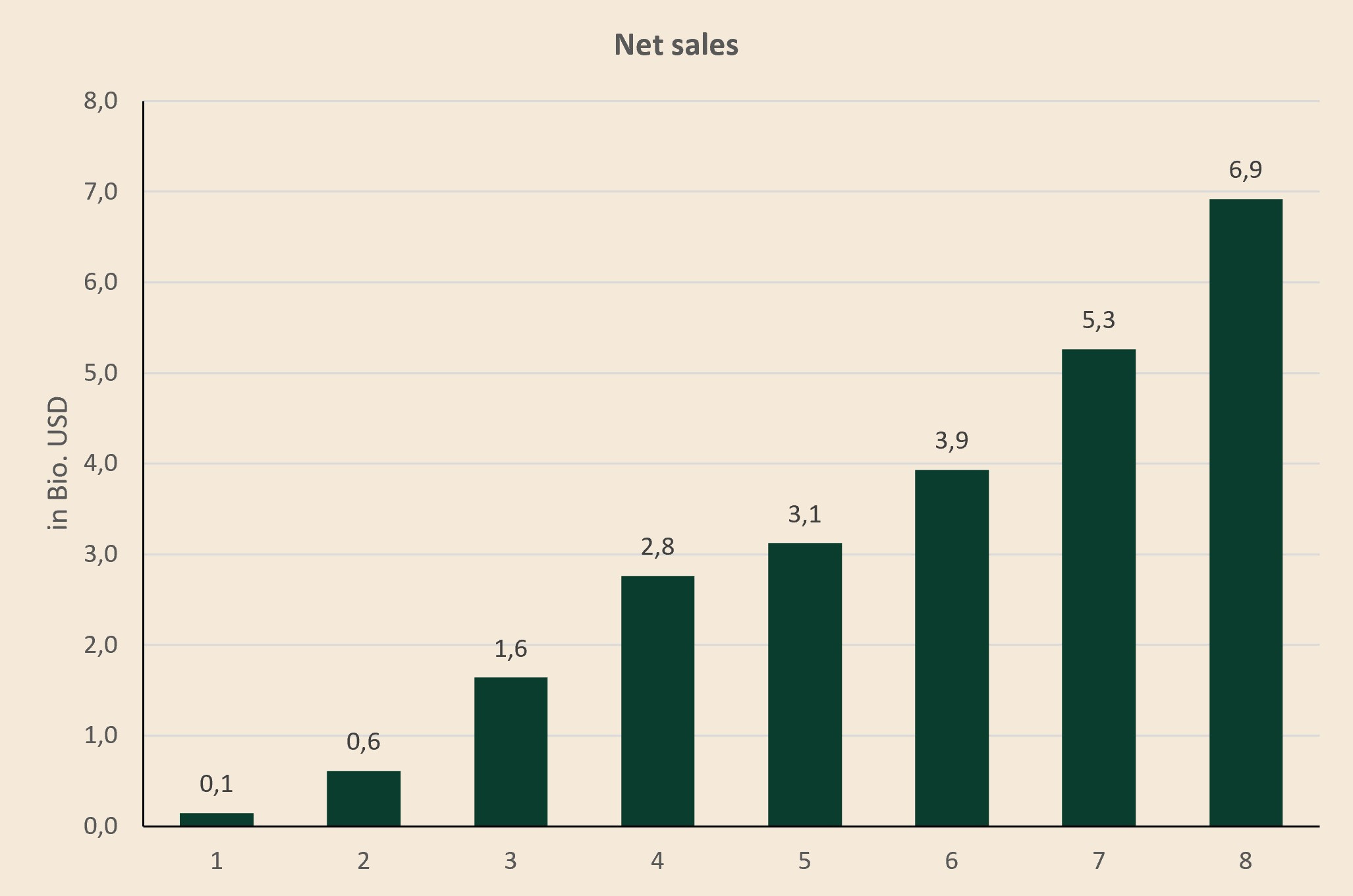
Gross profit increased from almost nothing to roughly $1.6 billion over the first eight reporting periods, while the gross profit margin moved from the high-teens into the low-to-mid twenties.
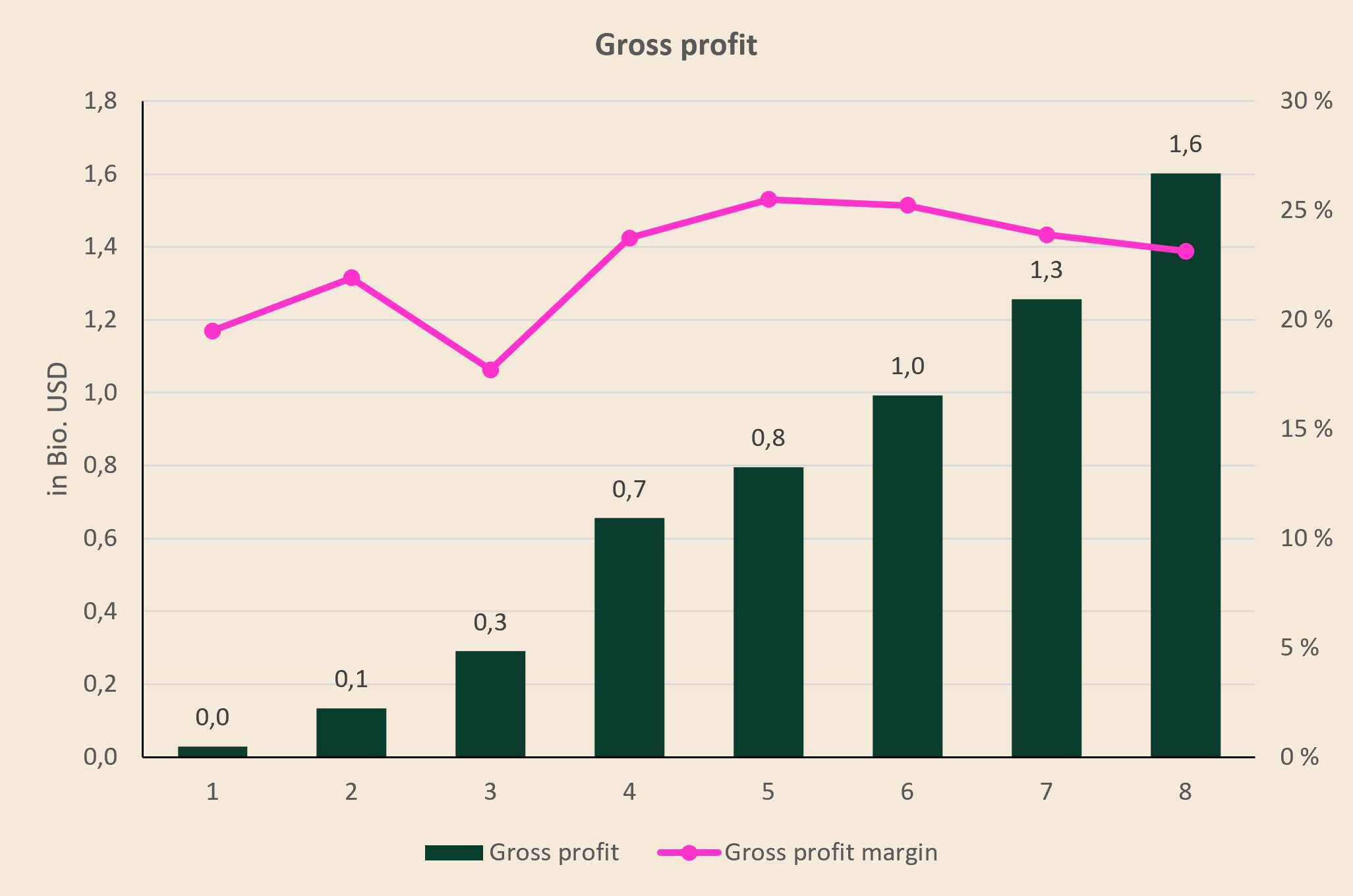
However, almost all of this expanding gross profit was being consumed below the gross profit line. Fulfillment, technology, marketing, and administrative expenses remained heavy because the company was still building the infrastructure required to support a much larger business. This is why the company could show clear gross profit progression while still reporting substantial operating losses. EBIT remained negative for several years, and the operating margin only turned positive once the revenue base had grown large enough to absorb the investments made in earlier periods.
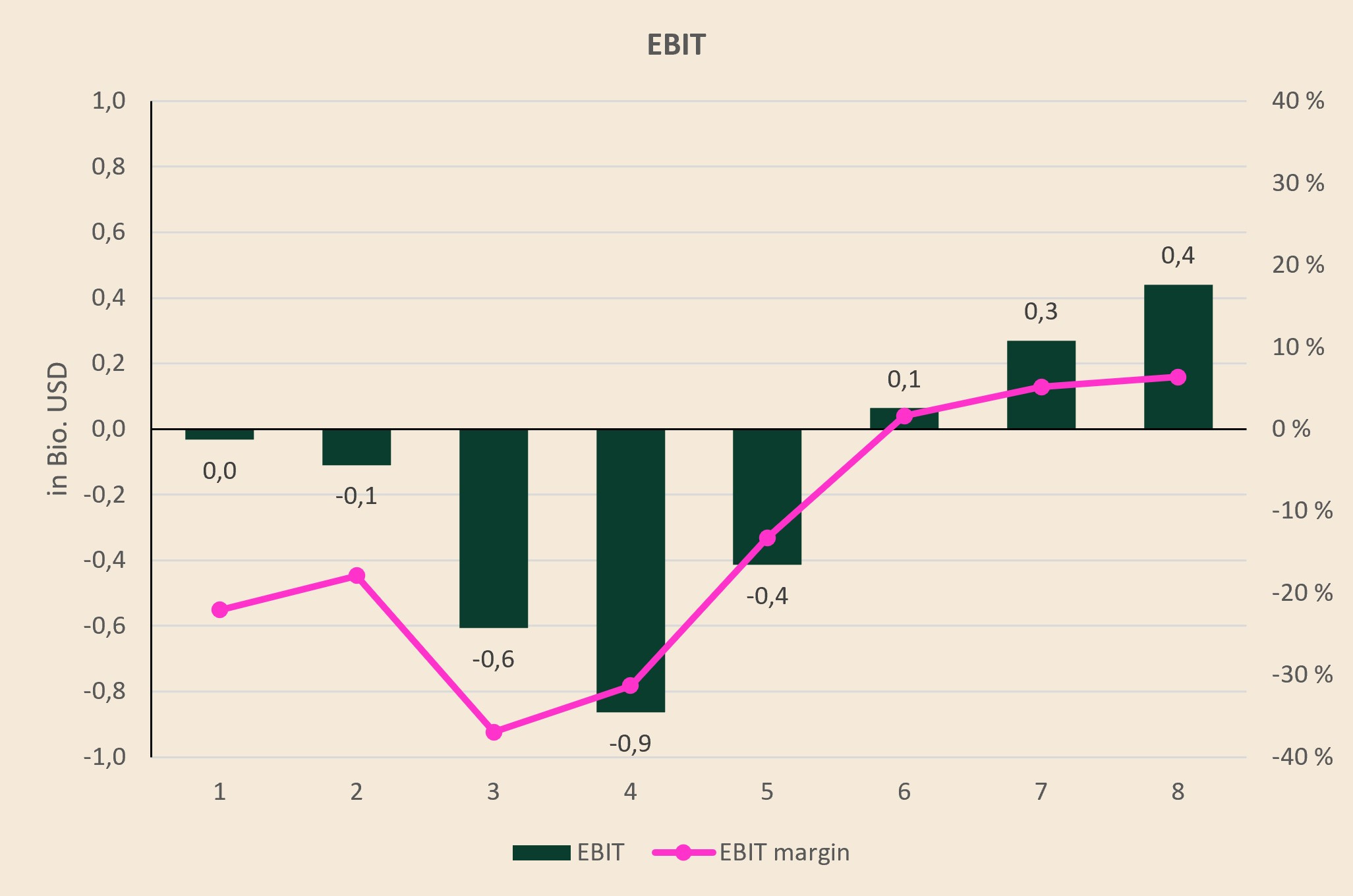
By year 6 after its IPO, the company turned EBIT positive. By year 8 after its IPO, the company generated approximately $440 million of EBIT on $6.9 billion of net sales, equivalent to a 6.4% operating margin. For a business that many investors had previously dismissed as structurally unprofitable, this looked like an important proof point.
There was, however, one important cost item that already hinted at how management thought about the business: shipping.
The company was willing to absorb a negative gross profit contribution from shipping in order to make the customer proposition more attractive. Shipping revenue increased over time, but outbound shipping costs grew even faster. Beginning in the early 2000s, shipping became a clear gross profit headwind, with the gap between what customers paid for shipping and what the company incurred in outbound shipping costs widening materially.
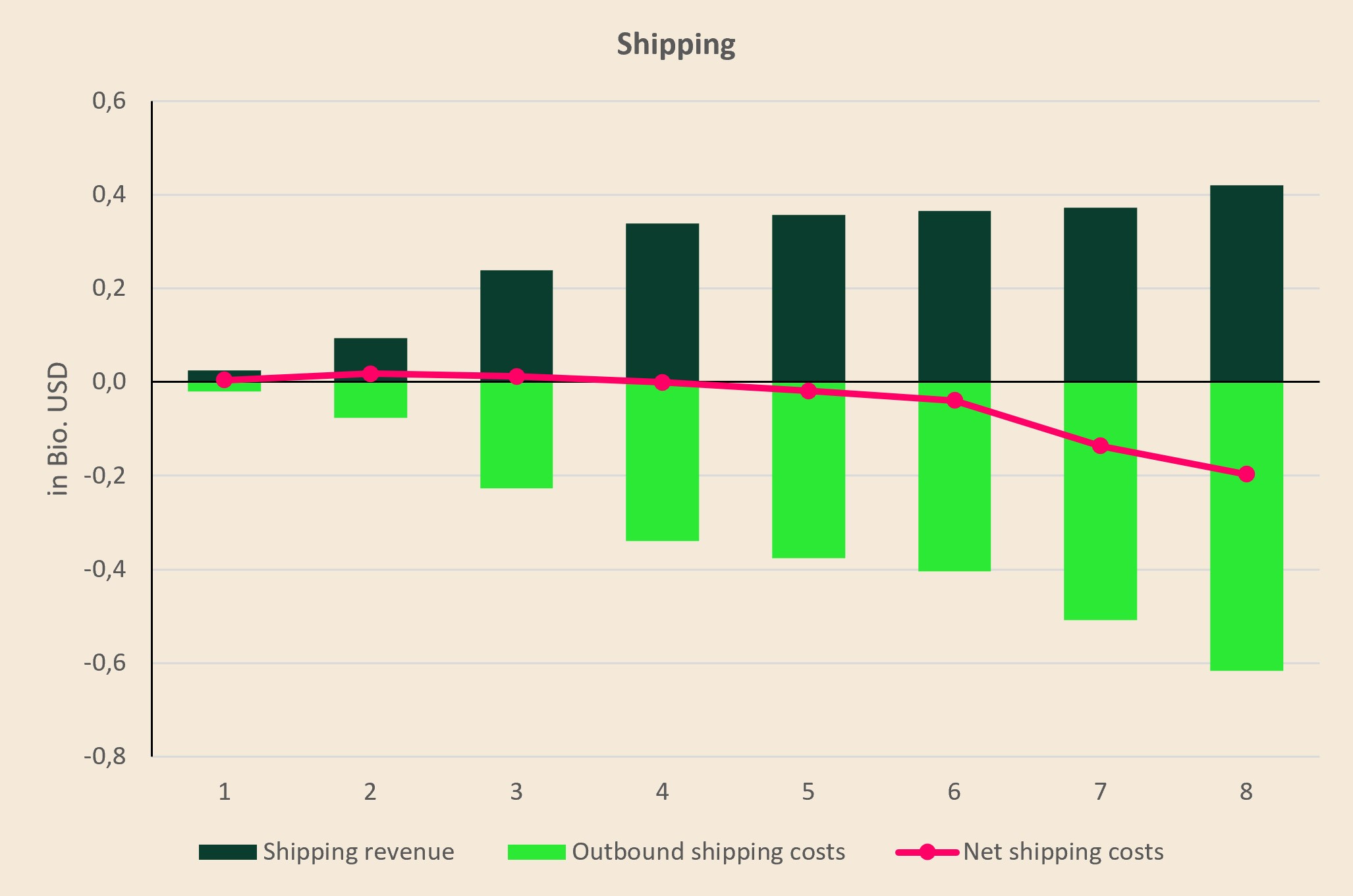
This is an important detail because it shows that the company was not treating shipping as a pass-through cost to be fully recovered from customers. Management was already using shipping economics strategically. The company was effectively accepting lower reported gross profit in exchange for a better customer experience, higher conversion, and greater purchase frequency: Use logistics and shipping convenience as a way to deepen the customer relationship, even if that meant depressing near-term profitability.
At that point, a short-term investor might have expected management to let EBIT-margins expand. The company had spent years proving the model. The obvious next step seemed to be harvesting operating leverage.
Instead, management launched a membership program.
The customer proposition was extremely attractive: pay a fixed annual fee and receive a materially better shipping experience. From the customer’s perspective, this made the platform more useful. From the company’s perspective, it created a new cost burden. Shipping became even cheaper and easier for the customer precisely because the company absorbed more of the cost itself.
The following year, management added another major logistics initiative, this time designed to allow third-party sellers to place inventory inside the company’s fulfillment network. The two initiatives reinforced each other strategically, but they also made the reported financials more difficult to interpret.
The P&L immediately reflected the reinvestment.
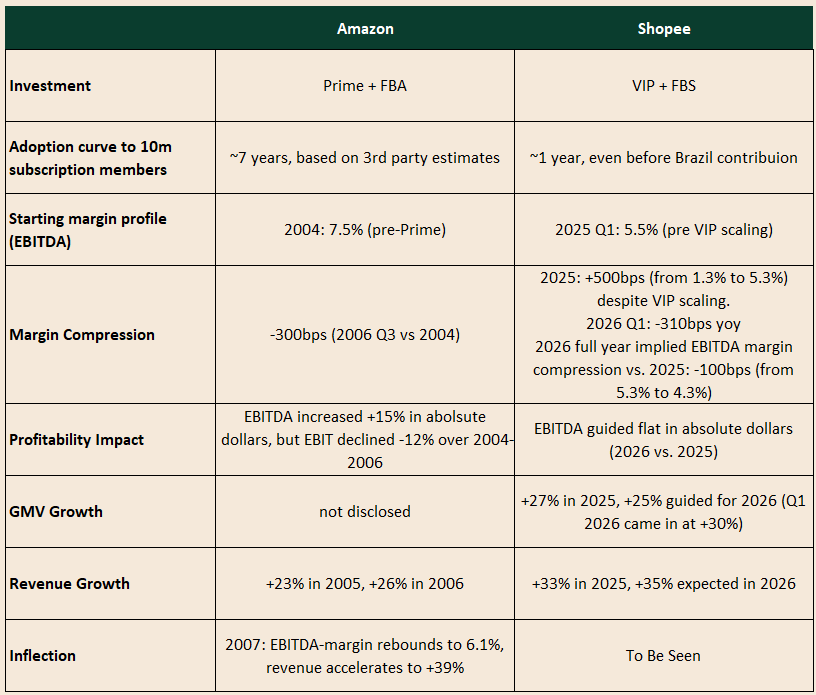
Operating margins declined from 6.4% to 3.6% within two years. Operating income declined in absolute dollars from roughly $440 million to approximately $389 million, even though revenue continued to grow from $6.9 billion to $10.7 billion.
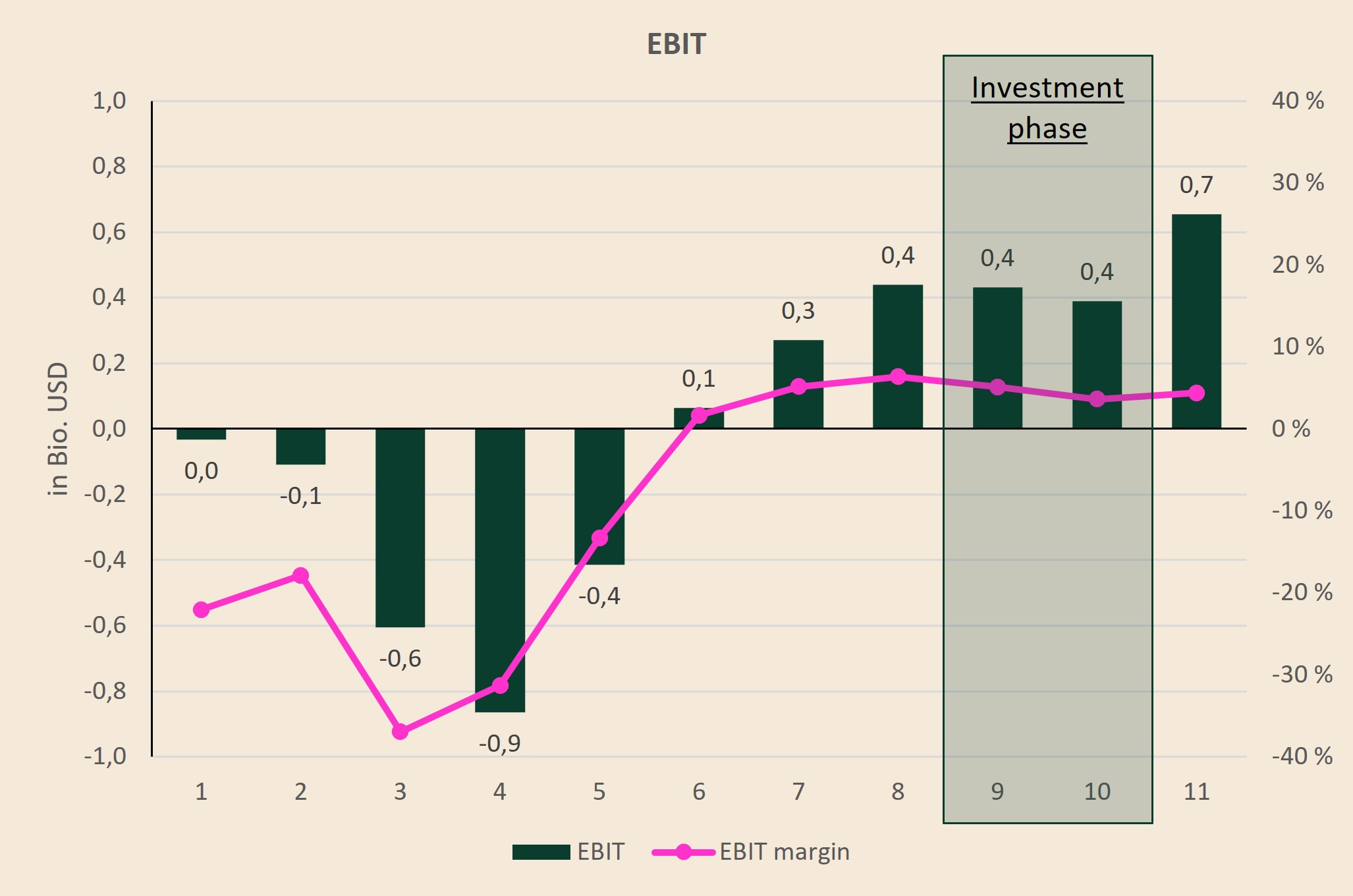
This is exactly the kind of situation the market often dislikes. Revenue was still growing, but margins were contracting as management reinvested to accelerate the flywheel and strengthen the moat. The company had only recently demonstrated profitability, and management was already choosing to give some of it back. Investors had to decide whether this was disciplined long-term investment or another example of an e-commerce company sacrificing profitability for growth.
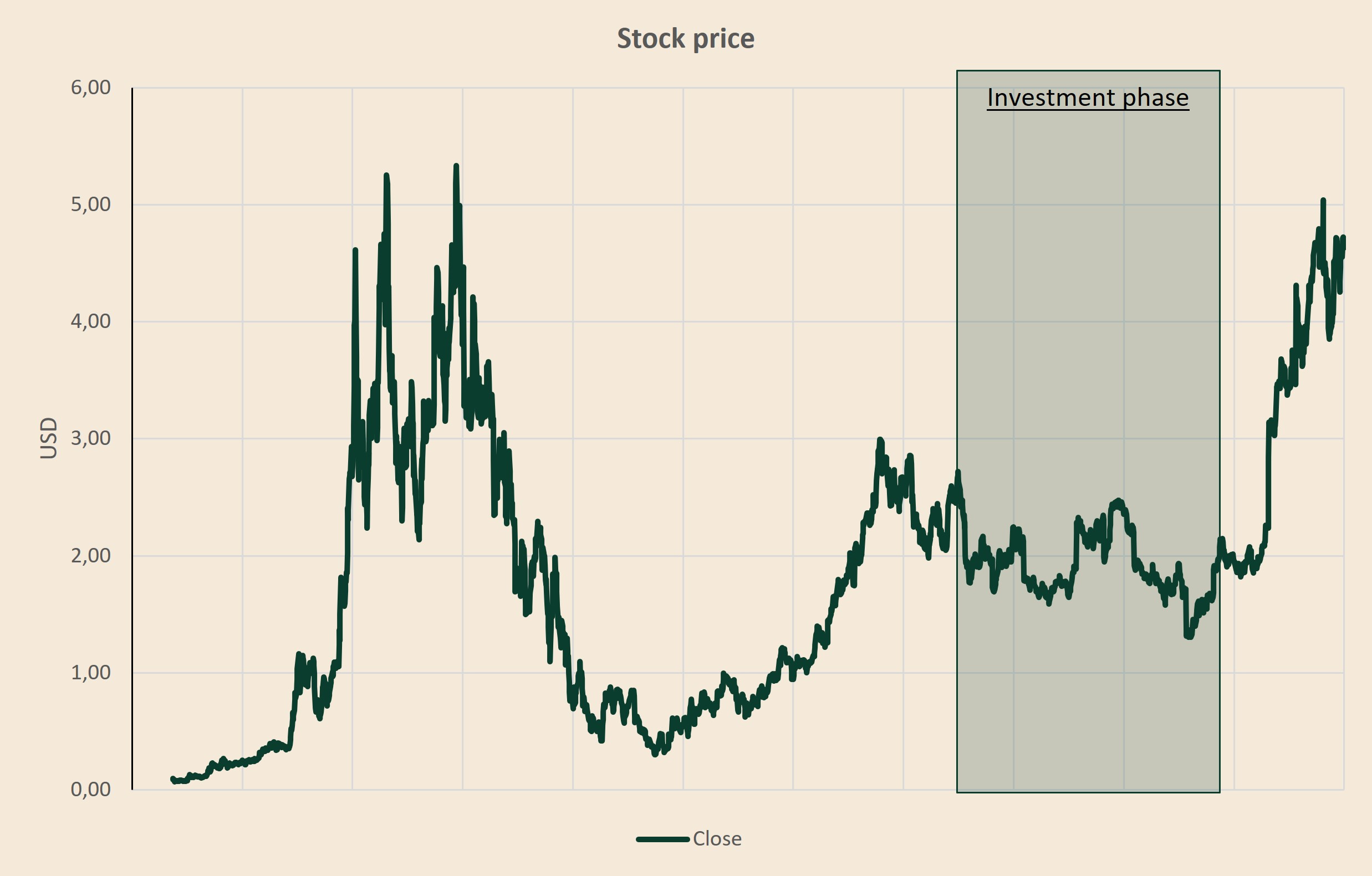
The stock reflected that uncertainty. During this investment period, the share price fell sharply, with a maximum drawdown of roughly 45% from peak to trough. To a skeptical investor, the conclusion was easy: the company had reached a local margin peak, competition and shipping costs were pressuring the model, and management was once again prioritizing growth over profits.
Yet the market’s interpretation changed quickly once the financial evidence began to improve. As operating margins recovered and revenue growth accelerated, the share price rebounded from roughly $2 to almost $5 at the peak in the following year. What had looked like margin-destructive spending began to be reinterpreted as the upfront cost of building a stronger customer relationship, a denser logistics network, and a more powerful marketplace flywheel.
Would you have bought the stock?
The company was Amazon.
The membership program was Amazon Prime, launched in early 2005. The seller logistics initiative was Fulfillment by Amazon (FBA), launched in 2006. In hindsight, both look obvious. At the time, they did not. They looked like expensive reinvestments in a business that had only recently convinced the market it could earn money at all.
Two decades later, the scale of what emerged from that supposedly expensive reinvestment cycle is difficult to reconcile with how uncertain the setup looked at the time. In 2025, Amazon generated $716.9 billion in net sales, of which $128.7 billion came from AWS. The remaining $588.2 billion came from Amazon’s non-AWS businesses — a broad mix of first-party retail, third-party marketplace services, advertising, subscriptions, physical stores, and other consumer-facing activities. Consolidated operating income reached $80.0 billion, equivalent to an 11.2% operating margin. On a gross merchandise value basis, Marketplace Pulse estimates that Amazon and its sellers processed roughly $830 billion of GMV in 2025.
Prime has become one of the central pillars of this ecosystem. Amazon does not disclose Prime membership regularly, but the last official figure was already more than 200 million members globally several years ago. In the U.S. alone, CIRP estimates that 201 million customers used a Prime membership, while eMarketer had previously projected roughly 90 million U.S. Prime households by 2025 (~7 out of 10 households). From the end of 2007, when the Prime/FBA flywheel was beginning to show up more clearly in the numbers, through the end of 2025, Amazon’s split-adjusted share price compounded at roughly 24% per year.
The combination of Prime and Fulfillment by Amazon had started to reinforce the broader marketplace flywheel. Prime increased purchase frequency and made Amazon the default starting point for more customers. This habit formation was central to the economics of the model. In e-commerce, the most valuable customer is not necessarily the one who places the largest single order, but the one who starts more shopping journeys on the platform. Once a marketplace becomes the default starting point, it no longer has to win each transaction from scratch. More frequent customer visits generate more data, improve personalization, increase advertising opportunities, raise seller value, and create the order density required to make fulfillment more efficient. Prime was powerful because it moved Amazon closer to that position: not just a place where customers occasionally bought products, but the place they instinctively checked first.
Need something? You check Amazon first. That sounds simple, but for an e-commerce platform it is one of the most valuable positions imaginable. It means the company has moved upstream in the purchase journey. It is no longer merely competing at the moment of transaction; it is shaping where the transaction begins.
Additionaly, FBA improved the seller-side proposition by allowing third-party merchants to offer a better delivery experience. → Better delivery improved the customer experience. → A better customer experience made Prime more valuable. → More Prime members created more order volume. → More order volume increased fulfillment density. → Greater density helped justify further logistics investment. → The flywheel starts to kick in.
This is the historical pattern that matters for Sea Limited today.
Not because Sea is Amazon.
Not because Shopee VIP is guaranteed to become Amazon Prime.
And not because Southeast Asia or Brazil should be treated as identical to the United States.
The comparison is useful as it shows how an e-commerce platform can deliberately accept near-term margin pressure in order to build a more valuable customer relationship, a denser logistics network, and a stronger marketplace flywheel.
The question is whether Shopee VIP can play a similar strategic role inside Sea’s ecosystem.
Sea’s Current Setup: A Profitable Platform Re-Entering Investment Mode
To answer that question, it is important to start with the setup Sea finds itself in today.
Shopee has already gone through one major profitability reset. After the post-pandemic boom, the market’s central concern was whether the company could ever turn its enormous GMV base into a sustainably profitable business. For several years, Shopee had been valued primarily on growth, scale, and market leadership. Then, as capital became more expensive and investors demanded profitability, the question changed. Growth alone was no longer enough. The company had to prove that the model could work economically.
Sea responded by heavily cutting incentives, rationalizing spending, improving monetization, and demonstrating that Shopee could generate positive earnings.
As a result, growth slowed, but the business crossed into profitability, albeit at a level still well below what a mature Shopee could potentially earn.
As competition from TikTok Shop became a more prominent concern, Sea chose not to maximize near-term margins. Rather than harvesting operating leverage, management elected to reinvest more aggressively into growth initiatives (again).
The company is investing logistics, fulfillment, and Shopee VIP. This is why the current moment is so interesting. Shopee is no longer an unproven e-commerce platform burning cash to acquire users. It is a much larger, more mature marketplace that has already demonstrated profitability and is now deliberately choosing to spend part of that profit pool to strengthen the ecosystem.
The market’s concern is understandable. Investors had only recently become comfortable with Shopee’s ability to earn money. A renewed investment cycle naturally raises the fear that margins were temporarily inflated, competition is intensifying, and the business now requires a higher level of spending simply to defend its position.
That is the defensive spend view.
There is, however, another interpretation. Sea may be using its scale and profitability to move from a transactional marketplace toward a more habitual commerce platform. In that view, Shopee VIP is not merely a discount program and Fulfilled by Shopee (FBS) is not merely a logistics cost center. Together, they are an attempt to increase purchase frequency, improve fulfillment reliability, create more order density, and make Shopee the default shopping destination for a larger share of users.
This is the offensive reinvestment view.
The distinction matters because the two scenarios can look almost identical at the beginning. In both cases, margins compress. In both cases, near-term earnings estimates may come down. In both cases, investors worry that management is giving up profitability just as the business was starting to scale. The difference only becomes visible later. Defensive spend preserves the existing business at a lower margin. Offensive reinvestment expands the future profit pool by making the platform more valuable to customers, sellers, and advertisers.
That is the same analytical problem investors faced in the earlier case study. The Prime membership product and the FBA buildout initially made the financials look worse, even though they eventually helped the platform become more valuable. The question for Sea is whether Shopee VIP and FBS are creating a similar improvement in customer behavior and ecosystem density, or whether they are simply subsidizing transactions in a more competitive market.
What Shopee VIP Is Trying to Change
The strategic importance of Shopee VIP is not that it gives users another set of discounts. E-commerce platforms have always used promotions, vouchers, and free shipping to stimulate demand. The more important question is whether VIP changes the structure of the customer relationship.
A normal marketplace relationship is transactional. A customer opens several apps, compares price, delivery time, seller reputation, and available vouchers, and then chooses where to buy. In that world, the platform has to win every transaction again and again. Even if the marketplace is large, customer loyalty can remain shallow because users are constantly comparing alternatives.
A membership product tries to change that behavior. It gives the customer a reason to start the shopping journey inside one ecosystem. If the benefits are used frequently enough, the platform becomes more habitual. The user does not necessarily stop comparing forever, but the starting point changes. That is the key.
For Shopee, this matters because the company operates in markets where competition is intense, average order values can be relatively low. TikTok Shop, Lazada, Tokopedia, Mercado Livre in Brazil, local players, social commerce channels, and offline retail all compete for consumer attention and wallet share.
Shopee VIP is designed to move the business in that direction. Free shipping with no minimum spend reduces friction for smaller, more frequent purchases. Daily vouchers create a reason to return to the app more often. The membership structure gives users a recurring relationship with the platform rather than a purely transactional one. If this works, VIP can increase order frequency, improve retention, and deepen Shopee’s position in the consumer’s shopping routine.
The Early Evidence: Small Penetration, Outsized GMV Contribution
Shopee VIP is still early, and the available data should be interpreted carefully. Some of the numbers rely on estimates, and the time period is short. It would be a mistake to treat the current data as proof that VIP will become a Prime-like product. At this stage, the data is better understood as a set of early signals.
Those signals are nevertheless highly interesting (and promising).
Sea first piloted the VIP membership program in Indonesia in the first quarter of 2025, targeting some of Shopee’s most loyal users with a paid membership product that included more generous free shipping benefits, larger discount vouchers, and priority customer service, as Indonesia is Shopee’s largest and most strategically important market in Southeast Asia, with enough scale to test whether a membership product could change behavior in a meaningful way.
The early response was strong enough for management to expand the program quickly. By the end of the second quarter, Shopee VIP had been rolled out to Thailand and Vietnam as well. Over the rest of 2025, the program was expanded further across Shopee’s Asian markets. By year-end, subscribers had surpassed 7 million, and management noted that VIP members were consistently showing a double-digit spending uplift after joining.
After proving the concept in Asia, Sea launched Shopee VIP in Brazil in April 2026, extending the membership model into its most important Latin American growth market.
Shopee VIP members increased from approximately 1.5 million in Q1 2025 to around 10.0 million in Q1 2026. That is a rapid adoption curve for a program that is still in the early stages of scaling — and notably, the Q1 2026 figure does not yet include any contribution from Brazil, where the rollout only began afterward.
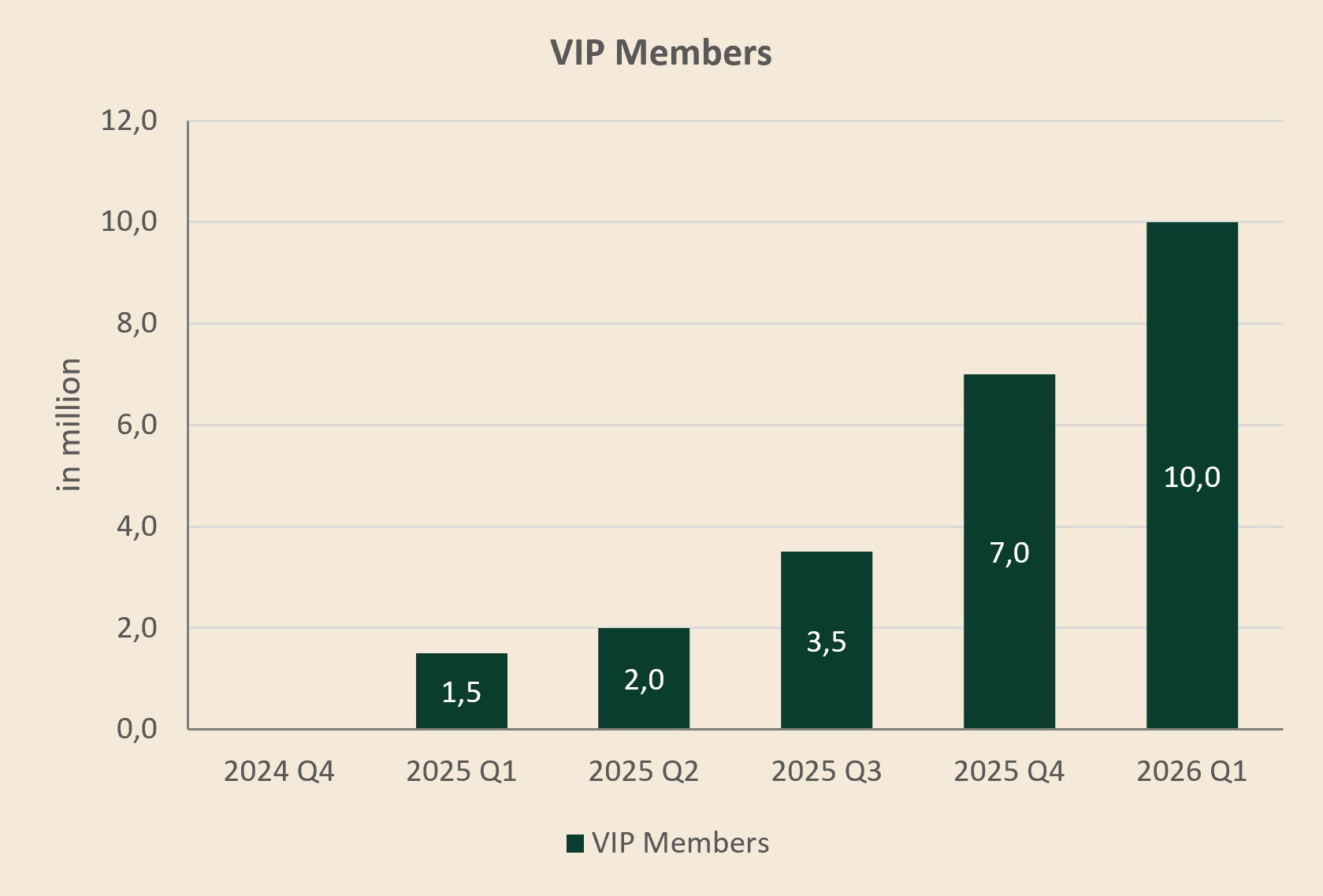
By comparison, Amazon Prime appears to have reached roughly 10 million members only by the end of 2012, around seven years after its 2005 launch (although Amazon did not officially disclose Prime membership at the time, so this figure is based on third-party estimates). Shopee reached that same milestone in roughly one year.
However, the penetration is still low relative to Shopee’s overall buyer base. Based on estimates, Shopee had ~418 million active buyers in Q1 2026. Against that base, 10 million VIP members would imply only around 2.4% penetration.
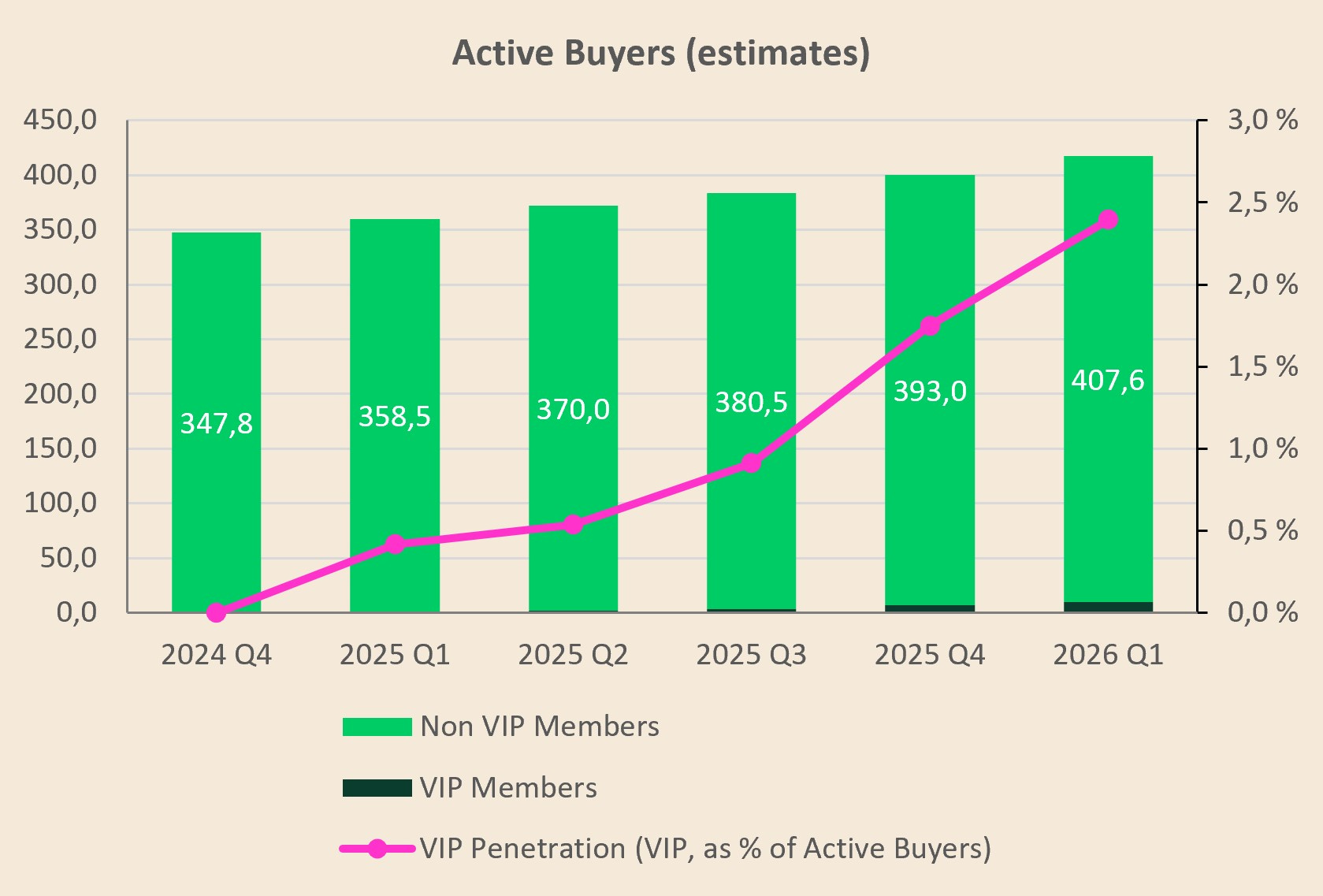
The GMV contribution appears far more significant than the membership penetration would suggest.
“By the end of March, total subscribers across our Asian markets surpassed the 10 million, up more than 40% from the previous quarter, with strong program retention averaging above 80%. Across all markets, our Shopee VIP members have consistently demonstrated double digit spending uplift after subscribing by as much as 30%-40% in some markets. Shopee VIP members now contribute around 20% of GMV across Asia. Building on this success, we have rolled out our Shopee VIP program in Brazil in April.” — Forrest Li (CEO), Q1 2026 earnings call
In other words, a very small share of buyers may already be driving a disproportionately large share of marketplace activity.
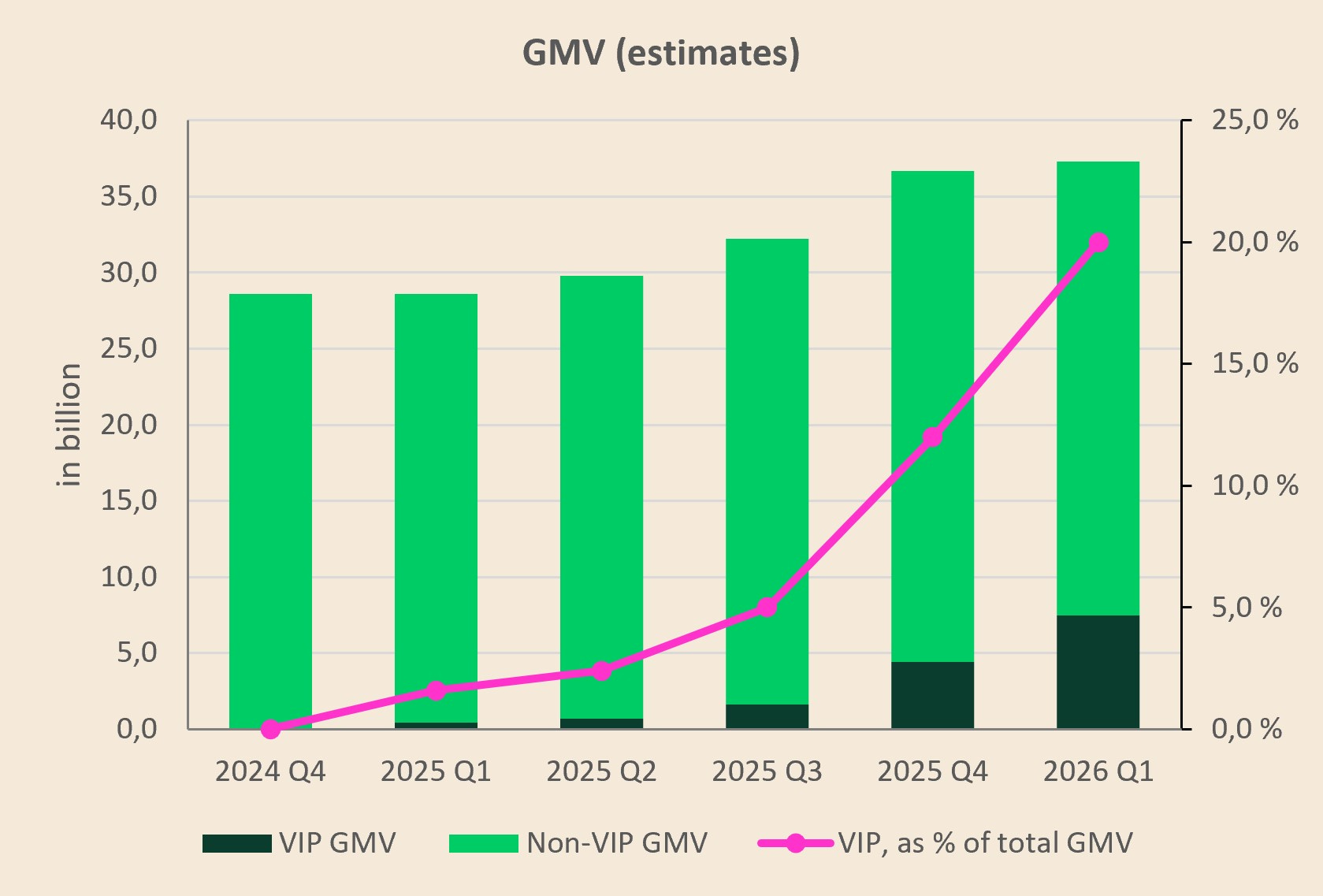
This is probably one of the most important charts in the article, but it also requires the most careful interpretation. VIP members are almost certainly not average Shopee users. Heavy users are more likely to join a membership program in the first place because they can extract more value from free shipping and vouchers. Therefore, part of the apparent outperformance reflects selection bias. VIP is not necessarily turning average users into power users overnight; it is likely attracting Shopee’s existing power users first. In that sense, the early adoption curve may partly reflect the low-hanging fruit: the users for whom the value proposition was most obvious from day one because they were already ordering frequently enough to justify the membership.
However, that does not make the data unimportant. In fact, it may be strategically desirable. A marketplace’s most valuable customers are its high-frequency, high-trust, high-retention customers — the classic Pareto principle applied to marketplace behavior. If VIP allows Shopee to identify, retain, and further monetize these users, that alone has value. The stronger version of the thesis is that VIP not only captures existing power users, but gradually increases the frequency of users who would otherwise have ordered less often.
My estimates suggest that quarterly GMV per VIP member is dramatically higher than GMV per non-VIP buyer. The exact ratio should not be treated as a precise metric, because the calculation relies on a handful of undisclosed metrics. But the directional message is difficult to ignore: VIP members are economically much more valuable than the average non-VIP buyer.
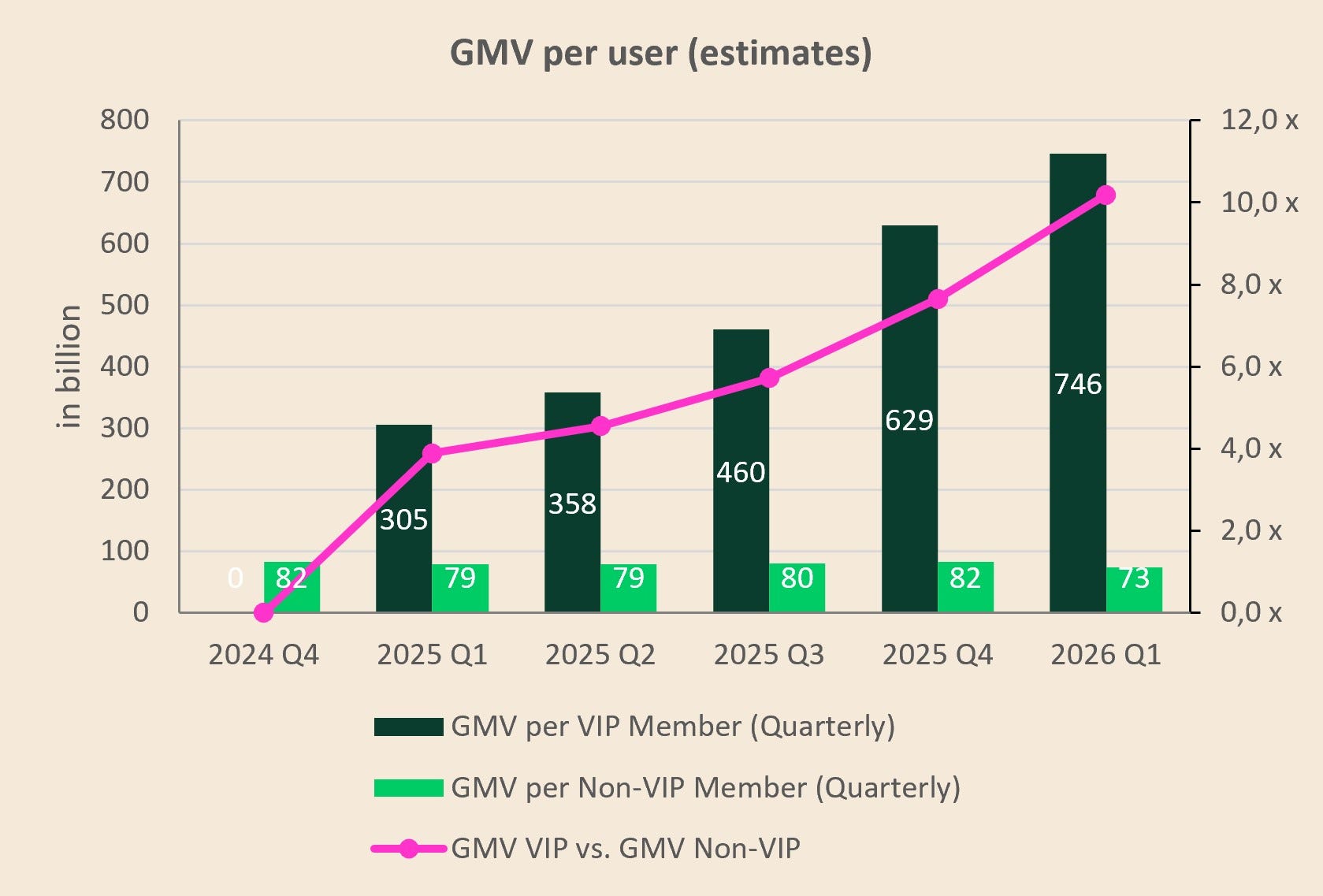
Sea’s own disclosure provides a useful sanity check for this estimate. On the Q3 2025 earnings call, management noted that Shopee VIP members in Indonesia “bought three times more frequently and spent five times more than non-subscribers” during the quarter, while accounting for about 10% of total GMV in Indonesia.
Why Frequency Is A Key Variable
Frequency determines how often the customer relationship is “refreshed”. A user who buys once per year has limited strategic value. A user who buys several times per month is very different. That user generates more GMV, more data, more opportunities for advertising, more seller value, and more logistics density. Over time, frequency can become one of the most important drivers of marketplace quality.
This is why membership programs can be so powerful when they work. They are not merely monetization tools; they are behavior-shaping tools. A well-designed membership product reduces the friction of placing incremental orders and gives users a reason to return more often. The more frequently the customer returns, the more natural it becomes to start future shopping journeys on the same platform.
For Shopee, this is particularly important because the company does not operate in a winner-take-all environment. Consumers can compare prices, search on other marketplaces, discover products through TikTok, buy through social channels, or return to offline retail. Shopee’s challenge is to become the most convenient, trusted, and habitual commerce destination.
Shopee VIP directly targets that challenge. Free shipping with no minimum spend lowers the barrier for small orders. Daily vouchers increase the incentive to open the app regularly. If those benefits create a loop in which users check Shopee more often, buy more frequently, and build a stronger preference for the platform, then VIP can improve the quality of Shopee’s GMV, not just the quantity.
That distinction is important. Subsidized GMV is low quality if it disappears once incentives are reduced. Habitual GMV is much higher quality because it reflects a deeper customer relationship.
This is also where management’s disclosure on post-subscription behavior becomes important. Sea noted that across markets, Shopee VIP members have consistently shown a double-digit spending uplift after subscribing, reaching as much as 30–40% in some markets. That does not eliminate the selection effect — VIP is still likely attracting Shopee’s existing power users first — but it suggests that the program is not merely identifying high-value customers. It appears to be increasing their spending after they join.
VIP and FBS: The Buyer-Side and Supply-Side Flywheel
Shopee VIP should not be analyzed in isolation. Its strategic value depends partly on how it interacts with Shopee’s logistics and fulfillment investments.
The buyer-side logic is straightforward. VIP makes the platform more attractive to consumers by reducing shipping friction and increasing the perceived value of frequent purchases. This can increase order frequency and create more predictable demand.
The supply-side logic comes through FBS. As more items are fulfilled through Shopee-controlled infrastructure, Shopee can improve delivery reliability, service consistency, and potentially cost efficiency. Better fulfillment improves the customer experience, which makes VIP more valuable. More VIP members create more order volume, which improves logistics density. Greater logistics density can justify more fulfillment investment, which further improves service quality.
This is the potential flywheel:
Shopee VIP increases frequency
↓
Higher frequency increases order volume
↓
More order volume improves logistics density
↓
Greater logistics density improves fulfillment economics and delivery reliability
↓
Better fulfillment makes the VIP proposition more valuable
↓
A more valuable VIP proposition attracts and retains more members
↓
More members generate more frequent orders
↓
The loop repeats
Amazon Prime created the customer demand for fast, reliable, low-friction shipping. FBA helped sellers participate in that promise. The two initiatives reinforced each other. Prime without fulfillment capability would have been difficult to scale. Fulfillment investment without Prime would have had less demand density behind it.
Shopee VIP and FBS may develop in a similar direction, although the economics will differ by region. Shopee’s markets generally have lower average order values and more fragmented logistics environments than Amazon’s early U.S. market. That makes the execution challenge harder, but it also makes density more valuable. If Shopee can aggregate demand, increase fulfillment control, and improve delivery reliability in markets where logistics are structurally difficult, that can become a meaningful competitive advantage.
Prime vs. VIP: Where the Analogy Holds
I’m not making the point that Shopee VIP will become as large or as powerful as Amazon Prime. The point is that both programs are attempts to form the consumer relationship from occasional and transactional to (even more) frequent and (even more) habitual.
Several similarities stand out.
Both programs were launched or scaled after the platform had already established meaningful market position. Neither was the first step in building the marketplace. Instead, each came after the company had already accumulated scale and could begin using that scale to improve the customer proposition.
Both programs created near-term pressure on reported profitability. Customer benefits, free shipping, fulfillment investment, and logistics infrastructure are expensive. The strategic logic may be strong, but the accounting impact appears first through the P&L.
Both programs were connected to fulfillment. Amazon Prime and FBA reinforced each other. Shopee VIP and FBS may do the same. A membership promise becomes more powerful when the platform can control delivery quality, and fulfillment infrastructure becomes more valuable when there is enough recurring demand to support it.
Both programs aim to increase frequency. A membership product that does not increase frequency is far less valuable. A membership product that makes the platform the first place customers check can change the long-term economics of the marketplace.
And both programs were introduced during periods when the market was uncertain about the payoff. In Amazon’s case, investors had to underwrite Prime and FBA before the flywheel was obvious. In Sea’s case, investors now have to decide whether VIP and FBS are defensive spending or offensive reinvestment.
Early Trajectory
Viewed through that framework, Shopee’s early trajectory is striking. On several of the early indicators we can observe, Shopee appears to be moving faster than Amazon did at a comparable stage. VIP reached roughly 10 million members in about one year, while Amazon Prime appears to have taken roughly seven years to reach a similar level based on third-party estimates. Shopee is also scaling VIP alongside FBS at a time when its GMV growth remains strong and the business has already demonstrated profitability.
Where the Analogy Could Break
The comparison also has clear limitations.
The first and most important difference is the nature of the value proposition. Amazon Prime was primarily built around convenience, especially fast and free shipping. Shopee VIP appears to rely more heavily on a combination of free shipping and daily vouchers. That matters because convenience-driven loyalty is usually more durable than discount-driven loyalty. A customer who stays because the platform is faster, more reliable, and easier to use is more valuable than a customer who stays only because today’s voucher is attractive.
The second difference is market structure. Amazon’s early Prime years benefited from rising U.S. e-commerce penetration, improving household internet adoption, and a relatively attractive logistics backdrop compared with many emerging markets. Shopee operates across Southeast Asia and Brazil, where average order values, payment methods, delivery infrastructure, geography, and consumer income levels can vary widely. Free shipping is harder to monetize when order values are low, and fulfillment density has to be earned market by market.
The third difference is competition. Amazon competed with traditional retailers and other e-commerce players, but Shopee also faces social commerce such as TikTok Shop. That changes the competitive battlefield. Shopee’s advantage must come from trust, selection, value, transaction reliability, fulfillment, and habit. VIP can help reinforce those advantages, but it does not eliminate the threat from entertainment-led commerce.
The fourth difference is the maturity of the broader ecosystem. Amazon eventually layered Prime on top of a business that would also benefit from a rapidly growing third-party marketplace, advertising, AWS, and an expanding logistics network. Sea has its own ecosystem assets, including Shopee, SeaMoney, and Garena, but the shape of the long-term monetization stack will not be identical.
What the Market May Be Missing
The market often struggles with reinvestment cycles because the costs are visible before the benefits are measurable. The expense shows up immediately in margins. The benefits show up later in retention, frequency, fulfillment efficiency, merchant demand, advertising monetization, and long-term earnings power.
Sea’s current valuation appears to reflect considerable skepticism. Investors see TikTok Shop competition, renewed spending, and lower near-term margins. They may be less willing to underwrite the possibility that Sea is reinvesting from a position of strength rather than weakness.
This distinction matters. Sea today is not the same company it was during the most painful part of the post-pandemic reset. Shopee has already demonstrated that it can generate profits. The marketplace is larger, more developed, and more deeply embedded in its core regions. Management now has a stronger base from which to invest.
If Sea were merely increasing subsidies to protect share, skepticism would be justified. But if the company is using its scale to build a stronger frequency and fulfillment loop, the market may be valuing the investment cycle incorrectly.
The potential upside does not require Shopee VIP to become Amazon Prime. It only requires VIP to improve the slope of Shopee’s core variables: frequency, retention, logistics density, and monetization. Even a modest improvement in those variables can have a large impact when applied to hundreds of millions of buyers and a very large GMV base.
What Needs to Be Proven
The coming quarters should be evaluated less on one single margin number and more on whether the strategic indicators continue to improve.
The first metric to watch is VIP penetration. A program with roughly low-single-digit penetration still has significant room to grow. If VIP penetration continues to increase while maintaining strong engagement, the program becomes more relevant to the overall Shopee ecosystem.
The second metric is VIP GMV share. If VIP members continue to account for a disproportionate share of GMV, Shopee may be concentrating more activity among its highest-value users. The composition of that GMV will matter, but the direction is important.
The third metric is frequency. This is the most important behavioral indicator. VIP only becomes strategically powerful if it increases order frequency and keeps users engaged over time.
The fourth metric is retention. A membership product can look strong early if it attracts heavy users, but the long-term value depends on whether those users remain members and continue to consolidate spending inside the platform.
The fifth metric is FBS penetration. VIP and fulfillment should ideally scale together. If more orders are fulfilled through Shopee-controlled infrastructure, the company may gain more control over delivery reliability, speed, and service consistency.
The sixth metric is logistics cost per order. The long-term case depends on density. If more frequent ordering improves cost efficiency, then near-term logistics investment can become a source of future operating leverage.
The seventh metric is competitive position. If Shopee continues to grow faster than the broader e-commerce market while TikTok Shop growth moderates, the defensive-spend bear case becomes less convincing.
Together, these indicators should help answer the central question: is Shopee VIP merely subsidizing transactions, or is it changing the structure of the customer relationship?
This is what I will be tracking closely over the coming quarters. Shopee VIP is still early, and each new disclosure should help clarify whether it is simply subsidizing transactions or becoming a more durable frequency and loyalty layer inside Shopee’s ecosystem.
Subscribe to Slow Compounding to follow the thesis as it develops.
Valuation: back to IPO-level pessimism
Measured on forward EV/Sales, the stock is now trading close to the lowest level in its public market history. EV/Sales is the more useful long-term valuation lens because Sea was not sustainably profitable before 2023, making a historical EV/EBITDA comparison less meaningful across the full period.
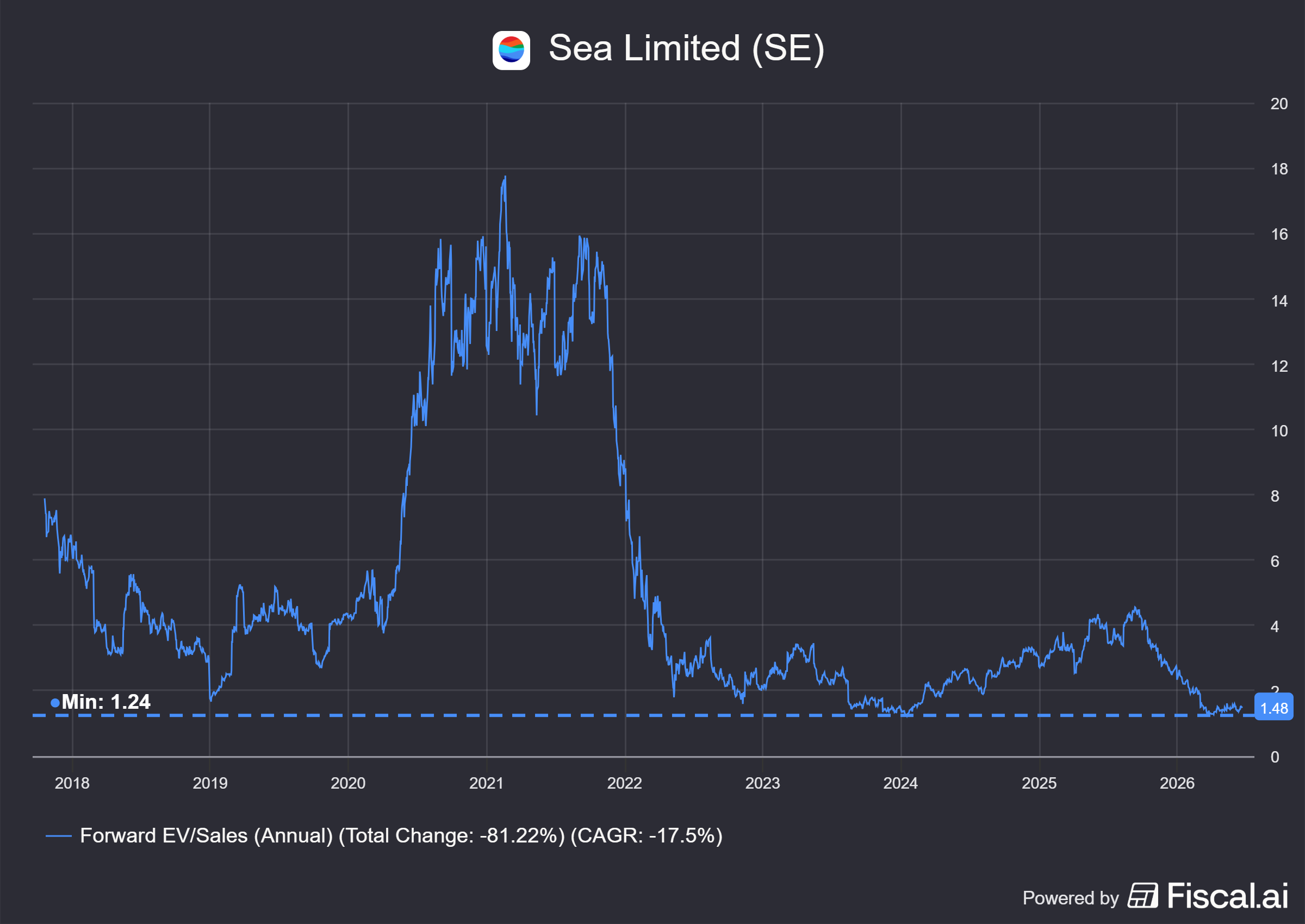
The contrast is striking. During the 2020–2021 growth bubble, Sea traded at more than 15x forward sales. Today, the multiple is closer to 1.5x, roughly back to the lowest levels seen since the IPO (also seen early 2024).
The market is no longer paying for a heroic growth story. It is assigning Sea a valuation that implies much lower expectations, despite Shopee being larger, more efficient, more entrenched, and closer to sustainable profitability than it was during earlier parts of its history.
If Shopee VIP helps increase order frequency, deepen customer loyalty, improve retention, and shift a greater share of spending into Shopee’s ecosystem, the market may eventually have to reassess not only the growth profile, but also the quality and durability of that growth.
At today’s valuation, the stock does not need a return to 2021-style optimism to work. It needs evidence that Shopee can compound profitably from here.
If that interpretation proves correct, Sea could offer a rare combination of near-term rerating potential and long-term compounding. The market is still debating whether Shopee’s reinvestment cycle is defensive or offensive. But if VIP and FBS continue to improve frequency, retention, logistics density, and monetization, the current valuation may be underestimating both the durability and the future earnings power of the platform.
Conclusion
Shopee VIP is still early, and the Amazon Prime analogy should be treated as a framework rather than a forecast. Sea is not Amazon. Shopee VIP is not Prime. Southeast Asia and Brazil are not the United States. The logistics, competitive, and consumer behavior realities are different.
Still, the early signs are worth paying attention to.
VIP adoption has grown quickly. Penetration remains low. VIP members appear to account for a disproportionate share of GMV. The program is directly connected to frequency, shipping, vouchers, fulfillment, logistics density, and merchant monetization. Most importantly, it is being scaled at a moment when the market is worried that Sea’s reinvestment is defensive.
That creates the potential for misunderstanding.
If Shopee VIP proves to be mostly a discount program, the market’s skepticism will likely be justified. But if VIP becomes a habit-forming product that increases frequency, retention, and logistics density, then Sea’s current investment cycle could be much more attractive than the near-term margin debate suggests.
In the earlier case study, the membership product and the logistics initiative made the financials look worse before the strategic payoff became obvious. Margins compressed, operating income declined, and investors had to underwrite a flywheel that was not yet fully visible. Once the evidence began to turn, the market’s interpretation changed quickly.
Sea may be approaching a similar type of moment.
The right question is not whether Shopee VIP will become as important as Amazon Prime. That is unknowable and probably too ambitious as a direct comparison. The better question is whether Shopee VIP can change the slope of Shopee’s frequency, loyalty, fulfillment, and monetization curve.
If it can, the market may be looking at Sea’s reinvestment cycle from the wrong angle.
What looks like lower margins today may eventually prove to be the cost of building a more durable and more profitable platform.