

In 3 articles, you’ll get a deep dive of Teqnion AB (76 pages).
It will be structured in three Parts:
Part 1 (today): From Compounding to Stress Test: Why the Model Cracked
Part 2: From Repairing to Re-Accelerating: What Changed in 2025
Part 3: Show Me the Numbers: Cohorts, Margin Mix, and much more
All parts are now available in one PDF. You can download it below.
👔 Company Name: Teqnion AB (“Teqnion”)
🔎 ISIN: SE0012308088
🔧 Business model: niche industrial serial acquirer
🌍 Geographic exposure: Sweden, UK (sales in Europe)
📈 Stock Price: SEK 169
💰 Market Capitalization: SEK 2.9 billion (~$321 million)
👨💼 Number of CEOs since foundation: 2
👨👩👦 Founder-/Owner-operator: Yes
📅 CEO tenure: Since 2009
🥇 Insider ownership: 5.0% of shares
📊 10Y EPS CAGR: ~23%
🔁 Reinvestment profile: High
💸 Capital intensity: Capital-light
🏰 Moat: M&A edge due to size, type of acquisition targets and deal-making approach
🧨 Main risks: Execution, quality drift, M&A engine, key-person risk
🌳 Slow Compounding fit: Yes – high-quality serial acquirer
Business Model in a Nutshell: Teqnion is a small Swedish sector-agnostic serial acquirer that describes itself as a builder of a conglomerate of industrial companies. The company is run as a decentralized group of subsidiaries, with a strong emphasis on culture, cash generation, and M&A.
1. Business Model: How Teqnion Makes Money
Teqnion is a small Swedish, sector-agnostic serial acquirer that describes itself as a builder of a conglomerate of industrial companies. It operates as a decentralized group of subsidiaries, with a strong focus on culture, cash generation, and M&A.
Teqnion acquires small, mostly founder-run niche businesses, keeps them operationally autonomous, and allocates capital in a repeatable way: retain and reinvest cash flows and let a diversified portfolio compound over time.
Most of Teqnion’s businesses don’t look “sexy” from the outside. And because the typical deal size is small, many of these acquisitions fly below the radar of larger strategics and most private equity buyers.
Teqnion’s promise to sellers isn’t “synergy extraction” or aggressive restructuring. Instead, Teqnion offers a long-term home where a small, well-run industrial business can keep its identity while gaining a stable owner, access to capital, and a peer group to learn from.
Management targets industrial product companies in niche markets, with the goal of building a diversified group by acquiring high-quality businesses with low risk, attractive long-term prospects, and a sustainable product portfolio. The acquired companies continue to operate independently, with an entrepreneurial mindset, while Teqnion supports their development by providing know-how, a strong network, and financial resources. This setup also allows the parent company (HQ) to remain lean, which supports fast decision-making and creates subsidiaries that are strong, adaptable, and able to execute.
Teqnion aims to win sellers’ trust by structuring each transaction individually and setting out a clear plan for what happens after the deal. This is what Teqnion describes as “becoming a safe harbor for their life’s work.” It can be a real competitive advantage in the acquisition process and it is rooted in Teqnion’s long experience in industrial entrepreneurship.
At its core, the model is to acquire healthy, established niche companies with high technology content and strong market positions, and then own them with a permanent horizon. Teqnion is not aiming for high synergy extraction.
The underlying businesses are a mix of pure trading companies that represent leading brands, contract manufacturers that support global companies, and product companies that develop their own differentiated offering for narrow industry niches. Maintaining a balanced mix across different market niches is an important part of building a diversified and resilient group (we will revisit this in detail later).
One of the key concepts emphasized by founder and CEO Johan Steene, and by Daniel Zhang (CXO — more on this role later), is long-term shareholder value creation.
The business model is built around decentralized leadership: subsidiaries operate independently to stay competitive, while maintaining clear accountability and genuine commitment from both management and employees. Teqnion supports them on an ongoing basis with strategy work, problem-solving support, financial resources (and more).
Teqnion’s philosophy and strategy therefore emphasize decentralized decision-making, with development driven by each subsidiary’s own strategy and circumstances. Competitive advantages are created at the subsidiary level by being fast and flexible, keeping decision-making paths short, offering differentiated solutions, and building long, strong relationships between employees and customers.
HQ provides central management functions that create value by adding support and structure for the independent subsidiaries. Teqnion places particular emphasis on having competent leaders at the subsidiary level: people who, together with their teams, are motivated to develop the business with a strong customer focus.
For acquisitions, Teqnion generally targets niche companies run by true enthusiasts, with employees who are experts in their field. These businesses typically have a solid financial track record, high profitability, strong cash flows, and attractive long-term prospects.
Geographically, the focus has historically been Sweden, but Teqnion began acquiring companies in the UK and Ireland in 2022. Management says it meets more than a hundred new companies each year, which gives it the ability to be highly selective about which opportunities it takes further.
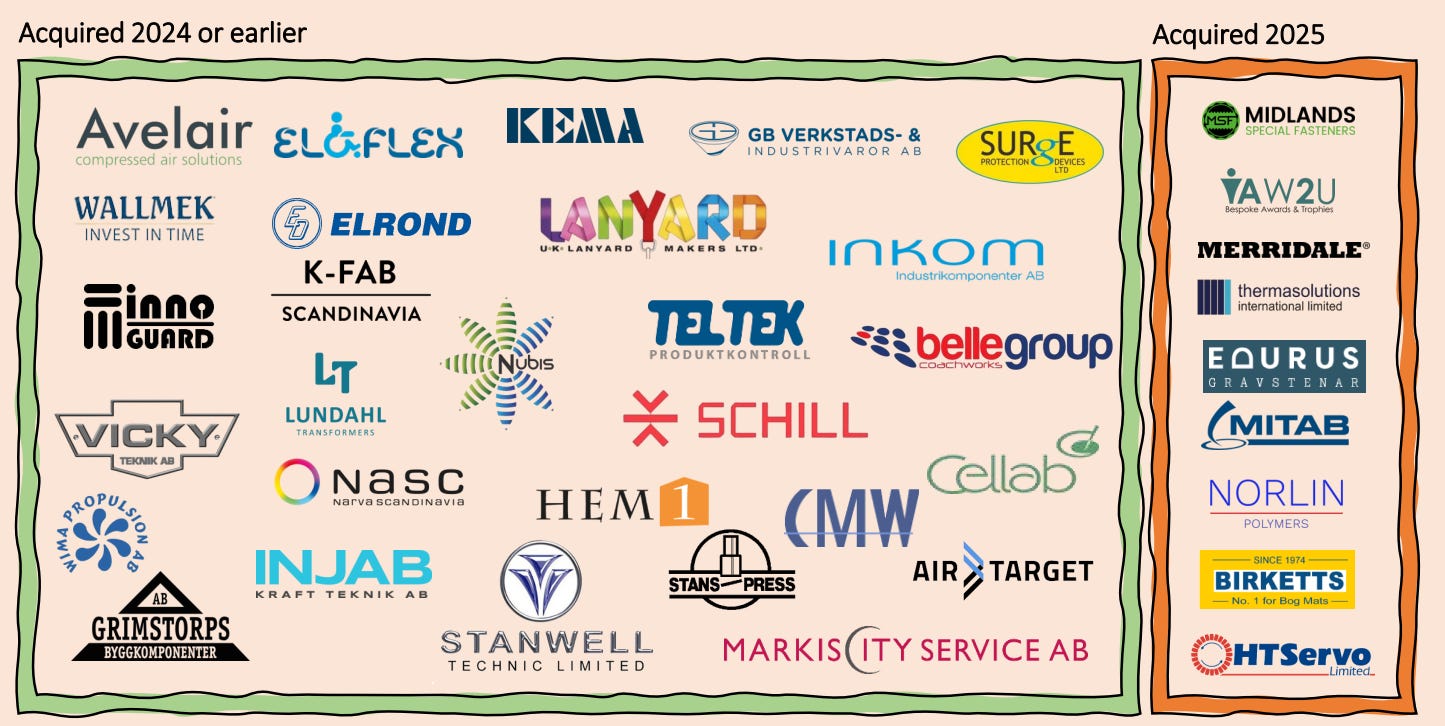
Teqnion currently owns 39 subsidiaries:
25 in Sweden
13 in the UK
1 in Ireland
Teqnion has three simple financial goals: Stability, Profitability, and Shareholder Value.
Stability: Net debt/EBITDA < 2.5.
To avoid risking what they have built and to ensure sustainable growth Teqnion treats financial stability as the foundation. The goal must always be met, and management aims to achieve it by not taking on too much debt relative to the business’s profit generation. This focus on financial stability is rooted in Johan’s experience from Teqnion’s early years, which we’ll explore in more detail later. In short, if you want to minimize risk and build something that lasts, financial stability is essential.
Profitability: EBITA margin > 9%
The focus is on projects and acquisitions with higher profitability margins than where Teqnion is today. Before they “rush ahead,” management wants to make sure the existing business is healthy and profitable. Profitability is a core principle at Teqnion. High margins and accretive sales growth are the foundation for the third goal.
Shareholder Value: Double EPS every five years
Once the other two financial goals are met, the third goal is “full speed ahead.” The focus then shifts to shareholder value creation by increasing earnings per share (EPS), primarily through acquisitions as the main growth driver. Growing profits per share sits at the center of management’s capital allocation framework.
To me, these targets don’t really stand out as unique. They essentially follow a classic serial acquirer playbook. Still, that playbook has a strong track record of delivering outstanding value creation, as demonstrated by very successful Swedish serial acquirers like Lifco, Addtech, Indutrade, and Lagercrantz. There’s no need to reinvent the wheel. If anything, simplicity is one of the defining features of these proven, acquisition-driven
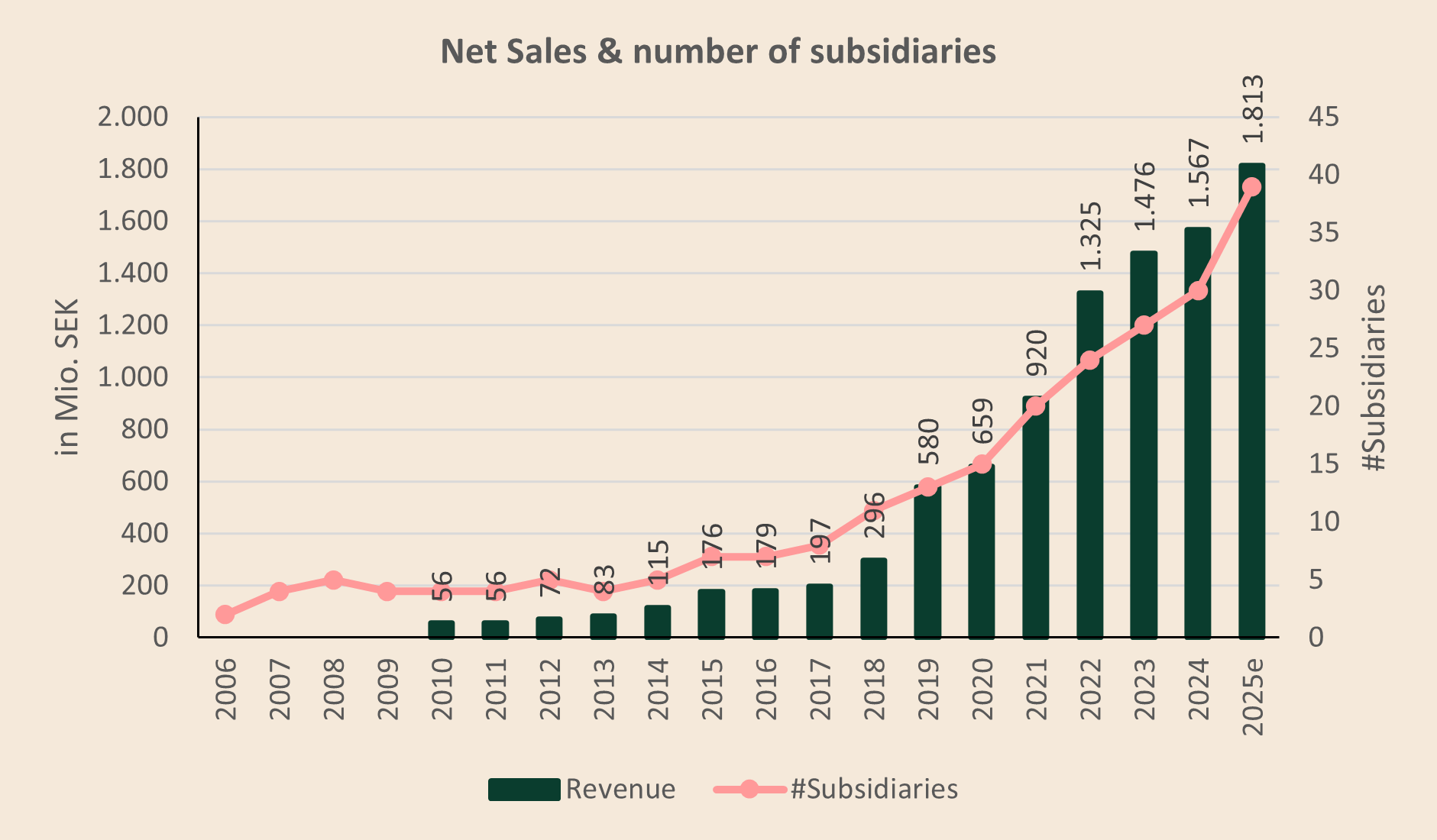
On a Last-Twelve-Months (LTM) basis, Teqnion generated SEK 1,740 million in sales (~$194 million) at a ~10% EBITA margin, with a positive margin trajectory throughout the year (we’ll go into this in more detail later), and SEK 141 million in operating cash flow (~$15.8 million). The businesses Teqnion acquires tend to be very asset-light. As a result, free cash flow conversion is high, which supports a higher reinvestment rate. Since 2010, net sales have grown at a CAGR of ~26% p.a., with acquisitions as the primary driver of that growth.
This philosophy is both Teqnion’s strength and its main operating challenge. Autonomy and entrepreneurship can produce excellent outcomes when subsidiary leaders are strong and incentives are aligned.
But as the portfolio grows, HQ still needs an operating system that ensures two things:
Problems are identified early, before performance has been deteriorating for several quarters.
The group has a consistent way to step in, support, and fix issues without turning into a bureaucracy.
As Johan put it:
The difficulty lies in “balancing the decentralized model with centralization guardrail.” (Johan Steene, InPractice interview, 28.08.2025)
2. Compounding Flywheel Stress Test
Teqnion is currently going through a painful but necessary phase. In my view, the group will come out stronger, and that should lay the groundwork for the next multi-year compounding chapter.
The stock price reflects how challenging the last 2–3 years have been. Since listing in 2019, Teqnion is now in its third ~50% drawdown despite its relatively short history as a public company. Even so, the stock has still compounded at ~36% p.a. since the IPO.
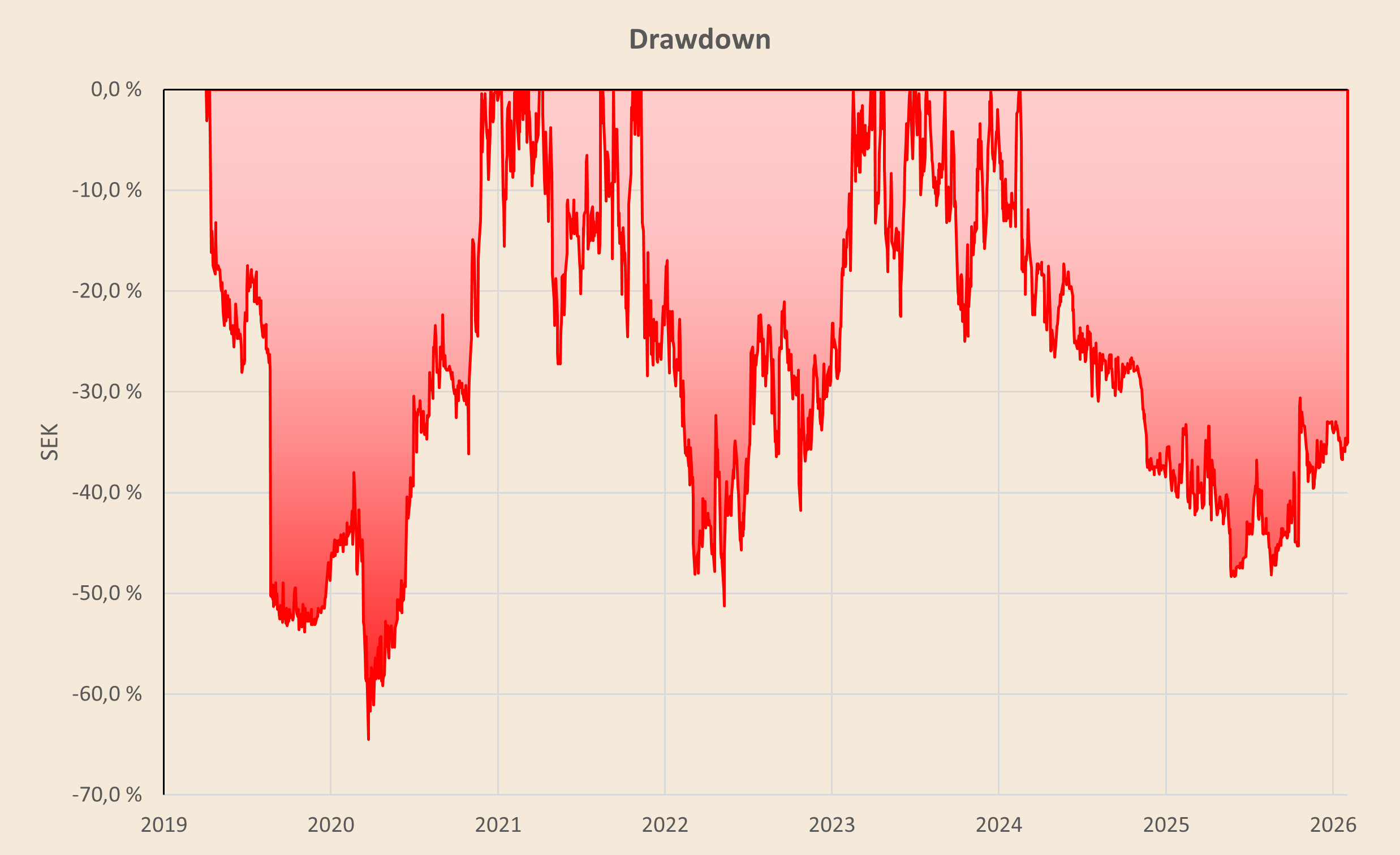
Teqnion’s model is easiest to think of as a portfolio and capital allocation machine. The group buys small companies where small (!) operational improvements, combined with disciplined reinvestment, can compound into meaningful value over long periods. Management repeatedly emphasizes that no single acquisition is “the” story; the story is the steady accumulation over time.
That said, the last 2–3 years require a more granular view. Across several earnings calls, management has effectively broken Teqnion down into three engines:
Engine 1: the M&A machine — sourcing, evaluating, and closing acquisitions that meet the quality bar and can be integrated without breaking the core.
Engine 2: the profitable core — the majority of subsidiaries that run well, manage costs, and keep selling even in a tougher environment.
Engine 3: the struggling bucket — the part of the portfolio that needs hands-on intervention, leadership changes, and a clearer playbook.
This breakdown matters because Teqnion is currently trying to do two things at the same time:
Fix Engine 3 and restart Engine 1 at a higher quality level while protecting Engine 2.
The compounding narrative only works if the profitable core stays intact and continues to grow, while the struggling bucket is repaired and new subsidiaries are added.
Management’s own words sum up the current situation plainly.
“We have a couple of companies building small wooden houses for the private sector and there we see absolutely the decrease in demand.” (Johan Steene, CEO, Earnings Call 2022 Q3)
“We’re not happy with the margins. We’re not happy with the cash flow.” (Johan Steene, CEO, Earnings Call 2022 Q3)
“I believe that there is a risk it’s going to get worse within the construction industry, I think the whole of the industry is going to struggle at least for the next year.” (Johan Steene, CEO, Earnings Call 2022 Q3)
“Some of our companies has been hit by the inflation and the raising prices, but we are product that we are still flat” (Carina Strid, former CFO, Earnings Call 2022 Q4)
“Normally, it’s nothing, it’s normal of course, but in general we have a few companies that struggle because of they have some difficulty in their industrial niche at the moment.” (Johan Steene, CEO, Earnings Call 2023 Q1)
“Still very difficult in the house building business in Sweden.” (Johan Steene, CEO, Earnings Call 2023 Q3)
“We had an organic decline now. And so, yes, there are others, but the construction companies or the homebuilders are the ones that are standing out there, yeah. Exactly. You can also see on the page that we made on the whiteboard where we look at the different companies, I mean, what really brought down both organic income and profit is the homebuilders.” (Daniel Zhang, CXO and Co-CEO, Earnings Call 2023 Q4)
“We still have difficulties of selling wooden houses in Sweden, as you might understand.” (Johan Steene, CEO, Earnings Call 2024 Q1)
“Well, we’re not really happy with how everything is running at the moment. We struggle in a tougher economic climate within a lot of our industrial niches. We see it from almost every spectrum that is not as easy to make good business now as it was a couple of years ago. And as we mentioned in the report, still the house building in Sweden is to a minimum and we don’t see any changes there.” (Johan Steene, CEO, Earnings Call 2024 Q2)
“As you see, we are losing some margins and we’re not happy for that.” (Johan Steene, CEO, Earnings Call 2024 Q3)
It escalated in Q4 2024. It’s rare to see a management team this candid and this humble about underlying business performance:
“It is with embarrassment and anger that we presented our 2024 Q4 report this Saturday. The numbers are truly bad, and the are not close to where we want them to be and expect them to be.” (Daniel Zhang, CXO and Co-CEO, Earnings Call 2024 Q4)
“Yeah, we have a few more companies that are losing money. I don’t know if we mentioned something about that in Q1 or the year-end report. It’s approximately one-third of the group. I think we are about there.” (Johan Steene, CEO, Earnings Call 2025 Q2)
As so often, it had to get worse before it could get better. The narrative and management’s tone started to improve in the second half of 2025:
“We’ve come quite a bit, which is shown in the figures. It’s a better EBITDA and free cash flow. This is positive, but we have a lot more to do and we will never be content.” (Johan Steene, CEO, Earnings Call 2025 Q3)
“The companies that have done better this year is not because the headwind has become tailwind. It’s because they have done more of the right things or less of the bad things.” (Daniel Zhang, CXO and Co-CEO, Earnings Call 2025 Q3)
3. How Teqnion Got Here (2006-Today)
To better understand where Teqnion is today and how the current setup came to be, it helps to view the company as an evolving story rather than a static business. Teqnion has gone through several distinct phases over time.
Teqnion started as a founder-led project in 2006, grew slowly for more than a decade using only internally generated cash, accelerated after the 2019 listing, and is now adjusting its organizational “operating system” to match the scale it has reached.
We can roughly break Teqnion’s development into three phases, interrupted by two crises:
Phase 1 (2006-2009) – Formation and early acquisitions.
Teqnion’s origins were pragmatic rather than financial. The first two acquisitions were done by persuading the owners to swap their shares for Teqnion shares—an early sign of how Teqnion positioned itself as a long-term home.
Crisis #1 (2008-2009) – Fragility, Liquidity, and a Forced Reset
The first real stress test came in 2008–2009. Teqnion was still small, buffers were thin, and the early portfolio could not absorb a sharp downturn. High leverage relative to cash generation and limited liquidity made the setup fragile. Teqnion recorded its first and only loss in that period, and one early subsidiary (UpTech Norden AB) went bankrupt in September 2009. The crisis forced a reset: stronger focus on financial stability, cash flows, and tighter operational discipline.
Phase 2 (2009-2017) – Slow compounding through internal cash deployment.
After the 2008/09 crisis reset the organization, Teqnion was rebuilt with stronger operational discipline. Growth was constrained by cash generation: Teqnion couldn’t acquire at will. That limitation acted as a natural brake, but it also forced the founders to learn the operations in depth.
Phase 3 (2018-2024) – Capital access and speed, followed by a process maturity gap
The IPO and the earlier private placement increased Teqnion’s acquisition capacity and speed. The portfolio expanded and became more complex across industries. With that complexity, a gap became visible: the organization still relied heavily on founder intuition and informal monitoring. Mistakes made years earlier began to compound and their negative effects surfaced from 2022 onward as interest rates rose and housing-related businesses came under pressure. Teqnion had to learn the hard way that a realignment was inevitable.
Crisis #2 (2022-2024) – When Scale Exposes Process Gaps
This was a different kind of crisis: not liquidity, but scale. By 2024, the portfolio had grown larger and more complex, while the operating system (measurement, early warning signals, escalation, standardized follow-up) had not fully caught up. When interest rates rose and conditions tightened, especially for housing-related exposures, weaknesses became visible. Problems were often detected too late, and interventions were not consistent enough. The result was a clear process maturity gap, setting up Phase 4: upgrade governance while protecting the profitable core and raising the quality bar for new acquisitions.
Phase 4 (2024/2025-?) – Closing the process maturity gap and gaining momentum
Phase 4 is about closing that gap through process upgrades such as explicit KPIs, standardized reporting, and stronger intermediate leadership layers. In essence, it’s about fixing Engine 3 (the struggling companies) and restarting Engine 1 at a higher quality level (M&A), while protecting Engine 2 (the profitable companies).
3.1. Phase 1 (2006-2009): Getting Started and Early Acquisitions
Teqnion’s origin story is unusually “unpolished” for a company that later branded itself as a disciplined long-term owner. The group was founded in the fall of 2006, after months of discussions earlier that year. What stands out is not only that Johan Steene and his co-founder (and then-CEO), Jonas Häggqvist, decided to build a micro-conglomerate—but how they took the first step. They essentially launched the group by persuading two “elderly gentlemen” to swap their businesses into Teqnion stock. Those two subsidiaries (UpTech Norden AB and Industrikomponenter AB) became the first fully owned group companies in December 2006.
“It took some time to persuade the elderly gentlemen that my friend Jonas and I were capable of doing this. After some discussions, they were on board and we finalized everything in October or November 2006. From there, we started to build something, or at least attempted to build something.” (Johan Steene, InPractice interview, 28.08.2025)
“We convinced the first two subsidiaries we acquired by persuading their owners to exchange their shares for Teqnion shares. These were the first two group companies fully owned by Teqnion when we founded it.” (Johan Steene, InPractice interview, 28.08.2025)
From day one, capital was the constraint. This was not a classic private-equity roll-up backed by a fund. In Johan Steene’s own words:
“When we started, we started without any external capital...” (Johan Steene, CEO, Earnings Call 2024 Q1)
That constraint shaped the entire early playbook. If you can only acquire using cash generated from operations, you don’t get to buy the best businesses in the market: you buy what you can afford. Johan explicitly links the lack of external funding to having to look for “cheaper companies”.
“… So we could only acquire companies from the cash that was generated from our own operations, which mean that we had to look for, let’s say, cheaper companies.” (Johan Steene, CEO, Earnings Call 2024 Q1)
That constraint also shaped what Teqnion was in the beginning: “more or less purely a distribution company,” with the rights to sell a specific externally manufactured product in the Scandinavian market, similar to a Bergman & Beving-style setup.
“Jonas and I started with very limited capital, so we decided the first rule of building a company group like this is to buy companies that don’t need fixing. These companies had a solid history, were good at earning money, and offered a good return on capital. However, we couldn’t afford those, so we ignored that rule initially, being young and driven. We bought whatever we could find, which often meant turnaround cases, requiring me to work operationally in these companies.” (Johan Steene, InPractice interview, 28.08.2025)
That capital constraint also had an important second-order effect for Teqnion’s later “operational DNA”: the founders couldn’t outsource mistakes, they had to fix them. Johan notes that he was “very operational” for the first 15 years largely because Teqnion didn’t raise capital to accelerate growth until the 2019 listing. Growth was financed “solely with free cash flow,” which forced hands-on involvement even while trying to build a decentralized structure.
“In the first three to four years, I acted as an interim CEO in different subsidiaries. I primarily worked on increasing sales activities and sales, making the organizations more effective, meeting more customers, selling more products, and covering more geographical areas.” (Johan Steene, InPractice interview, 28.08.2025)
This is an important nuance. Teqnion’s early strength wasn’t “M&A sourcing” or formal “capital allocation frameworks.” It was hands-on operator work under tight constraints, repeated across small industrial niche businesses. That experience has shaped Teqnion’s DNA for a long time.
But that constraint-driven hustle also created fragility. In hindsight, management draws a direct line from the early ambition to a near-death-experience in 2008. When the financial crisis hit, the lack of liquidity became obvious immediately, and Teqnion was forced into a survival transaction: selling half of the company to an external investor (Vixar).
“In the fall of 2008, during the financial crisis, we realized we had built something fragile because we reinvested everything we earned into new coworkers, offices, and acquisitions. We didn’t have cash for a rainy day, which became evident in the fall of 2008. We had to sell half the company to external investors. That was Vixar, who still holds a significant part of Teqnion. I think they have around 10% today. They bought half the company for very little money, but we needed that money to downsize and adjust costs during that tough period in the Swedish industry.” (Johan Steene, InPractice interview, 28.08.2025)
In a later discussion on how they think about downturns, management is even more explicit about what happened: the group “crashed” in that period because it had too high leverage and not enough cash reserves.
“But one of the things that made us go into that financial crisis and really crashed was that we had too high gearing, and we didn’t have enough cash and flexibility.” (Daniel Zhang, CXO and Co-CEO, Earnings Call 2023 Q3)
Importantly, this wasn’t an abstract macro “crisis”, it directly reshaped Teqnion’s operating model and governance. The group spent roughly nine months cutting back and resetting until it could show positive figures again. By summer 2009 it was back on “somewhat firm ground,” but only after shrinking to roughly half of its size from a year earlier. Around the same time, co-founder Jonas Häggqvist chose to leave, saying the original mission was “done.”
“By the summer of 2009, we were on somewhat firm ground again, but we were much smaller, about half of what we had been a year before. Jonas, being a true entrepreneur, said, ‘Now we did what we promised, now we do something else’ and he quit. I’m more stubborn and felt this was not what we set out to do, so I stayed on and have been here ever since. I’ve been the CEO since the summer of 2009” (Johan Steene, InPractice interview, 28.08.2025)
Post-2009, the ambition shifted from “whatever we can afford” toward “whatever can compound”. Just as importantly, the acquisition pipeline had to be rebuilt from scratch. Before he left, Jonas Häggqvist had focused on sourcing new targets, while Johan was pulled deep into operations.
After the restart, brokers didn’t view Teqnion as a serious buyer.
“I reached out initially after we more or less restarted in the summer of 2009. At that time, we weren’t really seen as serious contenders, so brokers weren’t interested in talking to us. It was mostly me cold calling potential businesses we wanted to acquire. We were limited in size because typically, people expect money when selling their company.” (Johan Steene, InPractice interview, 28.08.2025)
“It was tough, especially when we showed what we had done before—built something that collapsed—and now we were doing it again. It was a tough sell initially.” (Johan Steene, InPractice interview, 28.08.2025)
To summarize, Phase 1 is more than the founding chapter. It’s the origin of Teqnion’s two defining scars:
A deep, institutional allergy to leverage-driven fragility.
A hard-earned understanding that buying is the easy part; owning and operating through a cycle is the hard part.
Teqnion would later professionalize its processes and expand its acquisition ambition, but the core lesson was learned early: if you build without liquidity buffers, the first real downturn forces a choice between dilution and survival. Teqnion chose survival and rebuilt from there.
3.2. Crisis #1 (2008-2009): The First Reset (Liquidity Stress)
Teqnion’s first crisis matters because it reveals the founders’ bias and the company’s early DNA: aggressive reinvestment, optimism, and a willingness to learn by doing. It also helps explain why management today puts so much emphasis on cash generation, resilience, and solid free cash flow.
As described above, in 2008 the group realized it had built something fragile. The founders had reinvested essentially everything into organic growth and acquisitions. When the downturn hit, there was no cash buffer. The result was a forced reset, including selling a large stake to external investors at an unattractive valuation simply to survive.
“In 2008 everything was crumbling and we made the first and only loss in Teqnion history going from profit to loss.” (Daniel Zhang, CXO and Co-CEO, Earnings Call 2024 Q2)
Even worse, in 2009 the board filed for bankruptcy for UpTech Norden Aktiebolag (one of the first two subsidiaries acquired in 2006) because demand did not recover.
The operational lesson was straightforward: in a decentralized portfolio, you can live with small operational issues but liquidity issues can kill you. A serial acquirer that funds growth internally can’t treat cash as an afterthought. That early lesson is one reason Teqnion later emphasized payback in actual cash and the importance of long-term cash conversion.
There was a second lesson as well. Teqnion’s leadership became operational by necessity. After the crisis, Johan describes having to learn the “other skill set”: running businesses and also persuading entrepreneurs that Teqnion could still be a stable home after a very visible collapse. That reputational repair work likely shaped the company’s later focus on trust, long-term ownership, and supportive “help” rather than heavy-handed control.
Investors should view the first crisis as both a warning and a foundation. Teqnion has already survived a near-death experience, and it shaped the company’s definition of resilience. The key question is whether the second crisis will lead to a comparable step-up in process maturity.
3.3. Phase 2 (2009-2017): Compounding through Internal Cash Deployment
After the reset, Teqnion entered a long rebuilding phase defined by discipline, reputation-building, and a slow but deep accumulation of operating know-how. Johan became CEO in 2009 and had to develop the “seller outreach” skillset while still staying close to the operations.
For most of the decade, growth was largely self-funded. Acquisitions happened when free cash flow allowed, which enforced patience and it also created an unusually close understanding of the subsidiaries’ business models and what actually makes small industrial and technology-driven companies profitable.
This was Teqnion’s “craftsmanship period”. The organization learned how to operate many different small companies, but governance remained heavily people-driven and experience-based rather than process-driven. That dynamic would come back to haunt the group roughly 13 years later during the second crisis, as we’ll discuss shortly.
The result was a long, slow period of “credibility compounding”: fewer deals, more learning, more repetition of what works, and a gradual shift from its distribution roots into a broader set of industrial niches while HQ remained extremely lean for many years.
“I also waited perhaps too long before bringing more coworkers into the head office. We were just two people from 2009 until 2018.” (Johan Steene, InPractice interview, 28.08.2025)
During the first 6 years of Phase 2, the number of subsidiaries didn’t change, as Teqnion only acquired two subsidiaries during this period and 2 subsidiaries were disposed. As discussed above, insolvency was filed for UpTech Norden AB during 2009 and Electrona Sievert AB, acquired in 2007, was sold during 2013. Until 2017, the number of subsidiaries increased to 8.
3.4. Phase 3 (2018-2025): Capital Access and Speed, Followed by a Process Maturity Gap
The IPO era changed Teqnion’s tempo more than anything else. After more than a decade of growing “the slow way” (i.e., only buying what free cash flow allowed), management describes the 2018 pre-IPO placement and the 2019 listing as the moment Teqnion could finally pull the acquisition engine forward in time. Roughly ~SEK 100m (~$10 million) of fresh capital (2018 and 2019 combined) allowed the group to move from “a deal every year or every other year” to two or three acquisitions per year and eventually more, pushing Teqnion into a fundamentally different scale regime.
“By around 2017, I suggested to the board and the minority shareholders that we should list the company and raise more capital to accelerate growth. They agreed, and we did it in two steps. First, a pre-IPO or private placement in, I think, the spring of 2018, and then the IPO in 2019.” (Johan Steene, InPractice interview, 28.08.2025)
It may sound like a simple turning point, but the second-order effects are meaningful. Once deal flow accelerates, the holding company stops being a small, founder-driven organism and starts turning into a system. And systems need routines and measurement that don’t depend on one person’s intuition.
At the same time, Teqnion’s acquisition capability became more professional and began to look like a “two-engine” organization, especially after Daniel Zhang joined in 2021 and increasingly focused on sourcing and executing acquisitions.
But this is also when the process maturity gap quietly opened. Scaling a decentralized group is not mainly about finding deals; it’s about making sure the machine can absorb them without letting post-integration underperformance compound.
In early 2025, Johan Steene looks back at 2024 and says something unusually blunt for a serial acquirer:
“Yeah, we have a few more companies that are losing money. I don’t know if we mentioned something about that in Q1 or the year-end report. It’s approximately one-third of the group. I think we are about there.” (Johan Steene, CEO, Earnings Call 2025 Q2)
In 2024, only about two-thirds of the portfolio performed as management wanted, well below Teqnion’s long-term ambition of a setup where roughly ~10% needs help and the rest is solid.
“That is, of course, not acceptable. We’re consistently aiming for a situation where maybe 10% of the group is in need of help, and right now there’s too many struggling.” (Johan Steene, CEO, Earnings Call 2024 Q2)
Closing the gap between “what’s acceptable” and what actually happened is the core issue of Phase 3. Teqnion had become a more complex organism: more subsidiaries, more geographies, and more variation in end-markets and business quality—while the operating system (early-warning signals, reporting quality, follow-up cadence, and intervention discipline) didn’t mature fast enough to keep the portfolio healthy. In other words, the group hadn’t yet found the right balance between decentralization and the necessary centralized guardrails.
The key nuance is that this wasn’t a philosophical failure of decentralization. It was a systems failure of scale. Johan essentially admits he lost control and let go of too many responsibilities, because HQ wasn’t strong enough at institutionalizing consistent data collection and trend monitoring across the group:
“But as we grew to 36 companies, maybe around 20 or 25, I lost control over tracking working capital. I didn’t ask anyone to take over that responsibility.” (Johan Steene, InPractice interview, 28.08.2025)
“We lacked structures to capture data effectively, which made us slow and ineffective.” (Johan Steene, InPractice interview, 28.08.2025)
The result was that they became “slow and ineffective,” trusted plans without tight follow-up, and Johan even “lost control” over working capital tracking across a group of 20-36 companies. That’s exactly the kind of issue that doesn’t kill you overnight, but quietly weakens resilience and increases volatility.
That’s what a “process maturity gap” looks like in practice: the group is no longer small enough to run on founder intuition, but not yet mature enough to run on standardized routines and disciplined follow-up.
Phase 3 is where Teqnion had to learn the hard way that, in a decentralized acquisition model, HQ’s job is not to run subsidiaries day to day, but to ensure measurement, trend detection, and escalation are strong enough that “bad news” is not ignored for too long.
This gap could open up so quietly partly because of Teqnion’s founder story. Johan is, by his own description, a self-learner who built the playbook largely through repetition and lived experience rather than a pre-packaged “best practice” framework. After Jonas left following the first crisis, Johan effectively had to learn, decide, and execute as the central glue of the group—at a time when Teqnion was still small enough for that to work.
The problem is that the pattern became a structural habit. Because he spent so many years being highly operational, i.e. stepping into subsidiaries as interim CEO, driving sales execution, and fixing issues hands-on, he remained too embedded in the subsidiaries for too long relative to what a scaled, decentralized model ultimately requires.
In other words, Teqnion didn’t stumble because decentralization “doesn’t work.” It stumbled because the organization outgrew a founder-centric operating mode without upgrading the machinery around it. As the group expanded post-IPO, HQ needed to turn the founder’s intuition into a repeatable system: clear KPI definitions, consistent reporting quality, standard follow-up cadences, and a disciplined escalation playbook, so portfolio health could be managed without Johan personally having to “feel” every subsidiary.
“The way we have been organized, just to be self-critical of myself, is that we haven’t followed up close enough in a structured way and maybe a little bit in a, let’s say, standardized way.” (Johan Steene, CEO, Earnings Call 2025 Q2)
“There are numerous reasons we’ve underperformed for a while, and I know we could have done better earlier if we had better systems and processes in place from the start.” (Johan Steene, InPractice interview, 28.08.2025)
But that transition was delayed, at least to some extent, because the old model kept “working” for a long time. When you’ve been the operational problem-solver for 10–15 years, it’s easy to underestimate how quickly a growing portfolio creates blind spots once responsibilities are delegated.
For several years, Teqnion was also helped by the environment: a supportive macro backdrop, cheap capital, and solid demand meant small weaknesses could build quietly without turning into visible, portfolio-wide pain. In hindsight, some of this may simply have been good fortune. As long as the tide was high, the system didn’t need to be perfect to look good.
Once exogenous pressure hit through the interest-rate shock and a tougher demand environment, it was as if someone “drained the water” from the pool. Issues that had been building in the background suddenly became impossible to ignore: underperformers stood out, working capital and inventory mistakes started to matter, and deteriorating financial performance required faster intervention than the organization was structurally prepared to deliver.
That’s the real lesson of Phase 3. The operating system hadn’t been stress-tested in years, and once the macro tailwinds faded, Teqnion was forced to close the maturity gap quickly. Teqnion learned (again) that in a decentralized acquisition model, HQ’s job is not to run subsidiaries day to day, but to ensure measurement, trend detection, and escalation are strong enough that “bad news” doesn’t travel slowly.
So Phase 3 ends with a company that has clearly upgraded its opportunity set: more capital, a higher deal cadence, improving portfolio quality, and stronger international exposure, but also one that has to confront a simple internal reality: process maturity needs to catch up with size. That tension sets up Phase 4 of closing the maturity gap so Teqnion can keep compounding without repeatedly falling into “clean-up cycles”.
3.5. Crisis #2 (2022-2024): Scale Exposes Process Maturity Gaps
Teqnion’s second crisis is different from 2008/09. While the first crisis was a liquidity crisis, the second crisis is a story about organizational scale and portfolio health. The group expanded, complexity increased, and HQ did not yet have a standardized system that ensured early and consistent intervention across all subsidiaries.
The crisis shows up in two clear symptoms:
Portfolio underperformance, concentrated in a “too large” struggling bucket (what management describes as the “struggling bucket,” or the third engine that drags on overall performance).
Business-mix issues, where parts of the portfolio are more cyclical (housing) or structurally lower-margin (certain contract manufacturing) than Teqnion would prioritize in newer acquisitions.
Below, we break down each symptom and link it back to the underlying root cause: process maturity.
3.5.1. Symptom 1: Too Many Underperformers at Once
The key point is not that underperformers exist. In a portfolio of small companies, some will always lag. The issue is the size of the bucket. Management is effectively saying the struggling bucket became too large, which forces the CEO into firefighting instead of capital allocation.
That matters for compounding because the model relies on the profitable core to self-fund the acquisition engine. When too many subsidiaries need fixing at once, management attention becomes the scarce resource.
“Moving on to the next part of what we do is that we have a strong performance group of companies within the portfolio. It’s good for us, at least, to remember this, that the majority of our portfolio is performing as we like. As I mentioned in the Q3 report this fall, only about two-thirds of the group performed well in 2024. That is, of course, not acceptable. We’re consistently aiming for a situation where maybe 10% of the group is in need of help, and right now there’s too many struggling. The companies within the strong part of the group are delivering good results, and they have somehow successfully adapted to the changing economic landscape by managing their cost effectively, and they have intensifying their sales effort just to continuously generate new business, even though the climate is a little bit tougher.” (Johan Steene, CEO, Earnings Call 2024 Q4)
3.5.2. Symptom 2: Cyclicals and Structural Drags
At a high level, one reason Teqnion’s earnings quality temporarily deteriorated is that parts of the portfolio historically leaned into business types that are structurally less suited for resilient compounding: too cyclical, too low-margin, and with too little pricing power.
Two categories stand out: housing-related businesses and contract manufacturing (especially sheet metal work for large OEMs). These weren’t “bad companies” per se, but they are not ideal building blocks if the ambition is a diversified portfolio that can compound steadily through cycles.
What makes this especially instructive is how transparent management is about why it happened. In the early years, Teqnion simply couldn’t always afford the ideal targets. Without external capital, the company often had to buy what was available and “cheap enough,” rather than what was highest quality.
“When we started this company 18 years ago, it was we could only acquire what we could afford and you can imagine that was maybe not the best quality of companies.” (Johan Steene, CEO, Earnings Call 2024 Q2)
Over time, this created a path dependency. You end up with parts of the portfolio where the underlying economics are driven more by external forces than by your own capabilities, i.e. results are largely “made” or “broken” by the cycle.
The challenge is that even if you improve the mix over time, as you can afford to buy better, more resilient businesses, you still own the lower-quality ones. They can drag on consolidated performance for years, as we saw from 2022 to 2024 (and as will be mathematically explained in chapter 5.5).
Management describes three categories Teqnion’s subsidiaries fall into broadly (we’ll take a closer look at individual subsidiaries in chapter 5.3):
Category 1: Some subsidiaries own their own brands and designs. These typically have materially better pricing power because they control the value proposition and can “forge their own future.”
Category 2: Others are niche trading and distribution businesses. Competitive intensity can vary, but Teqnion has operated these models from the start and believes it can generate strong cash flows.
Category 3: The more problematic bucket is contract manufacturing and housing: factories supplying large global customers (e.g., heavy truck OEMs) where the buyer has the leverage and systematically presses margins. In that model, you carry high fixed costs (skilled workforce, certifications, overhead) yet you are “not allowed to earn very much money.”
Unsurprisingly, management is explicit that Category 3 is no longer the kind of business they want to acquire.
“So that is a very long that type of company is nothing that we look at anymore. It was something that we acquired back in 2018 and maybe on some mental flaws that it looked cheap on paper and nothing you should never do in acquisitions on those [nice little value traps]”. (Johan Steene, CEO, Earnings Call 2024 Q2)
Housing is the other key example. Here, the issue wasn’t only “we couldn’t afford better,” but also human bias. Johan openly frames it as a personal mistake:
“That’s my fault. I think we touched this topic at least once before, but I love wooden houses. And I really became friends with 1 of the entrepreneurs. And one of them is actually working with us in Teqnion now. And fantastic people, fantastic entrepreneurs doing everything right, but they are locked up in a very cyclical business. We’re not looking there anymore. Don’t be scared about that.” (Johan Steene, CEO, Earnings Call 2023 Q4)
Symptom 3 goes beyond an execution issue. It’s a portfolio construction lesson. Teqnion’s criteria were not always applied strictly enough, and the result was a portfolio with too many businesses where value capture is limited by the model itself, such as low pricing power, margin pressure from powerful customers, and too high cyclicality in some cases.
In a benign macro environment, those weaknesses can stay hidden for years. In a tougher environment, they can suddenly dominate results. That’s exactly why the current pivot toward “companies that own their own brands and designs”—and away from contract manufacturing and housing exposure—is not a tactical tweak. It’s a strategic repair of the portfolio’s economic foundation.
The setup explains why the model cracked under scale. The only question that matters now: what changed in 2025—and is it enough to restart compounding? That’s exactly what we will unpack in Part 2.

Excellent comprehensive write up. I agree with your thoughts. thank you for the eeffort!
> In newer markets (like the UK), Teqnion has leaned more on broker relationships after learning that cold outreach alone can be too slow.
As per Daniel’s comment in the last AR commentary, mgmt doesn’t use brokers.