
Röko Is Accelerating Again
Q2 EBITA grew 37% as acquired growth reached almost 30%—earlier and stronger than I expected.

Swedish serial acquirers are on fire 🔥
My Swedish serial acquirers are having quite a quarter.
Seven of my Swedish serial acquirers have now reported results covering April through June 2026. EBITA growth across the seven companies was as follows:
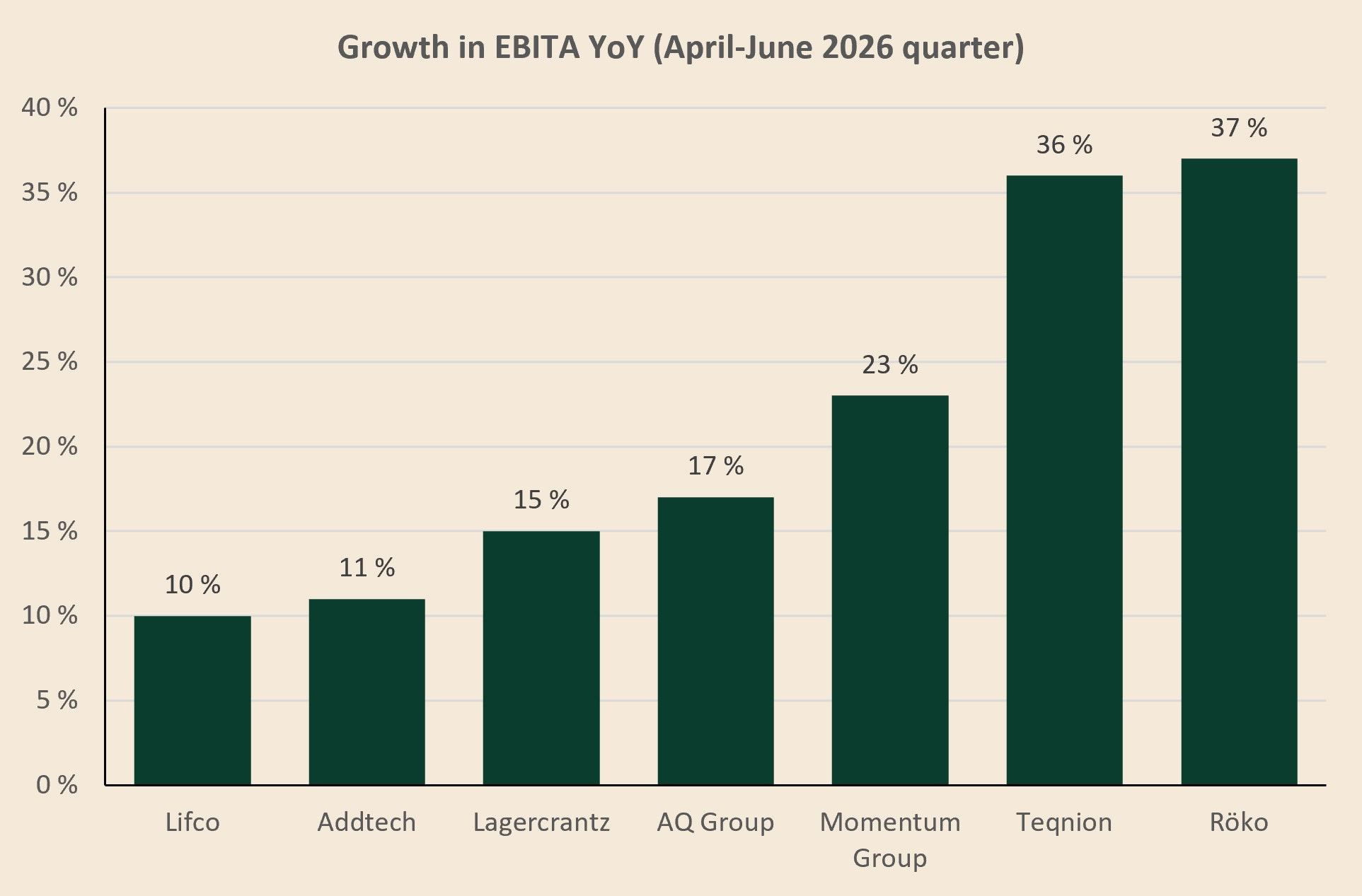
Not a single-digit result among them.
Röko stands out, as it delivered the highest EBITA growth (100 bp ahead of Teqnion), but also because it was one of the weaker performers in my serial-acquirer portfolio only a few quarters ago. Acquisition activity had slowed, organic growth was modest, and just a few weeks after the IPO, the market had started to question whether Röko’s acquisition engine could return to its earlier pace.
It has.
Despite the strong operating performance, the market reaction has been muted. Röko’s share price is almost unchanged, although it is still up around 30% since I published my Deep Dive in April. Meanwhile, the shares of my other Swedish serial acquirers have generally traded lower despite their solid results. In my view, this disconnect makes it a particularly good time to take a closer look at serial acquirers (again). Over the long term, share prices tend to follow earnings, and the best serial acquirers have delivered remarkably consistent earnings growth for decades.
Faster than I expected
At the end of May, I published an update titled Röko Is Waking Up Again.

My central argument was that the acquisition model itself had never stopped working. The problem in 2025 was simply that too few transactions had moved from the pipeline to completion.
That began to change in early 2026. Röko completed three acquisitions during Q1, followed by Fri-Jado in May—the company’s largest acquisition to date. The following chart shows the annual revenue of every company acquired by Röko, measured at the respective acquisition date.
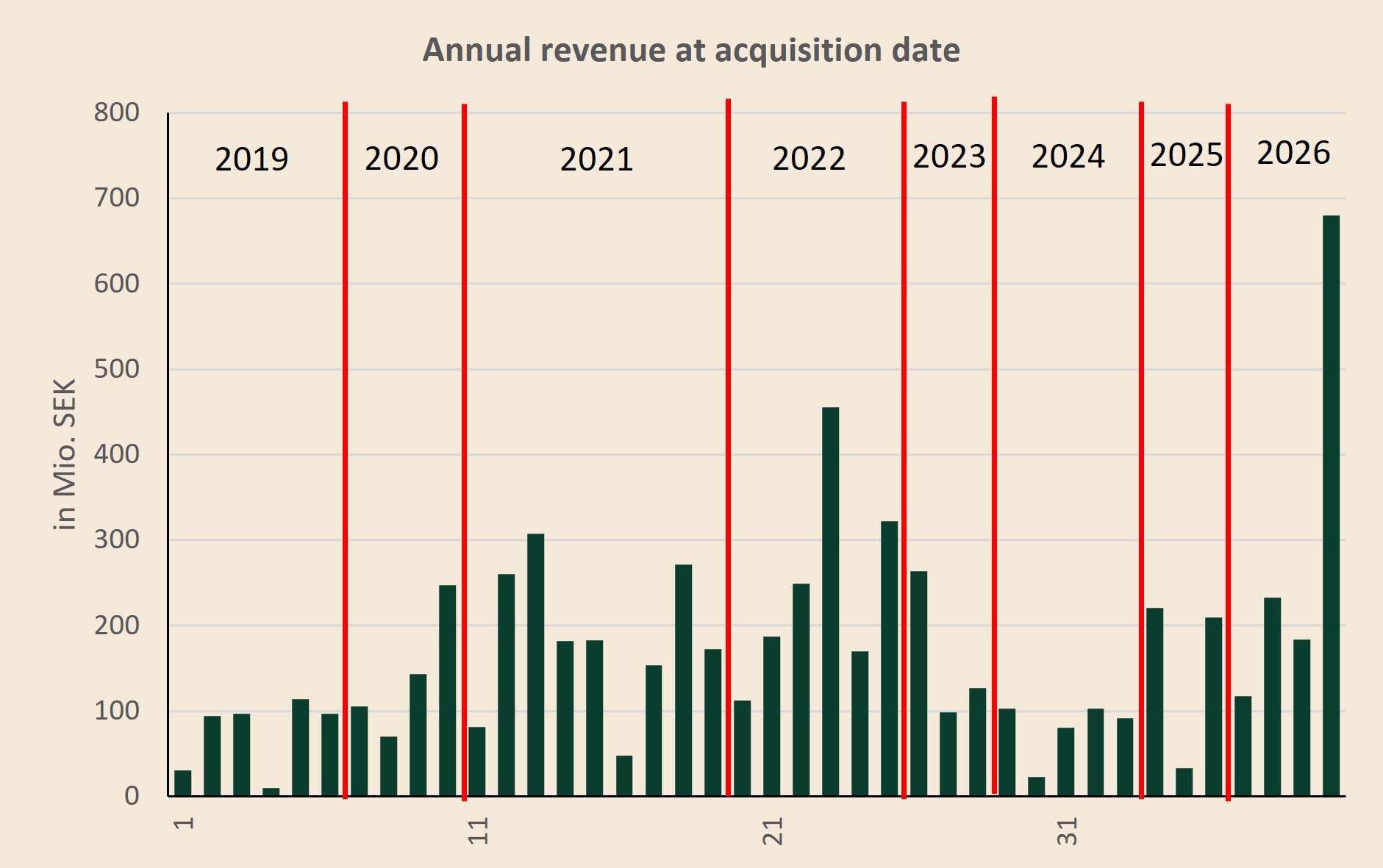
As a result, I expected acquired growth to accelerate as these companies became more fully reflected in the reported numbers. More specifically, I expected acquired growth to move above 20% by Q3.
Röko’s net sales increased by 31% in Q2, from SEK 1,562 million to SEK 2,045 million. Organic growth contributed 3%, while currencies had no meaningful impact. This implies that acquisitions contributed roughly 28 percentage points to quarterly revenue growth. Röko therefore exceeded my expectation by a wide margin.
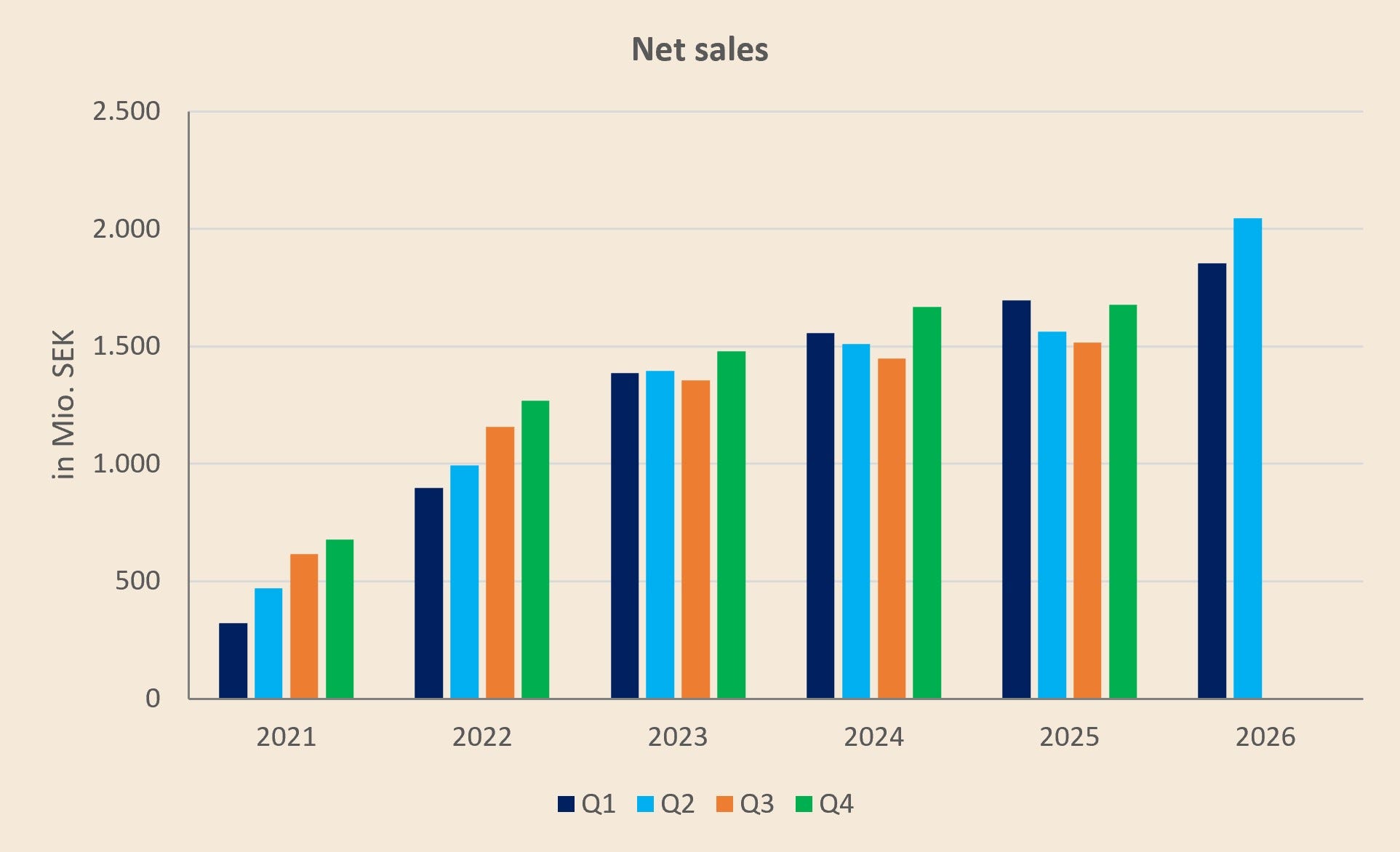
Reported growth of serial acquirers can be inherently lumpy. As acquisitions are completed, their contribution gradually enters the comparable figures. A slower period can therefore be followed by an abrupt acceleration, even when the underlying acquisition process has been building for several quarters unnoticed.
The charts below illustrate this dynamic using Röko’s 2026 acquisitions as an example. They estimate the revenue contribution from Lambda, ABP, NH, and Fri-Jado based solely on transaction timing and deal size, while excluding seasonality effects. Put differently, the acquired annual revenue is spread evenly across the remaining calendar days after each acquisition date. The left-hand chart illustrates the monthly pattern, while the right-hand chart applies the same logic on an aggregated quarterly basis.
This perfectly illustrates why reported M&A growth can be so uneven: acquisitions of different sizes close at different points in time, and their revenue contributions are therefore consolidated in very different amounts across subsequent months and quarters. It is also one reason why I prefer programmatic serial acquirers completing, on average, five or more acquisitions per year over companies making only one or two (think of Judges Scientific). A higher acquisition frequency typically results in a steadier and more predictable inorganic growth contribution, whereas infrequent acquisitions can make reported growth considerably more volatile and dependent on the timing and size of individual transactions.
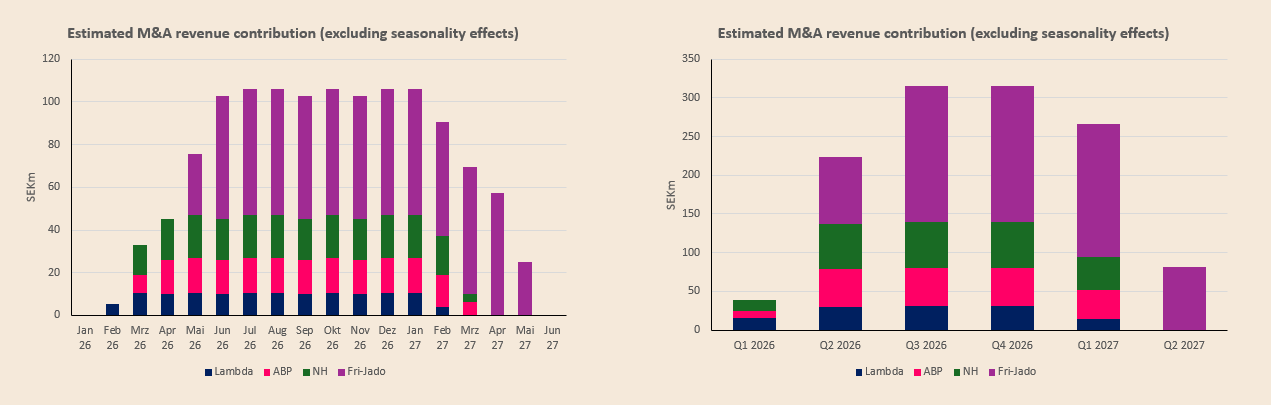
Small changes in acquisition timing, deal size, consolidation dates, and seasonality can materially shift reported growth between quarters without changing the underlying economics.
More than an acquisition-driven revenue jump
The strongest number in the report was EBITA growth. Adjusted EBITA increased by 37%, from SEK 312 million to SEK 427 million, meaning that earnings grew faster than sales. The adjusted EBITA margin increased from 20% to 21%.
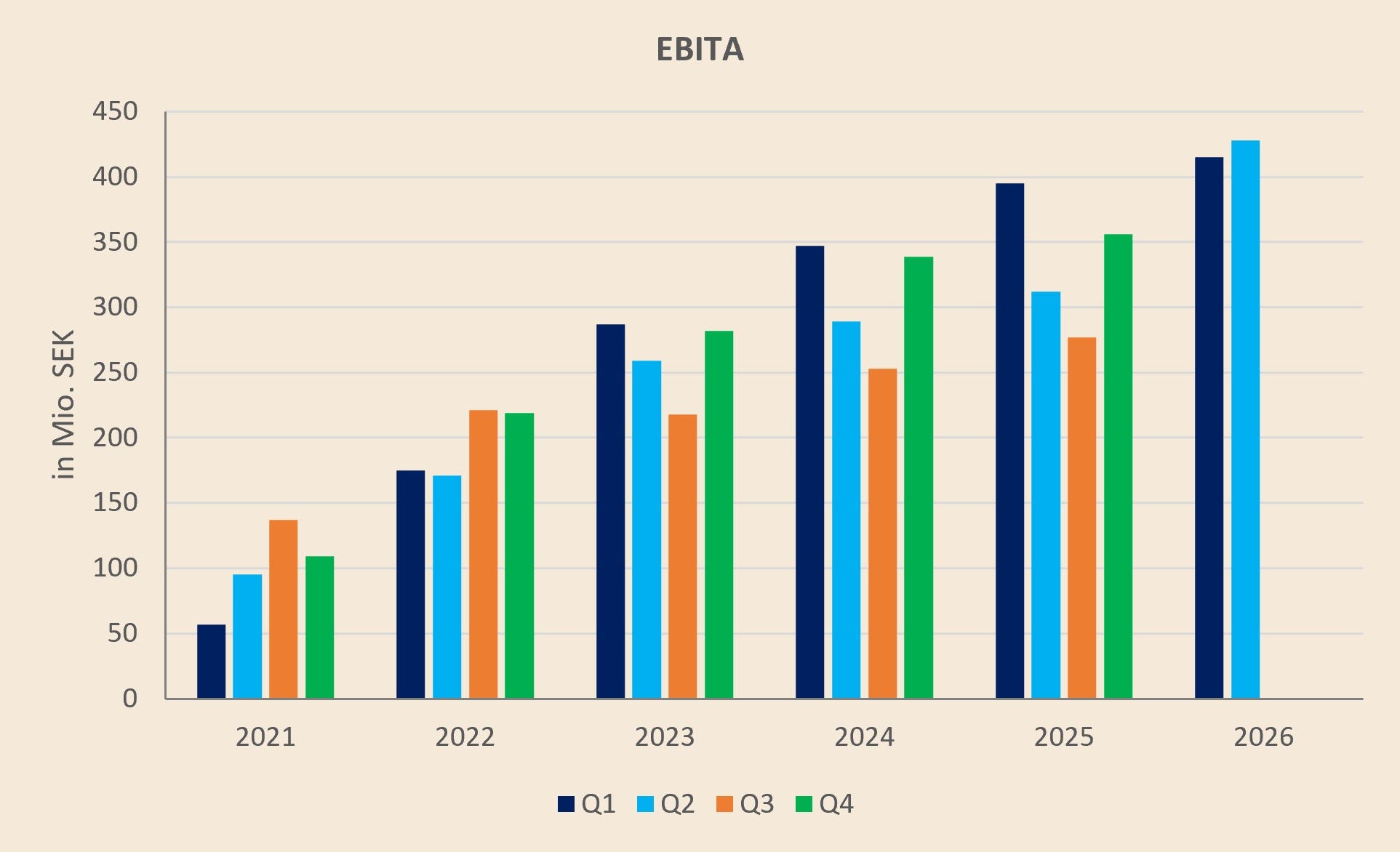
However, CEO Johan Bladh noted on the earnings call that organic EBITA growth outpaced organic revenue growth, while the group margin was diluted by newly acquired businesses operating at lower margins.
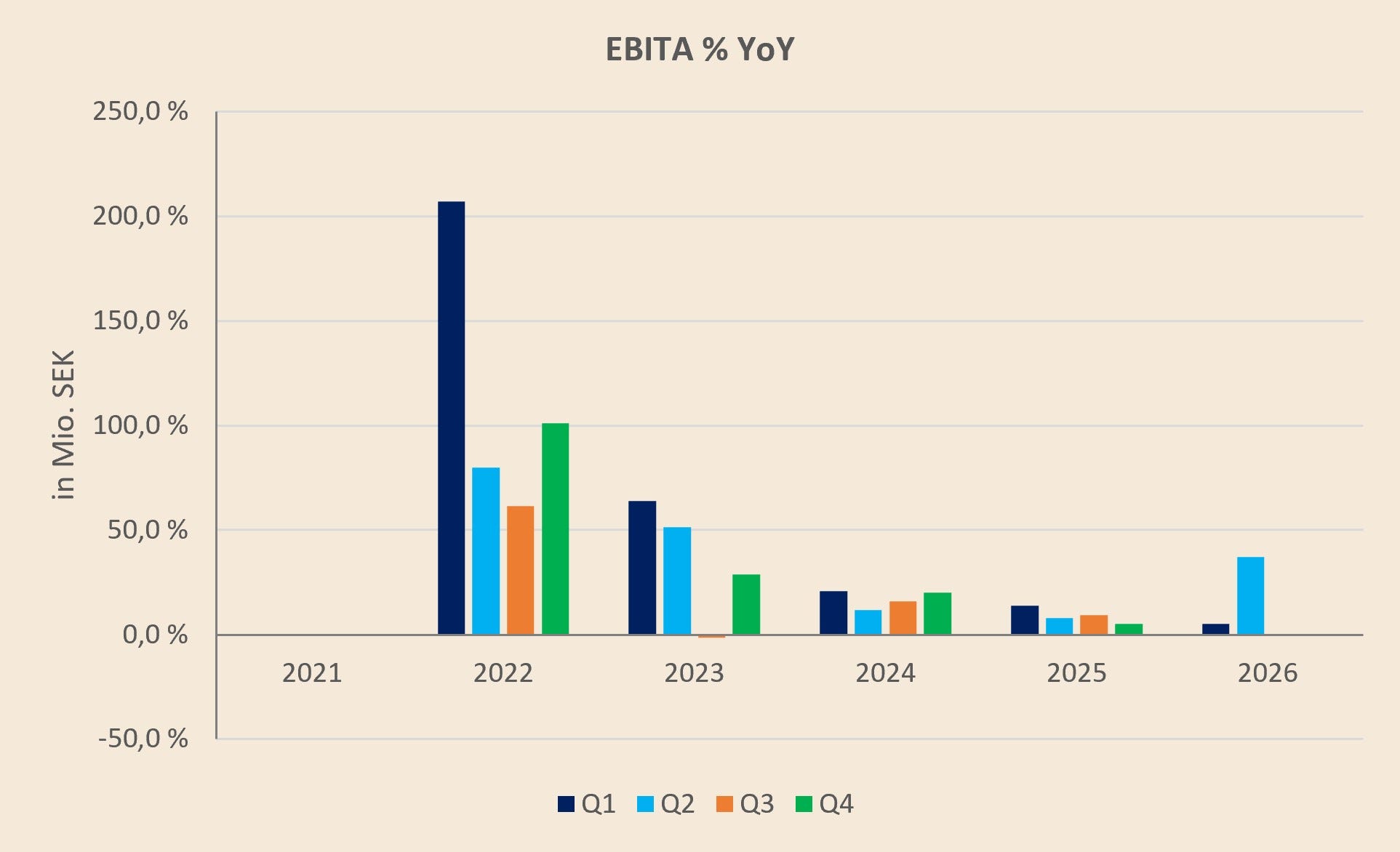
Overall, EBITA growth reaccelerated during the quarter after several years of gradually moderating growth rates, partly reflecting the increasingly demanding comparison base as Röko has grown significantly since 2022.
Organic revenue growth moderated from 6% in Q1 to 3% in Q2, but remained positive despite mixed demand across the portfolio. Management highlighted continued weakness among certain companies selling larger systems and machinery, as well as businesses exposed to construction, the US, and the Middle East. At the same time, subsidiaries that had acted decisively on pricing generally performed well.
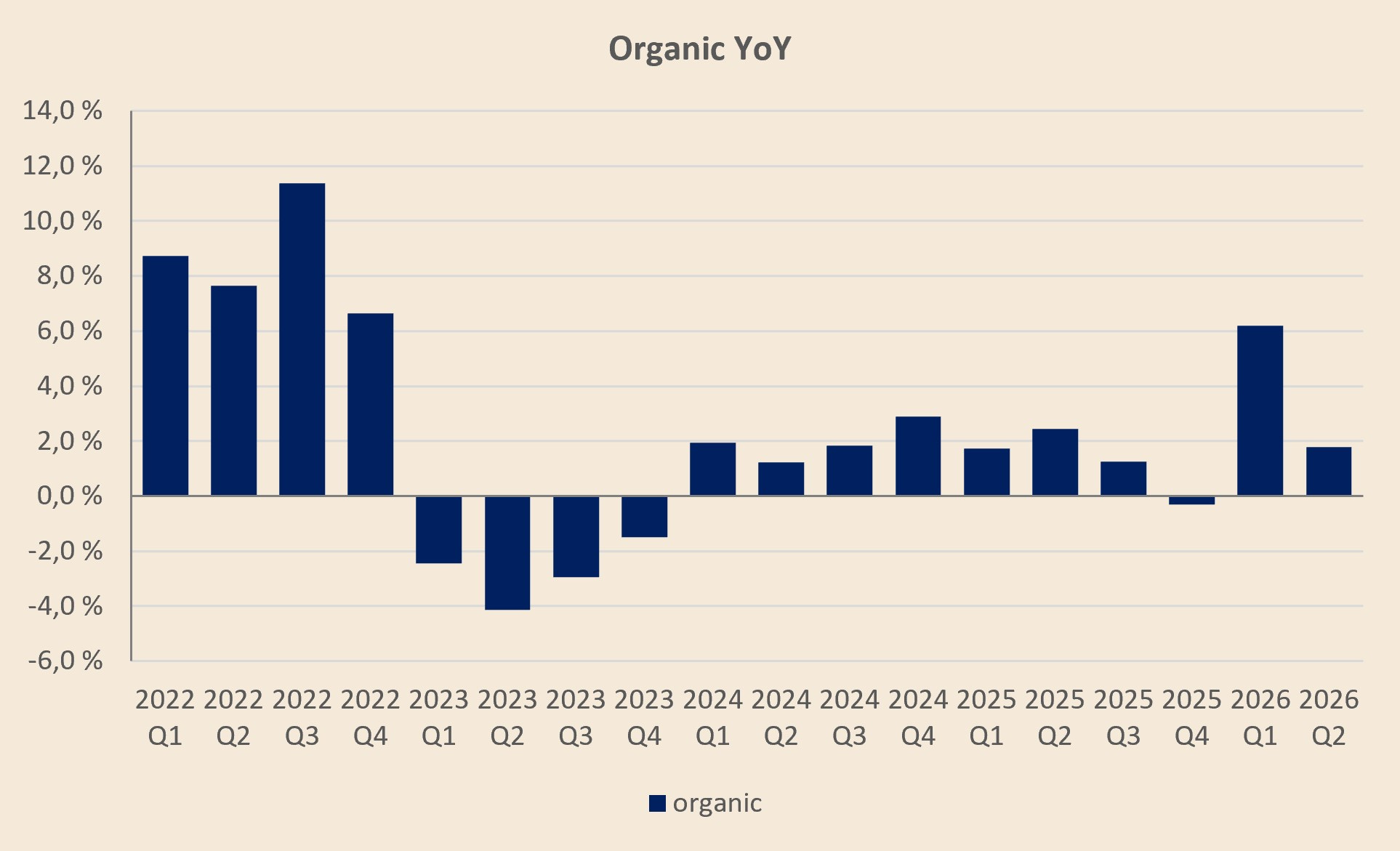
This fits the broader picture from recent quarters. Röko is not (yet?) benefiting from a broad and powerful cyclical recovery across all companies. The development remains mixed. The improvement instead appears to come from a combination of pricing, operational work within the subsidiaries, and a much stronger contribution from acquisitions.
More growth, but also more debt
The renewed acquisition pace has naturally increased leverage.
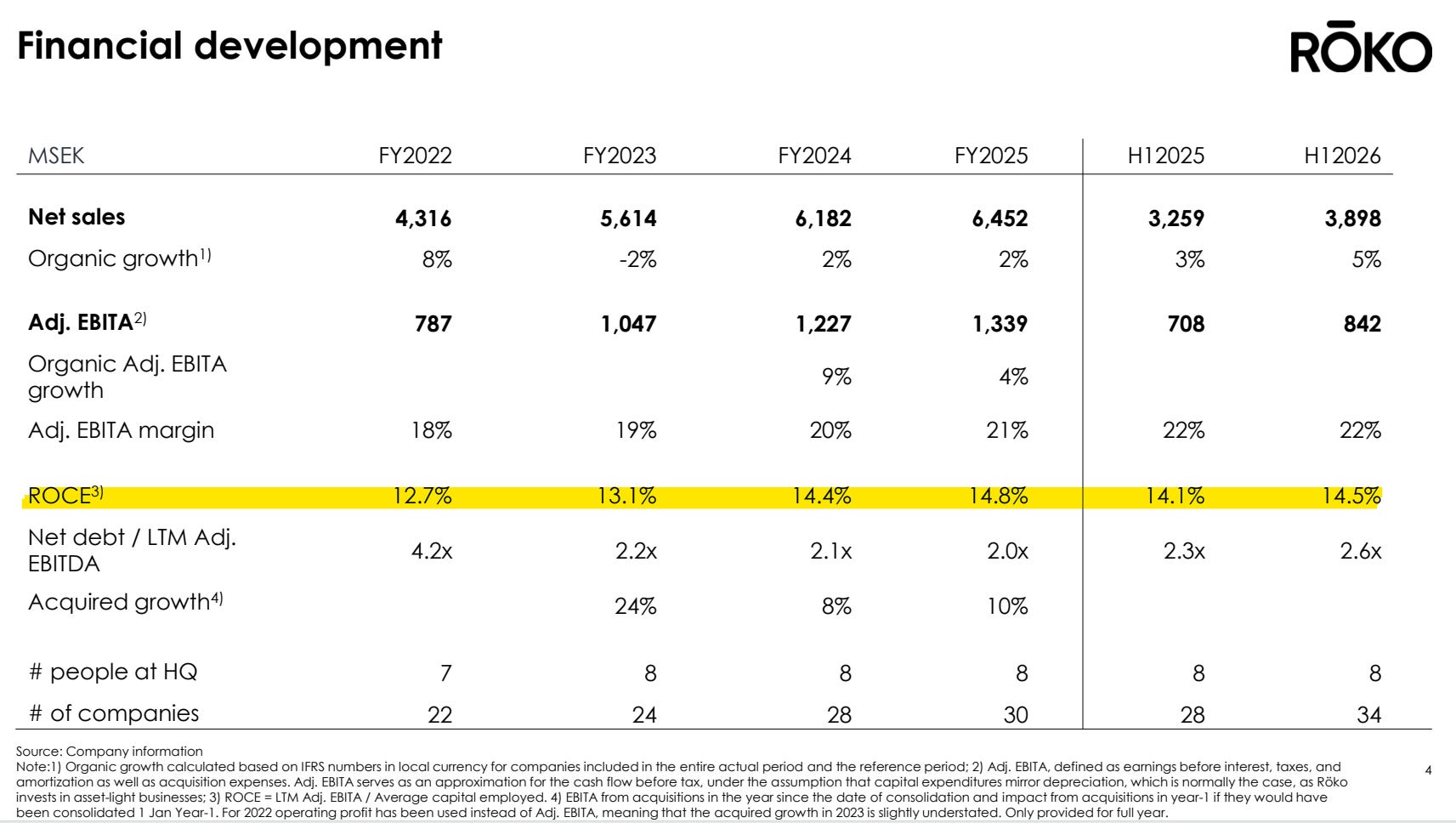
Interest-bearing net debt rose to SEK 1,817 million, equivalent to 1.1x LTM adjusted EBITDA. Including put/call liabilities for minority interests and deferred considerations, Röko’s broader financial net debt reached 2.6x LTM adjusted EBITDA, compared with 2.3x one year earlier. This remains below management’s long-term ceiling of 3.0x, but the balance sheet now provides less unused capacity than it did before the recent acquisition wave. At the same time, the phasing of the acquisitions will create a natural deleveraging effect, as the leverage ratio is based on LTM EBITDA and therefore only partly reflects the earnings contribution from recently acquired businesses. As these contributions become fully included in the denominator, leverage should decline mechanically, assuming no further major acquisitions or increase in debt.
Return on Capital and Capital Allocation
Encouragingly, return on capital employed increased from 14.1% to 14.5% despite the significant amount of capital deployed during the past year.
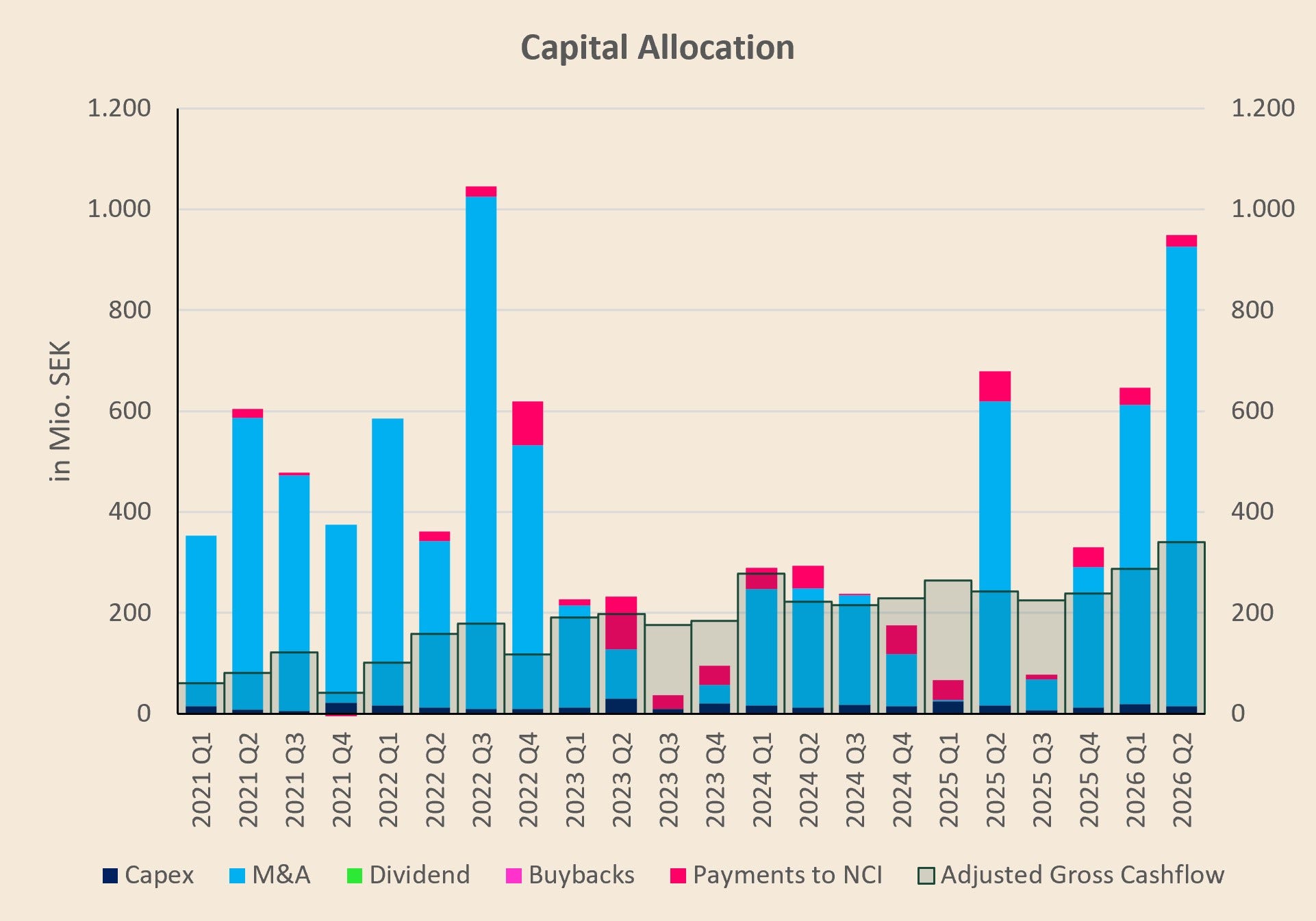
The recent acquisition momentum is also clearly visible in Röko’s capital allocation. Q2 2026 was one of the most acquisition-heavy quarters in the company’s history, with capital deployed into M&A substantially exceeding the adjusted gross cash flow generated during the period. This is not unusual for a serial acquirer, as acquisition activity is inherently lumpy and has now picked up after a quieter period between 2023 and 2025. (However, note that the M&A spend shown in the graph below also includes payments made to settle put/call option liabilities. These payments relate to the acquisition of additional minority stakes in companies that are already fully consolidated and therefore do not increase reported EBITA. Instead, they increase the share of EBITA attributable to Röko’s shareholders.)
Conclusion
The central concern surrounding Röko was (and still is) execution: the pipeline appeared healthy, but too few acquisitions were actually completed.
As the acquisition activity has now picked up again, the question is shifting back to the one that ultimately matters for every serial acquirer: not whether management can deploy capital, but whether it can continue doing so at attractive prices and generate strong incremental returns.
The newest acquisitions have only contributed for a short period, and their long-term performance cannot yet be judged. But the early evidence is encouraging. Revenue is accelerating, EBITA is growing faster than sales, margins are improving within the existing portfolio, cash flow is following earnings, and ROCE has moved upward rather than downward.
Three months ago, I wrote that Röko was waking up again.
Q2 confirms that Röko’s acquisition engine is running again and is now translating into accelerating revenue, EBITA, and cash flow growth.
New to Slow Compounding?
I am a professional equity analyst and I publish deeply researched analyses of serial acquirers and other high-quality compounders, supported by extensive historical data. Subscribe for free to receive future company updates and Deep Dives directly in your inbox.